
NRE vs NRO Account in India: Differences, Tax Benefits, Rules & Property Transactions (2026)
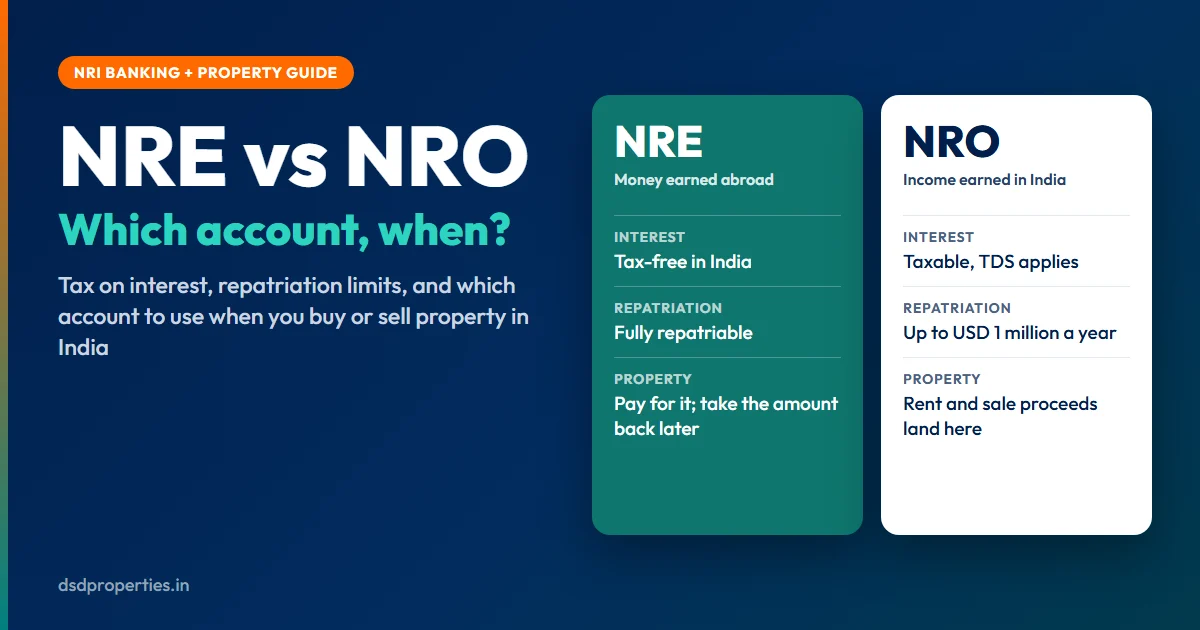
An NRE account holds money you earn abroad and keeps it fully repatriable, with tax-free interest in India. An NRO account holds money you earn in India, such as rent, pension or the price of a property you sell; its interest is taxed, and taking the money abroad has a yearly limit and paperwork. Most NRIs who own, buy or sell property in India end up needing both.
This guide explains both accounts in plain English, compares them side by side, covers the tax rules for tax year 2026-27 under the new Income-tax Act, 2025, and then walks through the part most NRIs ask us about: which account to use when you buy property, and where the money goes when you sell. The last section covers the checks to do before you pay for any property in Lucknow.
Key facts (checked 26 November 2026)
- RBI's FAQ says income in an NRE account is exempt from income tax and NRO income is taxable (RBI FAQ, as on 16 Jan 2025).
- NRIs and PIOs (including OCI cardholders) can remit up to USD 1 million per financial year from NRO balances and sale proceeds of assets, subject to tax (RBI Master Direction, Remittance of Assets).
- NRIs and OCIs can buy residential and commercial property in India, but not agricultural land, a farm house or plantation property (RBI FAQ, updated 6 Apr 2023).
- From 1 April 2026 the Income-tax Act, 2025 applies. Old section 195 is now section 393(2), and Forms 15CA/15CB are now Forms 145/146 (Income Tax Dept, Form 145 FAQ).
- Long-term capital gains on land or buildings are taxed at 12.5% without indexation for transfers from 23 July 2024. The older 20%-with-indexation option is for resident individuals and HUFs only, not NRIs (Income Tax Dept).
Quick answer: which account for what?
| Money | Account | Why |
|---|---|---|
| Salary or savings from abroad | NRE | Tax-free interest; fully repatriable |
| Rent from property in India | NRO | Indian income; taxed, then can be sent abroad as current income |
| Pension, dividends, Indian interest | NRO | Indian income |
| Buying property with money from abroad | NRE | Amount paid can be repatriated later (up to two homes) |
| Sale price of property you sell | NRO | Then remit within USD 1 million a year, after tax |
| Inherited money or property sale | NRO | Remit within USD 1 million a year, with proof of inheritance |
*While you are a person resident outside India under FEMA. Details and sources in the sections below.
1. Who is an NRI?
RBI defines a Non-Resident Indian (NRI) as "a person resident outside India who is a citizen of India". A Person of Indian Origin (PIO) is a foreign citizen resident outside India with Indian ancestry, and RBI says a PIO includes an Overseas Citizen of India (OCI) cardholder (RBI FAQ). So an Indian passport holder working in Dubai is an NRI; a US citizen with an OCI card is a PIO/OCI, not an NRI. The difference matters for property, as you will see below.
The confusing part is that India tests "residence" under two different laws, for two different purposes.
FEMA residence (decides your bank accounts and property rights)
The Foreign Exchange Management Act, 1999 (FEMA) controls which accounts you may hold and what property you may buy. Under section 2(v) of FEMA, a resident is a person who lived in India for more than 182 days in the preceding financial year, but it excludes a person who has left India for employment, business or any other purpose that shows an intention to stay outside India for an uncertain period (RBI FAQ, Remittance of Assets). In practice, your FEMA status changes the day you leave India to take up a job abroad, not after 182 days.
Income-tax residence (decides what India taxes)
Section 6 of the Income-tax Act, 2025 counts days in India in each tax year (April–March). In short (Income Tax e-filing portal, Non Resident FAQ; CBDT transition FAQ):
- You are resident if you are in India for 182 days or more in the tax year, or for 60 days or more in the year plus 365 days or more in the four years before it.
- For an Indian citizen or PIO visiting India, the 60-day test becomes 182 days. If their Indian income (excluding foreign sources) is above ₹15 lakh, it becomes 120 days.
- An Indian citizen with Indian income above ₹15 lakh who is not liable to tax in any other country is deemed resident (section 6(7)).
Example: Ankit leaves Lucknow on 1 August 2026 for a job in Toronto. Under FEMA he is a person resident outside India from 1 August, so his bank must convert his savings account to an NRO account. For income tax he spent about 122 days in India in tax year 2026-27. Because he left India for employment, the 60-day test is replaced by 182 days for that year, so he is non-resident for tax too. Had he left for some other reason, the 60 + 365-day test could have made him a tax resident for the same year, while FEMA still treated him as non-resident.
2. What is an NRE account?
NRE stands for Non-Resident External account. It is a rupee account (savings, current or fixed deposit) for money that comes from outside India. When your employer in London pays you in pounds and you send £2,000 to your NRE account, the bank converts it to rupees at the day's rate and credits it.
- Who can open it: NRIs and PIOs, which includes OCI cardholders (RBI FAQ).
- What can go in: inward remittances from abroad, interest on the account, transfers from other NRE or FCNR(B) accounts, and maturity proceeds of investments made from it. RBI's FAQ also says current income such as rent, dividend, pension or interest "will be construed as a permissible credit" to an NRE account; your bank will check the money before accepting it.
- What can go out: local payments in India, transfers to other NRE/FCNR(B) accounts, investments, and remittances abroad.
- Repatriation: principal and interest are freely repatriable. You can send the whole balance back abroad without the USD 1 million limit that applies to NRO.
- Tax: RBI's FAQ says income in the account is exempt from income tax. Section 7 below explains the condition.
Example: Priya, an NRI in Dubai, sends AED 50,000 a year to her NRE fixed deposit. The interest is not taxed in India (the UAE has no personal income tax either). In 2029 she pays the down payment on a flat in Gomti Nagar from this deposit. Because the money came from abroad through the NRE account, the amount she paid can later be sent back abroad if she sells the flat (see section 12).
3. What is an NRO account?
NRO stands for Non-Resident Ordinary account. It is a rupee account for money that arises in India. RBI says any person resident outside India can open one "for putting through bonafide transactions in rupees" (RBI FAQ). When you become an NRI, your existing resident savings account should be re-designated as an NRO account.
- What can go in: inward remittances from abroad, "legitimate dues in India" (rent, pension, dividends, interest, maturity of Indian investments, sale price of property) and transfers from other NRO accounts.
- What can go out: local payments, transfers to other NRO accounts, and remittance of current income abroad.
- Repatriation: RBI's FAQ says NRO balances are "not repatriable except for all current income". Beyond current income, NRIs and PIOs can remit up to USD 1 million per financial year, together with their other eligible assets, after paying tax.
- Tax: interest is taxable in India, and the bank deducts tax at source (TDS).
Example: Rahul lives in New Jersey and rents out his late father's house in Aliganj for ₹30,000 a month. The tenant pays rent into Rahul's NRO account. Rent paid to a non-resident is subject to TDS by the tenant, and Rahul files an Indian return to claim his deductions and any refund. To send the rent to the US, his bank will ask for Form 145 (and a CA's Form 146 where required).
4. NRE vs NRO account: key differences
| Comparison factor | NRE account | NRO account |
|---|---|---|
| Full form | Non-Resident External | Non-Resident Ordinary |
| Primary purpose | Park and use money earned abroad | Manage income and assets in India |
| Source of funds | Inward remittances, transfers from NRE/FCNR(B); current income only as RBI permits | Inward remittances plus any legitimate Indian income (rent, pension, dividends, sale proceeds) |
| Account currency | Indian rupee | Indian rupee |
| Who can open | NRIs and PIOs (incl. OCI) | Any person resident outside India |
| Interest taxation | Exempt in India (if you are non-resident under FEMA) | Taxable; TDS deducted by the bank |
| Repatriation | Fully repatriable: principal and interest | Current income repatriable; other balances up to USD 1 million per financial year, after tax |
| Joint account | With another NRI/PIO, or with a resident relative on a "former or survivor" basis | With residents on "former or survivor" basis, or with other NRIs/PIOs |
| Deposit rules | Foreign money only; Indian income only within RBI's current-income rule | Foreign and Indian money |
| Withdrawal rules | Local payments, investments, remittance abroad | Local payments; remittance abroad within the limit and with Forms 145/146 |
| Property transactions | Can pay for property; amount paid can later be repatriated (up to two residential properties) | Can pay for property; receives sale proceeds; repatriation within USD 1 million |
| Suitable for | Savings from abroad, buying property with foreign money | Rent, pension, inherited property, sale proceeds |
Source: RBI FAQ on accounts in India by non-residents and RBI FAQ on purchase of immovable property.
There is also a third account, FCNR(B) (Foreign Currency Non-Resident), a fixed deposit held in a foreign currency such as US dollars, which avoids rupee exchange-rate risk. This guide focuses on NRE and NRO.
5. Advantages and disadvantages of an NRE account
- Interest is exempt from Indian income tax while you are non-resident under FEMA.
- Principal and interest are fully repatriable, with no yearly cap.
- An easy way to bring foreign income to India and spend it here.
- Property bought with NRE money keeps a clean route to send the amount back abroad later.
- Indian income can go in only within RBI's current-income rule and your bank's checks; most Indian income is simpler to route through NRO.
- Money is held in rupees, so a falling rupee reduces its value in your home currency.
- The account must be re-designated when you return to India, and the tax exemption ends.
- Your country of residence may tax the interest even though India does not.
6. Advantages and disadvantages of an NRO account
- Receives rent from Indian property, pension, dividends and other Indian income.
- Accepts money sent from abroad too.
- Can be held jointly with resident family members, for example a parent who manages your property.
- The natural account for sale proceeds of property and inherited assets.
- Interest is taxable in India.
- TDS is deducted at the non-resident rate unless you claim a lower treaty rate.
- Repatriation beyond current income is capped at USD 1 million per financial year and needs Forms 145/146 and bank paperwork.
7. Taxation on NRE and NRO accounts (tax year 2026-27)
The Income-tax Act, 2025 replaced the Income-tax Act, 1961 from 1 April 2026. The CBDT's transition FAQ says tax years starting before 1 April 2026 stay under the old Act. The section numbers below are the new ones; older articles will still quote the old ones.
Is NRE interest taxable in India?
No, as long as you qualify. The old section 10(4)(ii) exemption has been carried into Schedule IV of the 2025 Act, and the condition is unchanged: you must be a person resident outside India under FEMA, or be permitted by RBI to keep the account (CBDT transition FAQ). The test is your FEMA status, not your income-tax status. Once you return to India for good, you are FEMA resident and the interest becomes taxable.
Is NRO interest taxable?
Yes. It is part of your Indian income and is taxed at normal slab rates when you file your return.
TDS on NRO interest
Payments to non-residents fall under section 393(2) of the 2025 Act (old section 195), at the "rates in force" set by the Finance Act each year (section 393). The Income Tax Department's TDS chart lists 30% for "any other income" of a non-resident individual, plus surcharge where it applies and 4% health and education cess (TDS rate chart). CBDT says TDS rates were carried over unchanged into the new Act.
DTAA: paying a lower treaty rate
India has Double Taxation Avoidance Agreements (DTAA) with many countries. Many of them cap the tax India can charge on interest at a rate lower than 30%. To get the treaty rate (section 159 of the 2025 Act), give your bank a Tax Residency Certificate (TRC) from your country's tax authority and Form 41 (formerly Form 10F) (Form 41 FAQ). Check the treaty for your country, as rates differ.
TDS is not your final tax
TDS is only tax collected in advance. Your actual tax is worked out when you file your Indian return. If your total Indian income is low, or the treaty rate is lower, you may get a refund; if TDS was too low, you pay the difference.
Tax in your country of residence
The NRE exemption is an Indian rule. Countries such as the USA, UK, Canada and Australia generally tax their residents on worldwide income, so NRE and NRO interest may have to be reported there. Where both countries tax the same income, the treaty usually lets you claim credit for Indian tax. A tax adviser in your country can confirm how this works for you.
8. Repatriation rules: sending money from India abroad
Repatriation means converting rupees in India to foreign currency and sending them out of India.
- From NRE: the full balance, principal and interest, can be sent abroad.
- From NRO: current income (rent, interest, pension, dividends) can be sent abroad after tax. Other balances, such as sale proceeds of property or inherited money, fall under the USD 1 million facility.
The USD 1 million facility
RBI's Master Direction on Remittance of Assets lets banks allow NRIs and PIOs, on documentary evidence, to remit up to USD 1 million per financial year (April–March) out of NRO balances, sale proceeds of assets, and assets acquired by inheritance or legacy (RBI Master Direction, updated 29 Jun 2026). Conditions to know:
- The limit is per person per financial year and covers all such assets together.
- Remittances are subject to payment of applicable Indian taxes.
- You give the bank a declaration that the money comes from your legitimate receivables in India, not from borrowing or a transfer from another person's NRO account.
- If you send it in instalments, all instalments must go through the same bank.
- Above USD 1 million in a year needs RBI's approval (RBI FAQ).
Form 145 and Form 146 (formerly 15CA and 15CB)
For remittances from 1 April 2026, the remitter files Form 145 on the e-filing portal before the money is sent, and gives a copy to the bank. It has four parts (Form 145 FAQ):
| Part | When it is used | CA certificate (Form 146)? |
|---|---|---|
| Part A | Taxable remittance up to ₹5 lakh in the year | No |
| Part B | Taxable, above ₹5 lakh, with an Assessing Officer's certificate under section 395 | No |
| Part C | Taxable, above ₹5 lakh, without such a certificate | Yes: a chartered accountant files Form 146 first |
| Part D | Remittance not chargeable to tax | No |
Source: Income Tax Department, Form 145 FAQ (Rule 220 of the Income-tax Rules, 2026).
Documents your bank will usually ask for: PAN, Form 145 (and Form 146 if Part C), the remittance application, proof of the source (sale deed, rent agreement, will or succession certificate for inherited assets), proof that tax has been paid, and the declaration described above. Each bank has its own checklist, so ask it before you start.
9. Transfer from NRE to NRO and NRO to NRE
NRO to NRE
RBI's FAQ says NRO funds "can be transferred to NRE account within this USD 1 Million facility". Treat it like a remittance abroad: tax must be paid, and the bank will ask for Form 145/146 and the declaration. Once the money is in your NRE account it becomes freely repatriable, and future interest on it is tax-exempt.
NRE to NRO
RBI's list of permitted NRE debits includes "local disbursements", and a payment into your own NRO account is a local rupee payment. Confirm with your bank. Be aware that once NRE money lands in NRO it loses its free repatriability: sending it out again counts against the USD 1 million limit, and interest on it becomes taxable.
Example: Neha's NRO account has ₹40 lakh from selling her late mother's flat in Indira Nagar. She files her return, pays the capital gains tax, gets Form 146 from her CA, files Form 145 Part C, and transfers the money to her NRE account. The ₹40 lakh is about USD 45,000–50,000, well within her USD 1 million for the year.
10. How to open an NRE or NRO account in India
- Select an Indian bank authorised to deal in foreign exchange. Compare its NRI service, online banking and remittance charges.
- Complete the application online or at a branch. Many banks let you start online from abroad.
- Submit your passport (and OCI card if you are an OCI cardholder).
- Submit your visa, work permit or residence permit as proof that you live abroad.
- Provide overseas address proof, such as a utility bill, bank statement or tenancy agreement.
- Submit your PAN, or the alternative documentation your bank accepts (for example, a declaration in the prescribed form) if you do not have one.
- Complete KYC: in-person at a branch, by video KYC, or by sending documents attested by an Indian embassy, a notary or an official your bank accepts.
- Make the initial deposit: by remittance from abroad for an NRE account; by remittance or Indian funds for an NRO account.
- Activate the account and set up net banking, nominees and, if needed, a mandate or power of attorney for a family member.
Requirements differ between banks, so check your bank's current checklist.
11. Which account is better for buying property in India: NRE or NRO?
Can NRIs buy residential and commercial property?
Yes. Under the FEMA (Non-debt Instruments) Rules, 2019, RBI's FAQ lists that an NRI or OCI may buy immovable property "other than agricultural land/ farmhouse/ plantation" from a resident, NRI or OCI (RBI FAQ). Houses, flats, residential plots, shops and offices are all allowed.
Agricultural land, plantation property and farmhouses
- Buying: not allowed for NRIs or OCIs.
- Gift: NRIs/OCIs can receive a gift of other property from a relative, but agricultural land is not in the permitted list.
- Inheritance: any immovable property, including agricultural land, can be inherited.
- Selling inherited agricultural land: allowed only to a person resident in India.
NRIs vs OCI holders vs other foreign citizens
RBI's purchase table treats NRIs and OCI cardholders alike. A foreign citizen of Indian origin who does not hold an OCI card is not named in that table, so get FEMA advice before you buy. RBI's FAQ says foreign nationals of non-Indian origin resident outside India can take property only on a lease of up to five years.
Buying through an NRE account
Paying from NRE (or FCNR(B), or by fresh remittance from abroad) is the better choice if you may want to take the money back abroad one day. RBI allows NRIs/PIOs to repatriate sale proceeds up to the amount paid in foreign exchange or from NRE/FCNR(B), for not more than two residential properties, outside the USD 1 million route.
Buying through an NRO account
Paying from NRO is allowed and makes sense when you already have rupee income or savings in India, such as rent or an inheritance. The trade-off is that sale proceeds can then go abroad only through the USD 1 million facility, after tax.
Example: Vikas pays ₹60 lakh for a flat: ₹45 lakh from his NRE account and ₹15 lakh from rent saved in his NRO account. If he sells it later for ₹90 lakh, the ₹45 lakh paid from NRE can be repatriated under RBI's two-property rule; the remaining ₹45 lakh goes through the USD 1 million route after tax. Keeping separate bank records for each payment makes this easy to prove.
Permitted banking channels
RBI's FAQ says payment must be received in India through banking channels, or from your NRE, FCNR(B) or NRO account. Payment must not be made in travellers' cheques or foreign currency notes. Never pay in cash. Pay by cheque, RTGS or NEFT, so that every rupee shows in a bank record linked to the sale deed.
Home loans for NRIs
Under RBI's Borrowing and Lending Regulations, 2018, banks may lend rupees to NRIs and OCIs to buy residential property in India. The loan cannot be credited to your NRE or FCNR(B) account, and EMIs can be paid by remittance from abroad, from NRE, NRO or FCNR(B) accounts, or from rent on the property (RBI notification, Dec 2018).
Buying through a Power of Attorney
You do not have to be in India to buy. Many NRIs sign a Power of Attorney (PoA) abroad, attested at the Indian embassy or consulate (or apostilled, depending on the country), so that a trusted family member can sign and register the sale deed. A document signed outside India must be stamped in India within three months of arriving here (Indian Stamp Act, 1899, section 18). Make the PoA specific to the property and the acts allowed, and pay from your own bank account, not the agent's. Our guide on bainama, registry and power of attorney explains why a PoA is not ownership.
Documents for an NRI property purchase
- Passport, OCI card (if any), visa or residence proof, PAN.
- Bank statements showing payments from NRE/NRO/FCNR(B) or inward remittance, and the bank's remittance certificates.
- Sale agreement and registered sale deed, with stamp duty and registration receipts.
- Seller's title chain, approvals and tax receipts (see the Lucknow checklist below).
- PoA, if someone acts for you.
FEMA compliance checklist
- The property is not agricultural land, a farm house or plantation property.
- All payments go through Indian banking channels or your NRE/FCNR(B)/NRO account.
- Keep every bank record; you will need them to repatriate the sale proceeds.
- Pay all Indian taxes and duties on the purchase.
12. Selling property in India as an NRI: where should the money go?
An NRI or OCI can sell residential or commercial property to a resident, an NRI or an OCI. Agricultural land can be sold only to a resident (RBI FAQ). For the paperwork, see our seller documents checklist.
The buyer must deduct TDS (section 393(2), old section 195)
When the seller is a non-resident, the buyer must deduct TDS under section 393(2) before paying, deposit it with the government, and issue a TDS certificate. Unlike the 1% TDS on property bought from a resident, this needs the buyer to have a TAN and file a non-resident TDS return. The TDS chart lists 12.5% on long-term capital gains, plus surcharge and cess. Short-term gains are deducted at the rates in force. Because the buyer cannot easily work out your actual gain, buyers often deduct on the full sale price. To avoid this, apply to your Assessing Officer for a lower or nil deduction certificate under section 395 (old section 197) before the sale.
Capital gains tax
- Long-term: land or building held for more than 24 months. Transfers from 23 July 2024 are taxed at 12.5% without indexation.
- Grandfathering: for land or buildings bought before 23 July 2024, resident individuals and HUFs can choose 20% with indexation if that is lower. The Income Tax Department says this option is not available to non-residents (Income Tax Dept).
- Short-term: held 24 months or less; taxed at normal slab rates.
Receiving and repatriating the sale proceeds
- The buyer pays you, after TDS, into your NRO account.
- If you bought the property with foreign exchange or NRE/FCNR(B) money, the amount you paid can be repatriated, for up to two residential properties.
- The rest (the gain, inherited property, property bought with rupee funds) goes abroad through the USD 1 million per financial year facility.
- Your CA issues Form 146 (if needed), you file Form 145, and the bank remits.
Documents for repatriation: sale deed, purchase deed and proof of how you paid for it, TDS certificate and proof of tax paid, Forms 145/146, PAN, and for inherited property the will, succession certificate or legal heir documents. Our guide to property transfer after death in Lucknow covers the heir paperwork.
Reinvesting to save capital gains tax (sections 82, 85 and 86)
| Section (2025 Act) | Old section | Applies when | Main conditions |
|---|---|---|---|
| 82 | 54 | You sell a residential house (long-term) | Buy one residential house in India within 1 year before or 2 years after the sale, or build one within 3 years. Gain above ₹10 crore is not counted. A one-time option for two houses if the gain is up to ₹2 crore. |
| 86 | 54F | You sell any other long-term asset (e.g. a plot or shop) | Same purchase and construction time limits; invest the net sale price for full exemption, or get partial exemption. Limits on other houses you own apply. |
| 85 | 54EC | You sell land or a building (long-term) | Invest in notified bonds (NHAI, REC or others notified) within 6 months; up to ₹50 lakh; 5-year lock-in. |
Sources: section 82, section 85, section 86, Income Tax Department.
If you have not bought the new house by your return due date, the unused gain must be deposited in a Capital Gains Account Scheme account to keep the exemption. The new house must be in India.
13. Property investment guide for NRIs in Lucknow
Many NRIs from Lucknow buy here because family can watch over the property, and because LDA keeps launching planned schemes (see our LDA schemes tracker). Distance is the main risk. You cannot visit the plot every month, so the paperwork has to be right before you pay. These are the checks we run.
- LDA or authority approval. For a plot or colony, confirm that the layout is approved by LDA (or the authority for that area) and that the colony is not on LDA's unauthorised list. See how to check an LDA-approved map. For a flat, check its UP RERA registration.
- Khasra and Khatauni. The Khatauni (record of rights) on UP Bhulekh shows who is recorded as the land holder. Match the khasra number and the names with the seller's sale deed. If the land is still recorded as agricultural, do not treat it as a residential plot: an NRI cannot buy agricultural land, so get advice before paying anything.
- Registry verification on IGRSUP. IGRSUP (Inspector General of Registration and Stamps, UP, at igrsup.gov.in) lets you search registered deeds, to check the seller's chain of title and earlier sales of the same property. Our IGRSUP search tutorial shows how.
- Master Plan and land use. Check that the land use under Lucknow Master Plan 2031 is residential (or commercial, for a shop). Land marked green belt, road or another use cannot be built on legally. See our Master Plan 2031 guide.
- Ownership and disputes. Check for mortgages and charges (encumbrance), pending court cases, stay orders, and whether the mutation is in the seller's name.
- Power of Attorney. If a relative acts for you, use a property-specific PoA, stamped in India within three months of arrival.
- Payments and banking. Pay from your NRE/NRO account or by remittance, by bank transfer only, in the seller's own name, and keep every statement for future repatriation.
- Registry and stamp duty. Budget for UP stamp duty and the registration fee (see our stamp duty guide), then get the mutation done.
Why independent verification matters for NRIs: the most common losses we see are not from tax mistakes. They come from paying advances on plots with a title problem, plots on unconverted agricultural land, or colonies without approval. Have the documents checked by someone who does not earn from the sale, before you send any money. Our NRI remote verification guide and NRI guide to buying LDA plots go deeper.
Are you an NRI planning to buy or sell property in Lucknow? DSD Properties can help you understand the local property market, explore suitable opportunities, and arrange independent property verification before making a decision.
Book property verificationBuy or sell in Lucknow14. Frequently asked questions (FAQs)
What is the main difference between NRE and NRO accounts?
Can an NRI have both NRE and NRO accounts?
Is interest earned on an NRE account tax-free?
Is interest earned on an NRO account taxable?
Can I deposit Indian rental income into an NRE account?
Can I transfer money from abroad to an NRO account?
How much money can I transfer abroad from an NRE account?
What is the USD 1 million repatriation facility?
Can I transfer money from an NRO account to an NRE account?
Can NRIs purchase residential property in India?
Can NRIs purchase agricultural land in India?
Can NRIs sell inherited property in India?
Can property sale proceeds be transferred abroad?
Is TDS applicable when an NRI sells property in India?
Can an NRI receive rental income in an NRO account?
Can parents be joint holders in an NRO account?
What happens to NRE and NRO accounts when an NRI returns to India?
Can OCI cardholders open NRE and NRO accounts?
Can NRIs obtain home loans in India?
Can an NRI buy or sell property through a Power of Attorney?
Sources
- Reserve Bank of India, FAQ: Accounts in India by Non-residents (as on 16 January 2025)
- Reserve Bank of India, FAQ: Purchase of Immovable Property (updated 6 April 2023)
- Reserve Bank of India, FAQ: Remittance of Assets
- Reserve Bank of India, Master Direction: Remittance of Assets (updated 29 June 2026)
- FEMA (Borrowing and Lending) Regulations, 2018, RBI notification
- Income-tax Act, 2025, as amended by the Finance Act, 2026
- CBDT, FAQs on interplay and transition from the Income-tax Act, 1961 to the Income-tax Act, 2025
- Income Tax e-filing portal, Non Resident FAQs
- Income Tax Department, TDS rate chart
- Income Tax Department, Tax on long-term capital gains
- Income Tax Department, Form 145 (earlier Form 15CA) FAQ and Form 41 (earlier Form 10F) FAQ
- Income Tax Department, section 82, section 85, section 86 and section 393 of the Income-tax Act, 2025
- IGRSUP, Department of Stamps and Registration, Uttar Pradesh and UP Bhulekh
Sources: RBI FAQs and Master Directions, the Income-tax Act, 2025 and Income Tax Department guidance (linked next to each fact). Examples with names are illustrations, not real cases. Last checked: 26 November 2026.
Leave a Comment