
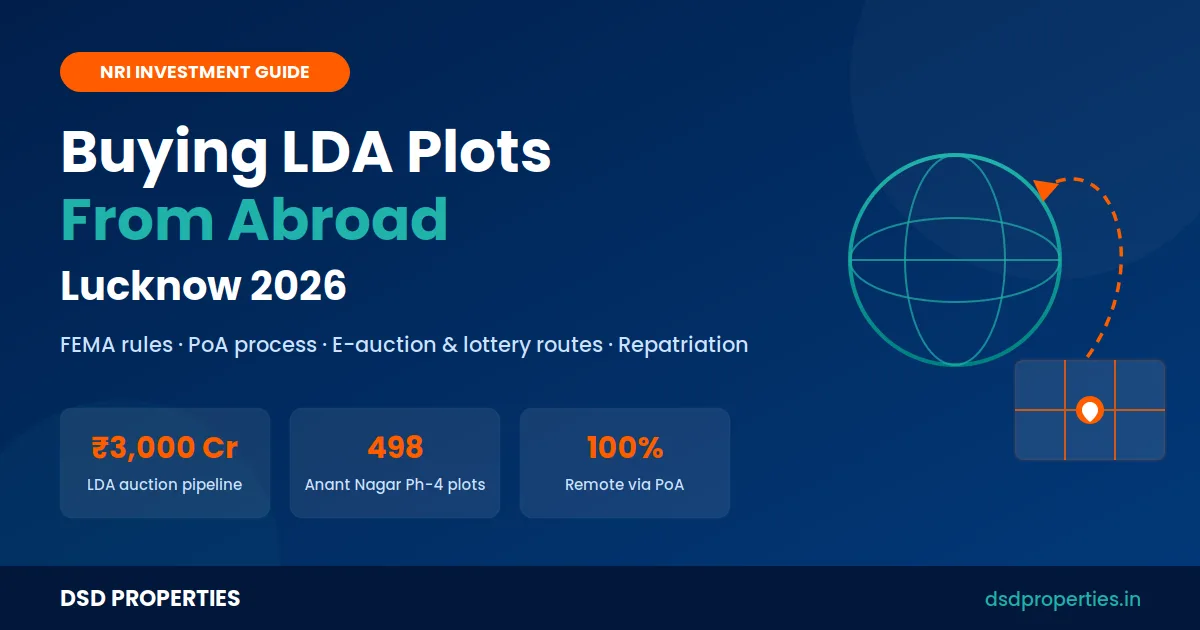
NRI Guide to Buying LDA Plots in Lucknow 2026: FEMA Rules, PoA Process & Rs 3,000 Cr Scheme Pipeline
For a Non-Resident Indian, buying property back home is never just a financial transaction. It is about roots — a tangible piece of your homeland, an asset your family can see and touch, a plot where the retirement house will one day stand. And yet, for decades, the same fear has kept lakhs of NRIs on the sidelines: what if the land is disputed? What if someone encroaches while I am 8,000 km away? What if the colony itself turns out to be illegal?
These fears are not irrational. Unapproved Gram Sabha plotting, double registries, forged Powers of Attorney, and benami occupation of NRI-owned plots are among the most common property frauds reported in Lucknow. That is precisely why a quiet shift is underway: instead of trusting private developer promises, NRI buyers are going straight to the source — the Lucknow Development Authority (LDA).
LDA plots offer something genuinely rare in Indian real estate: a state-government-backed title with planned infrastructure, combined with the freedom to build on your own timeline. With LDA currently auctioning roughly 475 properties worth around ₹3,000 crore and launching massive new townships on Mohan Road and Sultanpur Road, 2026 is arguably the strongest window NRIs have ever had to buy government land in Lucknow.
This guide covers everything an overseas buyer needs: why LDA plots beat private options, the FEMA rules that govern your purchase, the three official routes to acquire an LDA plot, the complete remote-buying process through Power of Attorney, costs, taxes, repatriation, and the red flags that catch NRIs most often.
Why LDA Plots Are a Magnet for NRI Money
1. Government-vetted titles, minimal dispute risk
The single greatest handicap an NRI buyer faces is the lack of physical oversight. When you buy a private plot remotely, you carry the risk of double allotment, zoning surprises, ancestral claims surfacing years later, or plain encroachment. LDA plots largely eliminate this anxiety because the land is acquired, legally vetted, and developed by a state authority before it ever reaches you. An LDA allotment letter and registry mean the chain of title starts with the government itself — no hidden seller, no mystery in the ownership history, and full zoning compliance from day one. No purchase is ever 100% risk-free (resale LDA plots still need transfer verification, which we cover below), but the baseline is dramatically safer than open-market farmland plotting.
2. Infrastructure-led capital appreciation
Lucknow has graduated from a heritage tier-2 city into one of North India's fastest-growing property markets. The Outer Ring Road, Kisan Path, and the expressway network have unlocked hyper-growth corridors — and LDA's new townships sit deliberately on top of them. The IT City and CG City belt on Sultanpur Road, the 785-acre Anant Nagar township on Mohan Road, and the upcoming Wellness City near Kisan Path are all master-planned schemes where your plot appreciates alongside state-funded infrastructure rather than waiting for a private builder to deliver roads.
3. Build on your terms, on your timeline
A builder flat locks your capital into a rigid layout that ages and depreciates structurally. A plot is pure land banking with optionality: hold it as a wealth-preservation asset today, construct your custom home five or fifteen years later, with full control over design, materials, and budget. For NRIs planning an eventual return to India, this flexibility is usually the deciding factor.
4. Planned civic infrastructure, not promises
LDA sectors are developed under master-plan norms: wide internal sector roads, planned drainage and sewage, dedicated green belts, and zoned land for schools, clinics, and markets. Compare this with private colonies where waterlogging and missing road access are discovered only after possession — often by an NRI who visits once a year.
Quick reality check
LDA plots are urban, non-agricultural residential land. This matters enormously for NRIs, because FEMA prohibits NRIs from buying agricultural land. A government residential plot keeps you automatically on the right side of that rule — one entire category of legal risk simply disappears.
FEMA Rules Decoded: What an NRI Can and Cannot Buy
Every NRI property purchase in India is governed by the Foreign Exchange Management Act (FEMA) and RBI regulations. The good news: for LDA residential plots, the rules are clean and favourable.
| Question | FEMA position (2026) |
|---|---|
| Can NRIs buy residential plots? | Yes. NRIs and OCI cardholders can buy residential and commercial property in India without any RBI approval, with no limit on the number of properties. |
| Can NRIs buy agricultural land? | No. Agricultural land, plantation property, and farmhouses are prohibited for purchase (inheritance is allowed). LDA plots are non-agricultural, so this restriction does not apply. |
| How must payment be made? | Only through banking channels: NRE, NRO, or FCNR(B) accounts, or direct inward remittance. Cash payment is strictly prohibited and traveller cheques or foreign currency notes cannot be used. |
| Can NRIs take a home loan? | Yes, Indian banks typically finance a large share of property value for NRIs; the margin must come from your own NRE/NRO funds. |
| Can money be taken back abroad later? | Yes, with conditions. Funds routed through NRO accounts can be repatriated up to USD 1 million per financial year with tax clearance (Forms 15CA/15CB). If you paid from NRE/foreign remittance, the original investment amount enjoys easier repatriation, generally for up to two residential properties. |
| Is RBI reporting needed? | Most NRI purchases need no prior approval; keep every remittance receipt and bank statement safely — you will need the paper trail at the time of sale and repatriation. |
Why the paper trail matters
Years later, when you sell, your bank will ask exactly how the property was originally funded before permitting repatriation. NRIs who paid through mixed or informal channels routinely get stuck at this stage. Rule of thumb: one property, one clearly documented funding route, every receipt preserved.
The Three Official Routes to an LDA Plot
Fresh scheme registration and lottery
When LDA launches a new plotted scheme — like Anant Nagar on Mohan Road — it opens online registration on its portal, collects registration money, and allots plots through a computerised lottery among eligible applicants. Phase-4 of Anant Nagar offered 498 plots in the 785-acre township, with online registration open from 28 April to 27 May 2026 and the lottery draw held on 12 June 2026 at Indira Gandhi Pratishthan, Gomti Nagar. NRIs are eligible to apply in LDA schemes, subject to the scheme brochure's conditions. Payment terms are buyer-friendly: typically registration money upfront, then the balance in around eight quarterly installments with roughly 9% annual interest — and a 5% rebate on 75% of the amount if paid within 60 days of allotment.
Best for: Patient buyers who want fresh, first-allotment plots at LDA's declared rates rather than market premiums.
LDA e-auction
LDA periodically auctions developed plots in established schemes through its online e-auction portal. The recent cycle put 149 residential plots in Gomti Nagar Extension and Basant Kunj on the block — part of the larger plan to auction nearly 475 properties worth about ₹3,000 crore. The process: register on the e-auction portal, deposit an Earnest Money Deposit (EMD) equal to 10% of the reserve price within the notified window, and bid online on auction day. Plot sizes in recent auctions ranged from compact 25 sq m units to premium 300 sq m plots.
Best for: NRIs who want a specific, already-developed location (Gomti Nagar Extension, Jankipuram, Basant Kunj) and immediate registry rather than a lottery gamble. The entire process is online, which suits remote bidders — but you must arrange EMD and bid-day participation through Indian banking channels in time.
Resale purchase of an existing LDA plot
The largest inventory is in the secondary market: original allottees selling their LDA plots in Gomti Nagar, Jankipuram, Aliganj, Kanpur Road schemes, and elsewhere. Here the government-title advantage still applies, but a new layer of verification enters: you must confirm the seller is the genuine recorded allottee, check for LDA dues and freehold status, verify there is no pending mutation or court dispute, and complete the transfer (namantaran) in LDA records after registry — not just at the sub-registrar office. This is exactly the stage where NRIs, transacting through relatives and phone calls, get defrauded by impersonators and forged documents.
Best for: Buyers targeting mature, fully built-up localities — provided every document is independently verified before money moves.
The Step-by-Step Remote Buying Process for NRIs
You do not need to fly to India to buy an LDA plot. Here is the complete remote workflow used by overseas buyers:
- Get your documentation base ready
You need a valid passport, PAN card (mandatory for property purchase and registry), OCI card if applicable, overseas address proof, and photographs. If you do not have a PAN, apply for one first — nothing moves without it.
- Open or activate NRE/NRO accounts
All payments — registration money, EMD, installments, stamp duty — must flow from NRE/NRO/FCNR accounts or direct inward remittance. Decide your funding route now, because it determines your repatriation rights when you eventually sell.
- Choose your route and shortlist plots
Track live scheme registrations and e-auction notices on ldalucknow.in, or shortlist verified resale plots. Study the scheme brochure: eligibility, reserve price, payment schedule, freehold/leasehold status, and possession timeline.
- Execute a Power of Attorney (PoA)
Draft a Special PoA in India naming a trusted person — preferably a close blood relative — with narrowly defined powers (apply, bid, pay, execute and register the sale deed for a specific property). Sign it before the Indian Embassy or Consulate in your country; Hague Convention countries can use apostille, though consular attestation is widely preferred by sub-registrars. Courier the original to India.
- Adjudicate the PoA in India
The foreign-executed PoA must be adjudicated (stamped) in India within three months of arrival to become legally usable. Your PoA holder presents it with ID proof and pays the applicable UP stamp duty — nominal for close blood relatives, substantially higher for non-relatives, which is one more reason to appoint family.
- Apply, bid, or negotiate — then verify
Your PoA holder completes the LDA application or e-auction bidding, or negotiates the resale deal. For resale plots, this is the stage for full legal verification: LDA allotment records, dues clearance, freehold conversion papers, encumbrance check, and seller identity verification.
- Pay through banking channels and register
On allotment or agreement, route every rupee through your NRE/NRO account. The sale deed is executed and registered at the Lucknow sub-registrar office (stamp duty in UP is 7% for male buyers plus 1% registration fee, with a concession for women buyers). Your PoA holder appears with witnesses for biometrics.
- Complete mutation and secure the plot
After registry, complete the name transfer in LDA records and municipal records. Then protect the asset: boundary demarcation, periodic photographs, and ideally fencing — vacant NRI plots are the favourite target of land grabbers in Lucknow.
Red flags that catch NRI buyers
- The "LDA-approved" lie: Private colonisers on Lucknow's outskirts routinely market unapproved Gram Sabha plotting as "LDA approved." Only land allotted or registered by LDA itself, or in a sanctioned layout, qualifies. Check LDA's published illegal-colony lists before believing any brochure.
- General PoA misuse: Never issue an open-ended General PoA. Courts have repeatedly held that a GPA cannot substitute a registered sale deed, and broad PoAs are the raw material of NRI property fraud. Keep it Special, property-specific, and time-limited.
- Cash components: Any seller demanding a cash portion is asking you to violate FEMA — penalties can run up to three times the amount involved — and destroying your future repatriation eligibility.
- Skipping LDA mutation: A registry alone is not enough for an LDA plot. Until the transfer is recorded in LDA's own books, the previous allottee remains on record — a gap fraudsters exploit for double sales.
- Unverified resale sellers: Impersonation of elderly or deceased allottees through forged Aadhaar and registry papers is a documented, recurring fraud pattern in Lucknow. Independent identity and chain-of-title verification is non-negotiable.
Where the Opportunities Are in 2026
| Scheme / Corridor | What is on offer | NRI angle |
|---|---|---|
| Anant Nagar Yojana, Mohan Road | 785-acre integrated township; Phase-4 offered 498 plots, lottery held 12 June 2026; further phases and Aditi Apartments (1,392 flats) approved | Fresh government allotment at scheme rates with installment plans — the classic long-hold land bank |
| Gomti Nagar Extension & Basant Kunj e-auctions | 149 residential plots (25–300 sq m) auctioned in the 2026 cycle; commercial and group-housing land also on the block | Developed sectors, immediate registry, fully online process suited to remote bidders |
| IT City / CG City, Sultanpur Road | 3,490-acre township anchored by HCL and the CBD; commercial auctions have already crossed ₹1,100 crore in cumulative bids | The appreciation story — residential phases here are the most awaited launches in Lucknow |
| Wellness City, Kisan Path belt | Proposed LDA medical-and-residential township; social impact assessment notified | Early-stage corridor for buyers tracking the next launch cycle |
| Established resale schemes | Gomti Nagar, Jankipuram, Aliganj, Kanpur Road — mature, built-up sectors | Ready infrastructure today, but demands rigorous transfer verification |
Plot rates across LDA schemes currently span a wide band — affordable township phases on the periphery to premium Gomti Nagar Extension sectors — so the corridor you choose should match your horizon: Mohan Road and Sultanpur Road for 7–15 year appreciation plays, established sectors for build-ready land.
Money Matters: Costs, Taxes, and Repatriation
Acquisition costs to budget
Beyond the plot price
- Stamp duty and registration: 7% stamp duty plus 1% registration fee in UP for male buyers (women receive a concession on stamp duty). Budget roughly 8% over the sale consideration.
- EMD / registration money: 10% of reserve price for e-auctions; scheme-specific registration amounts for lotteries.
- PoA costs: Consular attestation fees abroad plus UP adjudication stamp duty after the document reaches India.
- Freehold and mutation charges: Applicable on some older leasehold LDA plots and on every resale transfer in LDA records.
- Verification and legal fees: The cheapest insurance in the entire transaction.
When you eventually sell
Long-term capital gains on property sold after July 2024 are taxed at 12.5% without indexation for NRIs, with TDS deducted by the buyer at the applicable rate. Repatriation of sale proceeds requires a chartered accountant's certification through Forms 15CA and 15CB, and the NRO-route cap of USD 1 million per financial year applies. If the plot was bought from NRE/foreign funds, the originally invested amount can be repatriated for up to two residential properties. None of this is painful if your purchase paperwork was clean — which is the entire argument for doing it right at the buying stage.
How DSD Properties Helps NRI Buyers
DSD Properties was founded after our founder personally discovered, during his own Lucknow plot search, how wildly prices and paperwork quality vary for near-identical plots. For NRI buyers, we act as your verified eyes on the ground:
What we verify before you pay a rupee
- LDA allotment and transfer records — is the seller genuinely the recorded allottee?
- Dues, freehold status, and pending mutation checks directly against authority records
- Registry chain and encumbrance verification through IGRSUP
- Physical site inspection with geotagged photographs and boundary confirmation
- Scheme legitimacy screening against LDA's illegal-colony lists
Our property verification reports start at ₹5,000 for residential plots, with a premium tier including a full site visit — a fraction of the stamp duty you would pay on a bad deal.
Related Guides
Buying an LDA Plot from Abroad? Do Not Do It Blind.
From scheme shortlisting and e-auction support to full document verification and registry coordination through your PoA holder — DSD Properties manages the entire ground process while you stay updated on WhatsApp.
Frequently Asked Questions
Can an NRI buy an LDA plot in Lucknow?
Yes. NRIs and OCI cardholders can freely buy residential plots in India under FEMA without RBI approval, and LDA schemes permit NRI applicants subject to the individual scheme brochure's eligibility conditions. Since LDA plots are urban non-agricultural land, the FEMA bar on agricultural land does not apply.
Does an NRI need to be physically present in Lucknow to buy an LDA plot?
No. The entire process — scheme application or e-auction bidding, payments, sale deed execution, and registration — can be completed through a Special Power of Attorney holder in India. The PoA must be attested at the Indian Embassy or Consulate abroad and adjudicated in India within three months of its arrival.
How can an NRI participate in an LDA e-auction?
Register on the LDA e-auction portal during the notified window, deposit an EMD equal to 10% of the property's reserve price from your NRE/NRO account, and bid online on the auction date. Recent cycles have offered residential plots from 25 sq m to 300 sq m in Gomti Nagar Extension and Basant Kunj.
Which bank account should an NRI use to pay for the plot?
Payments must be routed through NRE, NRO, or FCNR(B) accounts or direct inward remittance — cash is prohibited under FEMA. If repatriating the money abroad later matters to you, funding from an NRE account or fresh foreign remittance gives the cleanest repatriation rights.
What is the stamp duty on plot registration in Lucknow for NRIs?
NRIs pay the same rates as resident buyers in Uttar Pradesh: 7% stamp duty plus 1% registration fee for male buyers, with a stamp duty concession for women buyers. Budget roughly 8% of the sale consideration over and above the plot price.
Can an NRI take the money back abroad after selling the plot?
Yes, with conditions. Sale proceeds routed through an NRO account can be repatriated up to USD 1 million per financial year after tax clearance with Forms 15CA and 15CB. If the plot was originally bought from NRE or foreign funds, the invested amount enjoys easier repatriation for up to two residential properties.
Is a resale LDA plot safe for an NRI to buy?
It is safer than private land but not automatically safe. You must verify the seller is the genuine recorded allottee, confirm LDA dues and freehold status, check the registry chain on IGRSUP, and complete the transfer in LDA records after registry. Impersonation of allottees through forged documents is a documented fraud pattern in Lucknow, so independent verification is essential.
Which LDA scheme is best for NRI investment in 2026?
It depends on your horizon. Anant Nagar on Mohan Road and the IT City belt on Sultanpur Road suit 7–15 year appreciation strategies with fresh government allotments, while Gomti Nagar Extension e-auction plots and established-sector resales suit buyers who want developed infrastructure and build-ready land today.
Leave a Comment