
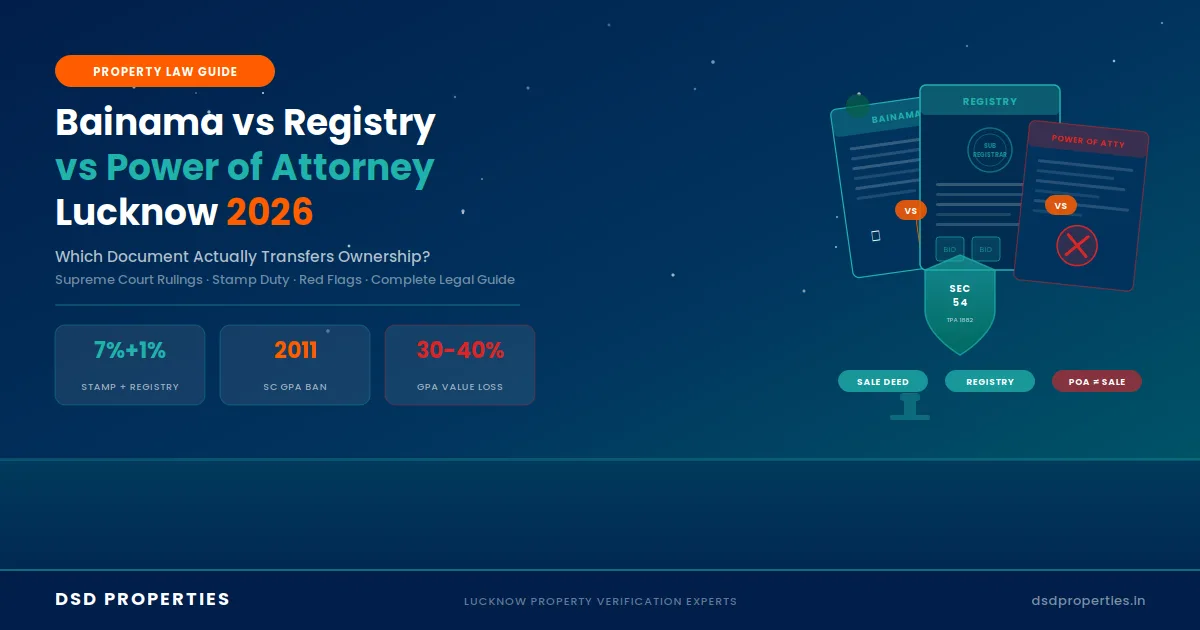
Bainama vs Registry vs Power of Attorney Lucknow 2026 — Which Document Actually Transfers Ownership?
Sources: Transfer of Property Act 1882, Registration Act 1908, Indian Contract Act 1872, Powers of Attorney Act 1882, Supreme Court of India (Suraj Lamp & Industries Pvt. Ltd. v. State of Haryana 2011, Ramesh Chand v. Suresh Chand 2025), IGRSUP Official Portal (igrsup.gov.in), UP Stamp & Registration Department, DSD Properties Field Research — April 2026
🧭 Quick Navigation
🔴 Why This Confusion Costs Lucknow Buyers Lakhs Every Year
- Bainama, Registry, and Power of Attorney are NOT interchangeable — each serves a fundamentally different legal purpose in property transactions
- The Supreme Court ruled in 2011 (and reaffirmed in 2025) that property sold through GPA alone is NOT a valid transfer — yet hundreds of Lucknow plots are still sold this way
- Only a registered Sale Deed (Bainama + Registry) legally transfers ownership under the Transfer of Property Act 1882 and the Registration Act 1908
- GPA-based 'sales' lose 30–40% resale value because banks refuse to finance them and future buyers cannot get home loans
If you are buying property in Lucknow — whether a plot in Sultanpur Road, a flat in Gomti Nagar, or agricultural land in Mohanlalganj — you will encounter three terms that every broker, seller, and property dealer uses almost interchangeably: Bainama, Registry, and Power of Attorney. The casual mixing of these terms is not just sloppy language — it is the single biggest source of property fraud in Uttar Pradesh.
A seller who says "bainama ho jayega" may mean a fully registered sale deed, or he may mean a scrap paper agreement with no legal standing. A broker who says "POA de denge" is offering you a document that the Supreme Court of India has explicitly declared cannot transfer property ownership. And a buyer who thinks "registry" and "bainama" are the same thing is missing a critical legal distinction that could cost them their entire investment.
This guide breaks down each document with precise legal definitions, explains exactly what each one can and cannot do, maps out the Supreme Court rulings that every Lucknow buyer must know, and gives you a clear framework to protect your money.
What Is Bainama? (Sale Deed / Bikri Patra)
Bainama — also called Sale Deed or Bikri Patra — is the legal document that records the actual sale of immovable property from seller to buyer. It is the physical paper on which the sale transaction is written, stamped, and signed by both parties. The word 'bainama' literally translates to 'sale document' in Urdu/Hindi, derived from 'bai' (sale) and 'nama' (document).
Under Section 54 of the Transfer of Property Act, 1882, a sale of immovable property worth more than ₹100 can only be made through a registered instrument — meaning a bainama that has been formally registered at the Sub-Registrar Office. An unregistered bainama, no matter how detailed or how many witnesses sign it, does not legally transfer ownership.
What a Bainama Contains
- Full details of buyer (Kreta) — name, father's name, address, Aadhaar
- Full details of seller (Vikreta) — name, father's name, address, Aadhaar
- Complete property description — khasra/gata number, area in sq.m., boundaries (north/south/east/west), village/mohalla, tehsil
- Sale consideration (price) — total amount paid, payment mode, and confirmation of receipt
- Seller's declaration — confirming sole ownership, no pending mortgage/lien, no court case, and right to sell
- Witness details — typically two witnesses with signatures and identification
The critical point: a bainama is the content document — the written record of the sale. Registry is the legal process that makes it enforceable. A bainama without registry is like a cheque without a signature — it exists on paper but carries no legal weight.
What Is Registry? (Registration Process)
Registry (or Registration) is not a document — it is the legal process of officially recording the bainama at the Sub-Registrar Office (SRO) under the government's supervision. When people say "registry ho gayi" they mean the sale deed has been presented before the Sub-Registrar, both parties' biometrics (fingerprints and photos) have been captured, stamp duty has been paid, and the document has been entered into the official government record.
Under Section 17 of the Registration Act, 1908, every document that transfers immovable property worth more than ₹100 must be registered. This is not optional — it is a legal mandate. An unregistered sale deed is inadmissible as evidence of title in any court of law under Section 49 of the same Act.
So when we say Bainama + Registry = Legal Ownership Transfer, we mean that the bainama is the written agreement and the registry is the government authentication. You need both. Separately, neither is sufficient. In everyday Lucknow language, people often say "bainama karwa lo" when they actually mean "get the sale deed registered" — both the document creation and the registration process combined.
What Is Power of Attorney? (Mukhtar Nama)
Power of Attorney (POA) — called Mukhtar Nama in local terminology — is a legal document where one person (the Principal) authorises another person (the Agent or Attorney) to act on their behalf for specific legal or financial tasks. It is governed by Chapter X of the Indian Contract Act, 1872 and the Powers of Attorney Act, 1882.
There are two main types relevant to property transactions:
General Power of Attorney (GPA)
Gives broad authority to manage multiple affairs — renting, banking, paying taxes, legal proceedings. Does NOT specifically authorise property sale. Often misused in illegal 'GPA sales.'
Special Power of Attorney (SPA)
Grants limited powers for one specific act — e.g., 'Only to sign the Sale Deed for Plot No. 123 in Gomti Nagar.' More legally defensible, but still not a transfer document.
NRI Power of Attorney
Used when an NRI property owner in USA/UK/Gulf cannot physically attend the SRO. Authorises a relative in India to execute the registered sale deed on their behalf.
'GPA Sale' (Illegal Practice)
Seller gives GPA + Agreement to Sell + Possession + Affidavit — but NO registered sale deed. The Supreme Court declared this method invalid in 2011. Still common in Lucknow.
The fundamental legal reality: a Power of Attorney is an authorisation to act — not a transfer of ownership. It creates an agency relationship where the agent represents the principal. It does not, cannot, and has never been able to transfer title of immovable property under Indian law. A POA holder can sign a sale deed on behalf of the owner, but the sale deed itself is what transfers ownership — not the POA.
Additionally, a POA is inherently revocable — the principal can cancel it at any time by sending a notice. If the principal dies, the POA becomes void instantly. The seller's legal heirs can then claim the property, and any buyer who relied solely on the GPA loses everything.
Bainama vs Registry vs POA — Master Comparison Table
This is the single most important table in this article. Bookmark it, screenshot it, and show it to your property lawyer before signing anything:
| Criterion | Bainama (Sale Deed) | Registry (Registration) | Power of Attorney |
|---|---|---|---|
| What is it? | Written document recording the sale | Government process of officially recording the bainama | Authorisation letter for someone to act on your behalf |
| Transfers ownership? | Yes — when registered | Yes — this is the legal act of transfer | No — never transfers ownership |
| Governing law | Section 54, Transfer of Property Act 1882 | Sections 17 & 49, Registration Act 1908 | Indian Contract Act 1872, Powers of Attorney Act 1882 |
| Stamp duty required? | Yes — 7% (male) / 6% (female) of property value | Yes — 1% registration fee on top of stamp duty | Nominal — ₹100 to ₹1,000 depending on type |
| Can be revoked? | No — once registered, permanent | No — government record is permanent | Yes — can be cancelled anytime by the principal |
| Valid after death? | Yes — ownership passed permanently | Yes — registered record survives | No — dies with the principal |
| Bank loan possible? | Yes — banks accept registered sale deed | Yes — registration is prerequisite for loan | No — banks reject GPA-based properties |
| Appears on IGRSUP? | Yes — fully searchable on igrsup.gov.in | Yes — registration creates the IGRSUP record | No — POA does not appear in property search |
| Court evidence value | Primary evidence of title | Government-certified proof | Not evidence of ownership — only of agency |
| Resale value impact | Full market value — clean title | Full market value | 30–40% below market — buyer pool restricted |
Supreme Court Rulings Every Lucknow Buyer Must Know
The legal position on GPA-based property sales has been settled by the highest court in India — not once, but repeatedly over the past 15 years. Here are the landmark rulings:
Suraj Lamp & Industries Pvt. Ltd. v. State of Haryana
A three-judge bench of the Supreme Court declared that property transfers through Sale Agreement, GPA, and Will are not legally valid. The Court observed that GPA 'sales' were being massively used to evade stamp duty and invest black money, creating a 'property mafia.' The ruling explicitly stated that a Power of Attorney is not an instrument of transfer in regard to any right, title, or interest in immovable property.
Ghanshyam v. Yogendra Rathi
The Supreme Court held that a POA or a Will cannot be recognised as title documents conferring any right in immovable property. Even if a power of attorney authorises the POA holder to sell property, the POA holder cannot do so without execution of proper registered documents.
Ramesh Chand v. Suresh Chand
The Court went further: even a registered Will, combined with GPA and Agreement to Sell, cannot by itself create valid title without a registered sale deed. The Court found that an agreement to sell, GPA, affidavit, and receipt did not amount to a deed of conveyance under Section 54 of the Transfer of Property Act.
🔴 What This Means for Lucknow Buyers in 2026
- Any property offered via 'GPA sale' is legally unsafe — regardless of possession or payment
- If the seller refuses to do a registered sale deed, they are either evading stamp duty or hiding a title defect
- Your GPA becomes worthless the moment the seller dies — his legal heirs become the owners, not you
- The seller can fraudulently sell the same property again via a registered sale deed to someone else — and that registered deed will override your GPA
Stamp Duty & Registration Costs — Lucknow 2026
One of the main reasons GPA sales persist in Lucknow is stamp duty avoidance. Buyers and sellers conspire to skip the registered sale deed and its associated costs. Here is what a proper registered sale deed actually costs — and why it is worth every rupee:
| Buyer Type | Stamp Duty | Registration Fee | Total |
|---|---|---|---|
| Male Buyer | 7% of property value | 1% | 8% total |
| Female Buyer | 6% (up to ₹10L value, then 7%) | 1% | 7% effective |
| Joint (Husband + Wife) | 6.5% | 1% | 7.5% total |
| Women (July 2025 rebate) | Additional 1% rebate up to ₹1 Cr | 1% | 6% effective |
| Gift Deed (Blood Relatives) | Flat ₹5,000 | ₹1,000 | ₹6,000 total |
| GPA 'Sale' (No Registry) | ₹100–₹1,000 (POA stamp only) | Nil | Saves money but NO legal ownership |
Stamp duty is always calculated on the higher of the transaction value OR government circle rate for that locality (Section 17, Registration Act 1908). If you buy a Lucknow plot for ₹40 lakh but the circle rate values it at ₹50 lakh, you pay stamp duty on ₹50 lakh. Always check the circle rate on igrsup.gov.in before negotiating the deal price.
The math is simple: on a ₹50 lakh property, a male buyer pays approximately ₹4 lakh in stamp duty and registration. Skipping this via GPA 'saves' ₹4 lakh — but creates a property that cannot be sold at full market value, cannot be used as loan collateral, and can be legally taken away by the seller's heirs. The 'savings' of ₹4 lakh put your entire ₹50 lakh investment at risk.
How to Properly Register a Sale Deed in Lucknow — Step by Step
Draft the Sale Deed (Bainama)
Engage a licensed deed writer or property lawyer to draft the sale deed on stamp paper. The draft must include complete buyer/seller details with Aadhaar, full property description with khasra/plot numbers and boundaries, sale consideration, payment confirmation, and seller's ownership declarations. Both parties review and agree to all terms before proceeding.
📍 Tip: Have your lawyer verify the seller's title chain on IGRSUP before draftingPurchase E-Stamp Certificate
Calculate stamp duty based on the higher of transaction value or circle rate. Purchase the e-stamp certificate through the IGRSUP portal (igrsup.gov.in) or SHCIL-authorised centres. E-stamping is now mandatory for urban areas including Lucknow. The e-stamp certificate has a Unique Identification Number (UIN) that can be verified for authenticity.
📍 Verify circle rate: igrsup.gov.in → Property Registration → Market Value SearchBook SRO Appointment Online
Go to igrsup.gov.in → Property Registration → New Registration. Create an application number, enter all property and party details. The portal calculates stamp duty and registration charges automatically. Book your slot at the correct Sub-Registrar Office — use the 'Know Your Office' feature to identify which of Lucknow's five SROs (Sadar, Sarojini Nagar, Malihabad, Mohanlalganj, Bakshi Ka Talab) handles your property.
📍 Wrong SRO = rejected application. Always verify using Know Your Office on IGRSUPVisit SRO with All Parties
Both buyer and seller (plus two witnesses) must physically attend the Sub-Registrar Office on the appointed date. Carry original Aadhaar cards, PAN cards, passport-size photos, the drafted sale deed, e-stamp certificate, and all supporting property documents (previous sale deed, Khatauni, encumbrance certificate). The Sub-Registrar captures biometrics — fingerprints and photographs — of all parties.
📍 If the seller cannot attend, a registered Special Power of Attorney holder can represent themPay Registration Fee & Complete Registration
Pay the 1% registration fee at the SRO (online or demand draft). The Sub-Registrar reviews the documents, verifies biometrics, and officially registers the sale deed. You receive a registration number and can collect the registered document — this is your legal proof of ownership. The transaction now appears on the IGRSUP portal for public verification.
📍 Registration number format: Book No / Volume / Year — save this permanentlyApply for Dakhil Kharij (Mutation) Within 3 Months
Registration transfers the deed — but Dakhil Kharij (mutation) transfers the revenue record. Within 3 months of registration, apply for mutation at your local Revenue Office or online via the UP revenue portal. This updates the Khatauni on UP Bhulekh (upbhulekh.gov.in) to show your name as the owner. Without mutation, you may face issues with property tax, future sale, and government correspondence.
📍 Mutation deadline: 3 months from registry date — do not delay6 Red Flags That Indicate a Fraudulent Property Deal
🚨 Red Flag 1 — Seller Offers 'GPA Sale' Instead of Registry
If the seller insists on transferring property through General Power of Attorney instead of a registered sale deed, walk away immediately. This usually means the seller wants to avoid stamp duty, is hiding a title defect, has an unresolved mortgage, or does not actually own the property. No legitimate seller refuses to do a proper registered sale deed.
🚨 Red Flag 2 — Agreement to Sell Presented as Final Document
An Agreement to Sell is a promise to sell in the future — it does NOT transfer ownership. Under Section 54 of the Transfer of Property Act, an agreement for sale does not by itself create any right, title, or interest in immovable property. If the seller hands you an agreement to sell and says 'this is your proof of ownership,' you own nothing.
🚨 Red Flag 3 — Seller's Name Does Not Match IGRSUP Record
Search the property on igrsup.gov.in before paying any money. If the seller's name does not appear as the most recent owner in the IGRSUP transaction history, the person offering you the property may not legally own it. This single check prevents the majority of property frauds in Lucknow.
🚨 Red Flag 4 — Seller Asks You to Undervalue the Sale Deed
If the seller asks you to register the sale deed at a lower value than what you actually paid (to save on stamp duty), both of you are committing a criminal offence. The IT department can investigate, and the Sub-Registrar can reject any sale deed valued below the circle rate. In UP, stamp duty is calculated on the higher of transaction value or circle rate — there is no legal way to reduce it by undervaluation.
🚨 Red Flag 5 — Property Has Unresolved Mortgage on IGRSUP
When you search a property on IGRSUP, mortgages appear in the transaction history. If a mortgage appears without a subsequent release/discharge document, the property still has an active lien. A seller who claims the loan is 'paid off' but cannot show the mortgage release on IGRSUP is either lying or has not completed the discharge process.
🚨 Red Flag 6 — Fake Stamp Paper or E-Stamp Certificate
Forged stamp papers worth crores circulate in UP's resale market. Always verify any e-stamp certificate using the IGRSUP E-Stamp Verification tool (E-Stamp Satyapan) by entering the UIN number. This takes under 30 seconds and confirms whether the stamp is genuine, cancelled, or invalid. Never accept a physical stamp paper without independent verification.
When Is a Power of Attorney Legitimately Used?
While the Supreme Court banned GPA 'sales,' it explicitly did not ban the legitimate use of Power of Attorney in property transactions. Here are the situations where a POA is both legal and appropriate:
NRI Property Sales
An NRI owner in USA/UK/Gulf gives a registered SPA to a trusted family member in India to execute the registered sale deed at the SRO. The SPA specifically names the property and authorises only the sale deed signing — not general management.
Medical Incapacity
If the property owner is hospitalised or physically unable to attend the SRO, a registered SPA allows a representative to complete the registration formalities. The sale deed itself is still the ownership transfer document.
Elderly Owners
Senior citizens who cannot travel to the SRO can authorise a child or relative via SPA. The SPA must be registered, must name the specific property, and the sale deed registration remains mandatory.
Property Management (Not Sale)
A GPA can legitimately be used to manage a property — collect rent, pay taxes, handle maintenance — without selling it. This is the original intended use of Power of Attorney in property contexts.
The key distinction: in all legitimate uses, the POA facilitates the execution of a registered sale deed — it does not replace it. The final ownership transfer always happens through the registered sale deed, never through the POA document itself.
Leave a Comment