
Zila Panchayat Approved vs LDA Approved Plots in Lucknow (2026): Legal Status, Loans & Risks
Sources: Lucknow Development Authority (ldalucknow.in approved-layout & illegal-colony lists, master plan), Zila Panchayat Lucknow, UP Revenue Code / UP Zamindari Abolition Act (Section 80), UP RERA (up-rera.in), UP Bhulekh (upbhulekh.gov.in), and published reports (The Daily Jagran and others, 2024–2026). Always verify a specific plot with the concerned authority before paying.
When you go plot-hunting in Lucknow, two phrases come up again and again: "LDA Approved" and "Zila Panchayat Approved." Both sound official. Both are quoted by agents as if they mean the same thing. They do not. The gap between them decides whether your plot is bankable and safe — or a cheap-looking purchase that ends up on an illegal-colony list.
This guide cuts through the confusion with verified facts: exactly who is allowed to approve what, the real legal and financial differences, the specific fraud pattern that traps buyers on Lucknow's outskirts, and a step-by-step way to check any plot before you part with money. The aim is not to scare you off Zila Panchayat plots — they are perfectly legitimate in the right areas — but to make sure you know what you are actually buying.
⚠️ The One Truth to Remember
- Zila Panchayat approval is valid only outside LDA's area. Inside the ~197 LDA villages, a Zila Panchayat layout approval does not make a colony legal
- "As good as LDA" is false. Legally and financially, the two are not equivalent — do not accept that claim from any dealer
- Registry-ready does not mean legal. You can register a plot that sits in an unapproved colony
- A RERA number is not a layout approval. They are separate things — check both
- Verify the plot, not the pitch: approved layout, land use, Section 80 and title — before any booking amount
First, the Big Picture: Who Is Allowed to Approve What?
Lucknow's land is split between two approving bodies. Inside the city's planned development area, the Lucknow Development Authority (LDA) approves colony layouts and building plans. Outside it — in the genuinely rural belt — the Zila Panchayat (District Panchayat) handles layout approvals for villages that the LDA has not brought into its planning area.
The crucial detail is the boundary between them. Following LDA's expansion, around 197 villages now fall under LDA jurisdiction, while the Zila Panchayat can approve layout plans in roughly 477 villages of the district. That single split explains almost every dispute: a Zila Panchayat approval only carries weight in those 477 outlying villages. The moment a piece of land sits inside the 197 LDA villages, only an LDA-sanctioned layout is valid — a Zila Panchayat stamp on the same land does not make a colony there legal.
This is exactly why "Zila Panchayat approved" can be both completely legitimate and a serious red flag, depending entirely on where the land is. Establishing which side of that line your plot falls on is the first thing to check.
Not sure who approved the plot?
We confirm LDA or Zila Panchayat approval at source, plus the khatauni owner, encumbrance and court cases — ₹5,000 for residential plots and flats, PDF report in 48 hours.
What "LDA Approved" Really Means
LDA-approved plots are part of the city's planned urban development. The colony is either developed by the authority itself or by a private developer who has obtained a licence and a sanctioned layout from LDA, in conformity with the Lucknow Master Plan. That sanction is not a formality — it guarantees a real, planned colony.
What an LDA-approved layout gives you
- A legally sanctioned layout with planned roads, drains, sewerage and parks
- Eligibility for home loans from all major banks (SBI, HDFC and nationalised banks)
- Compliance with the Master Plan land use — minimal risk of sealing or demolition
- Cleaner registration, mutation and resale, with stronger long-term liquidity
Typical LDA-approved names buyers recognise: Gomti Nagar and Gomti Nagar Extension, Jankipuram and Jankipuram Vistar, Kanpur Road Yojna, Vasant Kunj on Hardoi Road, the Sushant Golf City township on Shaheed Path, and CG City on Sultanpur Road. These command a premium precisely because the approval risk is taken off the table.
What "Zila Panchayat Approved" Really Means
Zila Panchayat plots sit on the rural outskirts, in villages the LDA has not yet folded into its planned limits. They are often marketed as "Section 80," "Abadi" or simply "registry-ready" land. In their proper place — the 477 outlying villages — a Zila Panchayat layout approval is genuine and the land can be perfectly sound for a budget purchase or a long-horizon investment.
Where Zila Panchayat / outskirt plots are common
- Kursi Road and Deva Road — popular for farmhouse-style and long-term land plays
- Mohanlalganj and outer Raebareli Road — high-growth revenue belt
- Bakshi Ka Talab (BKT) outskirts — lower-budget residential plots
- Faizabad Road beyond Tiwari Ganj, and IIM Road outskirts — emerging fringes
- Parts of the Sultanpur Road and Gosainganj belt not yet inside LDA limits
The honest framing: a Zila Panchayat plot is not "bad." It is cheaper and can appreciate strongly as the city expands. The danger is when the label is stretched — used for land that actually sits inside LDA's area, or attached to a colony that was never properly approved at all. That is where buyers lose money.
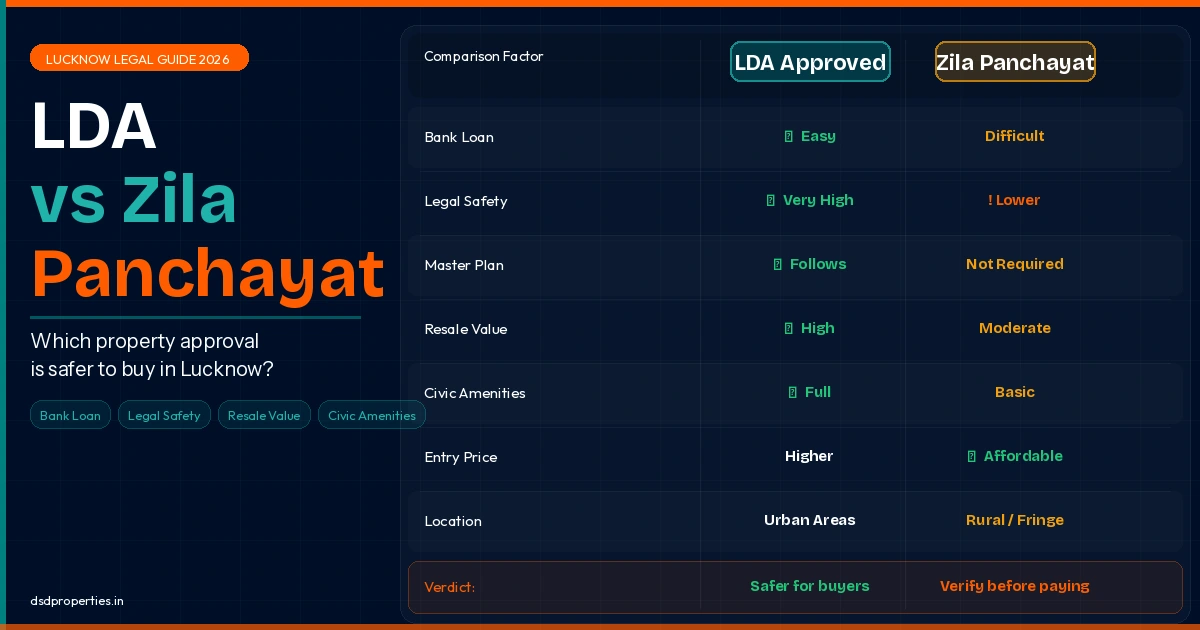
Head-to-Head Comparison
Here is how the two stack up on the factors that decide whether a plot is a safe home or a risky bet:
| Factor | LDA Approved | Zila Panchayat Approved |
|---|---|---|
| Legal layout | Licensed, sanctioned layout under the Master Plan | Valid only in the ~477 outlying villages; invalid inside LDA's ~197 villages |
| Home loans | Funded by all major banks | Harder — often only NBFCs / private finance at higher rates |
| Civic amenities | Planned roads, sewerage, water lines, parks | Depend on the developer; often septic tanks and patchy services |
| Demolition risk | Very low when fully compliant | High if the area is later declared an illegal colony |
| Resale & liquidity | Strong, broad buyer pool | Narrower; buyers wary without clear approvals |
| Price | Higher — approval premium | Lower entry cost |
| Best for | Building a home now, with finance and peace of mind | Budget, long-horizon land — only after thorough verification |
The Biggest Trap: "Approved" Colonies That Are Actually Illegal
The most expensive mistake on Lucknow's outskirts is not buying a clearly illegal plot — it is buying one that looks approved. Two patterns recur, and both have been documented in reporting on Lucknow's rural belt:
🚨 Over-plotting beyond the approved layout
A developer gets a small layout sanctioned — say 17 bighas — then develops and sells plots across a far larger area, like 150 bighas, showing buyers only the small approved plan. The extra plots are unapproved. This exact pattern has been reported in Gosainganj and Mohanlalganj.
🚨 Zila Panchayat approval claimed inside LDA's area
Land that actually falls within the ~197 LDA villages is sold on a Zila Panchayat approval that does not apply there. Such colonies can be declared illegal by LDA, exposing buyers to sealing or demolition.
🚨 Notices ignored
Over 100 property dealers and companies around Lucknow have been issued notices for developing plots without an approved layout, across Sarojini Nagar, Malihabad, BKT and other tehsils — yet sales continue. A notice you never hear about is still a notice against the colony.
None of this means the outskirts are off-limits. It means you must see the actual sanctioned layout map and confirm your specific plot sits inside it — not just somewhere in the seller's brochure.
Two Myths That Cost Buyers Money
Myth 1: "It's registry-ready, so it's legal." Registration transfers ownership of a land parcel; it does not certify that the colony's layout is approved or that the land use permits housing. You can absolutely register a plot that sits in an unapproved or illegal colony — and still face enforcement later. Registry and colony approval are two different checks.
Myth 2: "It has a RERA number, so it's fine." RERA registration is about builder transparency and buyer protection. Both LDA and Zila Panchayat projects can be RERA-registered if they qualify. A RERA number is reassuring, but it does not by itself prove the colony has a valid, sanctioned layout in the right jurisdiction. Verify the layout approval separately.
How to Verify Any Plot Before You Pay
Whichever label a plot carries, the verification is the same disciplined sequence:
Find out which jurisdiction the land is in
Confirm whether the village is among the ~197 LDA villages or the ~477 Zila Panchayat villages. If it is inside LDA's area, only an LDA-sanctioned layout counts.
📍 LDA / Zila Panchayat office; LDA master plan mapCheck the LDA approved-layout & illegal-colony lists
Search the colony name (and alternate spellings). If it is not on the LDA approved list, it may be Zila Panchayat approved — but if it is also on, or near, the illegal-colony list, stop.
📍 ldalucknow.in → approved layouts / illegal colony listSee the actual sanctioned layout map
Ask for the approved layout document and confirm your exact plot number falls inside the sanctioned area — guarding against the over-plotting trap.
📍 Approving authority (LDA or Zila Panchayat)Confirm land use & Section 80 conversion
Check the Master Plan 2031 land use and confirm the Khatauni shows Gair-Krishi (non-agricultural), not Krishi. For village/revenue land, Section 80 from the SDM is mandatory — "in process" is a red flag.
📍 upbhulekh.gov.in & SDM / tehsil officeVerify title, RERA and dues
Check the sale-deed chain and mutation, verify any RERA number on the official portal, and confirm there are no pending dues or charges. When in doubt, get an independent verification.
📍 up-rera.in & SRO recordsLoans, Resale and Long-Term Value
For most buyers, financing is the practical deciding factor. Banks lend comfortably against LDA-approved, approved-layout property because the title and compliance are clean; on Zila Panchayat plots, mainstream home loans are harder and buyers often fall back on costlier NBFC or private finance — if they can borrow at all. That same logic flows into resale: the broader the pool of buyers who can get a loan, the easier and stronger your exit.
That said, the appreciation argument for the outskirts is real. Land in the genuinely rural belt is cheaper, and well-located outskirt plots can appreciate sharply as the city and its Outer Ring Road expand. The catch is that this upside only materialises if the plot is clean — an unapproved colony does not appreciate, it litigates. Cheap and legal is an investment; cheap and unapproved is a liability.
So Which Should You Choose?
It comes down to your goal. If you want to build and live now, with a bank loan and no sleepless nights, an LDA-approved plot is the safer choice — you pay more, but you buy certainty. If you are a budget, long-horizon investor who can wait years for the city to reach the land, a Zila Panchayat plot can deliver stronger appreciation — but only if you have verified that it is genuinely outside LDA's area, has an approved layout, completed Section 80 conversion and a clean title.
The wrong reason to pick Zila Panchayat is simply that it is cheaper or because a dealer says it is "as good as LDA." The right reason is a deliberate, verified investment decision made with your eyes open.
Dealer Claims to Never Trust at Face Value
🚨 "Zila Panchayat approval is as good as LDA"
Legally and financially it is not. The two differ on loans, infrastructure, demolition risk and resale. Verify, do not take the equivalence on trust.
🚨 "LDA expansion is coming, so it will be approved soon"
Future inclusion is speculation. You are buying today's legal status, not a promise. Land mafias use this line near big LDA schemes to sell adjacent unapproved plots.
🚨 "Section 80 is in process"
Until conversion is complete and the Khatauni shows Gair-Krishi, the land is still agricultural. Do not pay against an "in process" assurance.
🚨 "Here's the approved map" (showing a small plan for a big colony)
Confirm the plan covers your exact plot. A genuine approval for 17 bighas does not legalise plots sold across 150.
How DSD Properties Helps
This is precisely the verification most buyers skip — and where the costliest mistakes hide. Our plot verification service answers the only question that matters: is this specific plot genuinely approved and safe to buy?
What our verification covers
- Jurisdiction check — LDA vs Zila Panchayat, and whether the village is inside LDA's area
- Approved-layout & illegal-colony cross-check against LDA records
- Master Plan 2031 land-use and Section 80 / Gair-Krishi status on UP Bhulekh
- Title, mutation & RERA verification, plus pending-dues check
- A documented PDF report within 48 hours so you can buy with confidence
The Bottom Line
"LDA Approved" and "Zila Panchayat Approved" are not two flavours of the same thing. LDA approval means a sanctioned, bankable, low-risk colony inside the planned city. Zila Panchayat approval is legitimate only in the roughly 477 outlying villages — and worthless on land that actually belongs to LDA's ~197. Registry-ready and RERA-registered are reassuring words, but neither replaces a valid, jurisdiction-correct layout approval.
Buy LDA-approved for a home you want to live in now; consider a verified Zila Panchayat plot only as a deliberate, eyes-open long-term investment. Either way, the habit that protects you is the same: verify the approval, the land use and the title before a single rupee changes hands.
Leave a Comment