
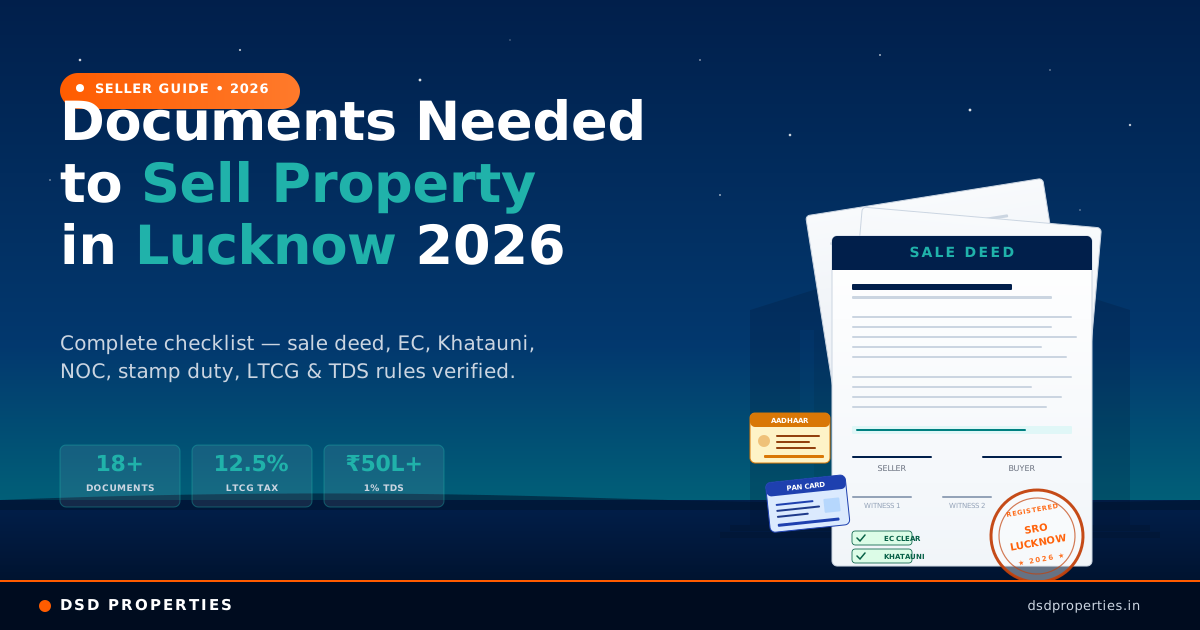
Documents Needed to Sell Property in Lucknow 2026 — Complete Seller Checklist with Stamp Duty, TDS & Capital Gains Rules
Sources: Inspector General of Registration & Stamps Uttar Pradesh (igrsup.gov.in), UP Bhulekh portal (upbhulekh.gov.in), Income Tax Department India (incometaxindia.gov.in), UP Stamp Duty Act 1908, Registration Act 1908 Section 17, Income Tax Act Section 194-IA, Union Budget 2024 LTCG provisions. All rates and rules verified as of May 2026.
Selling a property in Lucknow is not just about finding a buyer. Every Sub-Registrar Office across the city — Sarojini Nagar SRO, Mohanlalganj SRO, Bakshi Ka Talab SRO, Malihabad SRO, Sadar Tehsil SRO — runs a strict document checklist. Miss even one paper and your registry date gets pushed by weeks. Buyers walk away. Bank loan disbursements freeze.
This guide is built specifically for Lucknow sellers — whether you are selling a plot in Sultanpur Road, an LDA flat in Gomti Nagar, a builder apartment in Sushant Golf City, or inherited family land in Mohanlalganj or Malihabad. We cover every document the buyer's lawyer will demand, every paper the SRO requires at registry, and every tax form the Income Tax Department expects.
The list includes verified 2026 rules — UP stamp duty rates per official IGRSUP, current LTCG tax of 12.5% under Budget 2024, the ₹50 lakh TDS threshold under Section 194-IA, and the new Form 141 (replacing Form 26QB from 1 April 2026 under the Income-tax Act 2025).
⚠️ Before You List — What Every Lucknow Seller Must Know
- Document gathering takes 30–90 days. Encumbrance Certificates from older SROs, missing mutation entries, society NOCs, and bank loan closures all need time. Start before you list, not after a buyer is found
- Stamp duty is paid by the buyer. But sellers must produce all original documents on registry day or the SRO will refuse to execute the sale deed
- TDS is deducted by the buyer. If the property is ₹50 lakh or more (sale value or stamp duty value, whichever is higher), the buyer cuts 1% TDS before paying you — you must provide PAN or it jumps to 20%
- LTCG applies on the gain. Held more than 24 months? You pay 12.5% on the profit (or 20% with indexation for property bought before 23 July 2024 — whichever is lower). Section 54, 54EC, and 54F offer exemptions on reinvestment
- Property must be registered within 4 months of sale deed execution as per the UP Registration Act 1908
The Complete Document Checklist for Selling Property in Lucknow 2026
Below is every document required — grouped by category and ranked by importance. Originals are required at the SRO on registry day; certified copies are needed for the buyer's lawyer and the buyer's home-loan bank.
A. Ownership Proof Documents (Non-Negotiable)
Original Sale Deed (Title Deed) in Your Name
This is the foundational document proving you legally own the property. It is the registered sale deed (or gift deed, partition deed, or will-based ownership) by which the property came into your name. Buyers, their lawyers, and their banks will examine this first.
If your original sale deed is lost, file an FIR at the local police station and apply at the concerned Sub-Registrar Office for a certified copy. Without this, no buyer's bank will sanction a home loan, and no buyer's lawyer will clear the title.
📍 Where to obtain / verify
Certified copies available from the Sub-Registrar Office where the property was originally registered, or via the IGRSUP portal's online document search using deed number and registration year.
Chain of Previous Sale Deeds (Mother Deed Onwards)
The buyer's lawyer will request the full ownership chain — typically 30 years back — to establish a clear title. This includes the mother deed (earliest establishing document) and every subsequent sale, gift, partition, or inheritance transfer.
For inherited Lucknow properties (common in Mohanlalganj, Malihabad, Kakori areas), include the death certificate of the previous owner, legal heir certificate, and any varasat (succession) order from the tehsildar.
📍 Where to obtain / verify
Apply for certified copies at the SRO where each prior deed was registered. A 30-year Encumbrance Certificate (next item) helps identify which deeds exist in the chain.
Encumbrance Certificate (EC) — 13 to 30 Years
The Encumbrance Certificate is the official record from the Sub-Registrar Office of every transaction registered against your property — sales, mortgages, liens, court attachments. Buyers and their banks insist on a 13-year EC at minimum; many banks now ask for 30 years for clean-title comfort.
A "Nil EC" (Form 16) means no encumbrances exist. A "Form 15 EC" lists all transactions found. Any undischarged mortgage or lien must be cleared before registry — produce the loan closure certificate (next item) alongside.
📍 Where to obtain / verify
Apply on the IGRSUP portal (igrsup.gov.in → Encumbrance Certificate) or visit the concerned SRO physically. Processing usually takes 7–15 working days; expedited service available at the SRO counter.
Khatauni Extract Showing Your Name (For Plots & Land)
For any plot, agricultural land, or land-component property in Lucknow, the current Khatauni must show your name as the recorded owner. Buyers will cross-check this against your Aadhaar and previous sale deed. If your name does not appear, it means Dakhil Kharij (mutation) was never completed after you purchased — this must be fixed before listing.
Khatauni records also show land classification (Gair-Krishi / non-agricultural vs Krishi / agricultural). Agricultural land in UP cannot be sold for residential use without Section 80 conversion under the UP Zamindari Abolition Act.
📍 Where to obtain / verify
Download free from upbhulekh.gov.in by entering District (Lucknow), Tehsil, village name, and Khasra/Khata number. Certified copy from the tehsildar's office costs approximately ₹15–30.
B. Identity & Address Proofs of Seller
Aadhaar Card + PAN Card of Seller (and All Co-Owners)
Both buyer and seller — including every co-owner if the property is jointly held — must produce original Aadhaar and PAN at the Sub-Registrar Office for biometric verification. The names on Aadhaar, PAN, and the registry must match exactly. Any mismatch (initial difference, spelling variation, married surname) requires an affidavit before proceeding.
PAN is critical for tax compliance: if the property sells for ₹50 lakh or more, the buyer must deduct 1% TDS under Section 194-IA. Without your valid PAN, the TDS rate jumps to 20% under Section 206AA — and that excess cannot be refunded as easily.
📍 Where to obtain / verify
Aadhaar: any Aadhaar Seva Kendra in Lucknow. PAN: NSDL/UTIITSL portals. PAN-Aadhaar linking status: incometax.gov.in.
Recent Passport-Size Photographs (Coloured)
Two to four recent passport-size colour photographs of the seller (and each co-owner) are required for the sale deed and SRO records. The SRO photographer also takes live biometric photographs during registry, but separate physical photographs are still needed for the deed document and SRO file copy.
Witnesses — typically two — must also bring their own photographs along with Aadhaar.
C. Tax & Dues Clearance Documents
Latest Property Tax Receipts (Nagar Nigam Lucknow)
Property tax (House Tax) receipts from Lucknow Municipal Corporation (Nagar Nigam Lucknow) for at least the last three financial years must be cleared and produced. If any year's tax is pending, the buyer's bank will not release loan funds and the SRO may refuse registry until dues are cleared.
For LDA-developed properties (Gomti Nagar Extension, Anant Nagar, Atal Nagar, Basant Kunj), additional LDA development charges and lease rent (for leasehold plots) may also need clearance.
📍 Where to obtain / verify
Lucknow Municipal Corporation portal (lmc.up.nic.in) or any zonal Nagar Nigam office. LDA dues: ldalucknow.in or LDA Vipin Khand office.
Utility Bill Clearance — Electricity (UPPCL), Water (Jal Sansthan), Gas
Latest paid bills for electricity (UPPCL / Madhyanchal Vidyut Vitran Nigam in Lucknow), water (Jal Sansthan UP), and piped gas (IGL where applicable) must be produced. No-dues certificates from UPPCL are commonly demanded by buyer banks. After registry, the connections need to be transferred to the buyer's name — this requires a name-transfer application along with the new registered sale deed.
📍 Where to obtain / verify
UPPCL: uppcl.org. Lucknow Jal Sansthan: jalsansthanlko.org. IGL: iglonline.net.
Home Loan Closure / NOC from Bank (if Property Was Mortgaged)
If your property was bought through a home loan and the loan is still active, you must either: (a) close the loan from your funds and obtain a loan closure certificate plus original documents back from the bank, OR (b) arrange a tripartite transfer where the buyer's bank pays your outstanding loan directly to your bank.
Even after closure, request a No Objection Certificate (NOC) from the lending bank stating no dues remain and the original documents have been released. CERSAI (cersai.org.in) should also be checked independently by the buyer to confirm no charge remains registered against the property.
📍 Where to obtain / verify
Loan closure NOC from your home loan branch. CERSAI charge search at cersai.org.in to confirm no residual lien.
D. Approval & Compliance Documents
Approved Building Plan / Sanctioned Map (LDA or Concerned Authority)
For any constructed property — house, flat, commercial unit — the original sanctioned building plan from the Lucknow Development Authority (LDA), Lucknow Municipal Corporation, or relevant authority must be available. Buyer banks scrutinise this carefully against the actual construction; any unauthorised extension, additional floor, or deviation can result in loan rejection or, worse, demolition risk.
Properties in LDA's blacklist of 241+ illegal colonies do not have approved plans — these are extremely difficult to sell to bank-financed buyers. Properties near Amausi Airport need additional AAI NOCAS height clearance.
📍 Where to obtain / verify
LDA: ldalucknow.in or LDA Vipin Khand office. LMC: lmc.up.nic.in. AAI height clearance: nocas2.aai.aero.
Completion Certificate (CC) & Occupancy Certificate (OC)
For builder-sold flats and apartments — common in Sushant Golf City, Omaxe, Eldeco, Ansal projects — the Completion Certificate (issued after construction matches the approved plan) and Occupancy Certificate (permission to legally occupy) must be available. Resale of an apartment without OC creates serious risks: utility connections may be challenged, and the property may technically not be habitable in legal terms.
If you bought from the builder and CC/OC were never issued, request them now from the builder or the relevant authority. RERA-registered projects must obtain these — check status on up-rera.in.
📍 Where to obtain / verify
Builder office / housing society. RERA status: up-rera.in. Authority records: ldalucknow.in or LMC.
Society / RWA No-Objection Certificate (NOC) & No-Dues Letter
If your flat is in a housing society or apartment complex with a Resident Welfare Association (RWA) — Eldeco, Shalimar, Ansal API, Omaxe townships, and many Gomti Nagar group housing schemes — you need: (1) a No-Objection Certificate from the society for the transfer, and (2) a No-Dues Letter confirming all maintenance, repair fund, and other charges are cleared.
Process typically takes 7–30 days depending on the society's committee meeting schedule. Start early. Clear all pending maintenance dues before applying.
📍 Where to obtain / verify
Society / RWA secretary or office. Some apartment complexes process this online via society management apps.
Dakhil Kharij (Mutation) Record in Seller's Name
Mutation — known locally as Dakhil Kharij — is the update in revenue records or municipal records showing you as the current owner after you purchased. For plots and land, mutation appears in the Khatauni (Bhulekh). For built urban property, it appears in the Nagar Nigam house tax records.
If mutation was never completed in your name, the buyer will not get clean title transferred to them. Fix this before listing — the application is straightforward via IGRSUP or the local tehsildar/Nagar Nigam office.
📍 Where to obtain / verify
UP Bhulekh: upbhulekh.gov.in. Nagar Nigam: lmc.up.nic.in. IGRSUP Dakhil Kharij section: igrsup.gov.in.
E. Transaction & Special-Case Documents
Agreement to Sell (Bayana / Sale Agreement)
Before the final sale deed registration, sellers and buyers execute an Agreement to Sell — sometimes called bayana or sale agreement — which records the agreed price, advance amount paid, registry timeline, and conditions. This is typically executed on stamp paper and may or may not be registered (registration is recommended for higher-value transactions for legal protection).
Bainama and final sale deed are different — see DSD Properties' detailed bainama vs registry guide.
Form 26QB / Form 141 — TDS Compliance (For Sales Above ₹50 Lakh)
If the sale consideration or stamp duty value (whichever is higher) is ₹50 lakh or more, the buyer is legally required to deduct 1% TDS under Section 194-IA of the Income Tax Act before paying you. The buyer pays this TDS to the government using Form 26QB (or Form 141 from 1 April 2026 under the new Income-tax Act 2025) within 30 days of the month-end of payment.
The buyer must then issue you Form 16B (or Form 132 post-1 April 2026) as proof of TDS paid in your name. You claim this TDS credit when filing your income tax return — it adjusts against your final capital gains tax liability. Ensure your PAN is provided correctly to the buyer. Otherwise the TDS rate jumps to 20%, severely impacting your cash flow.
📍 Where to obtain / verify
Buyer pays TDS via NSDL TIN portal. Form 16B/132 downloadable from TRACES (tdscpc.gov.in) after challan clears. Verify credit in your Form 26AS / AIS on incometax.gov.in.
Power of Attorney (Only If Selling Through Authorised Agent)
If you cannot personally attend the registry (NRI seller posted abroad, senior citizen with mobility issues, owner residing in another state), you must execute a registered Power of Attorney (not just a notarised one) in favour of a trusted family member or representative. The PoA must specifically authorise sale of the property described with full identification.
NRI sellers: the PoA must be executed at the Indian Embassy or High Commission in your country of residence, attested by the embassy, and then adjudicated and stamped at the District Collector's office in India. Banks and SROs are particularly strict on PoA-based sales after multiple documented fraud cases.
📍 Where to obtain / verify
Registered PoA: Sub-Registrar Office in Lucknow. NRI PoA: Indian Embassy/High Commission in country of residence. Stamp duty on PoA in UP: nominal — typically ₹100–500 depending on scope.
Legal Heir Certificate, Death Certificate, Varasat Order (Inherited Property)
If you are selling property inherited from a deceased parent or relative, you need: (1) Death certificate of the original owner, (2) Legal Heir Certificate or Family Tree from the local tehsildar, and (3) Varasat (succession) order from the tehsildar formally transferring the property to the current legal heirs.
If there are multiple legal heirs, all must either be joint sellers in the registry OR execute a registered Relinquishment Deed in favour of the seller. Selling inherited property without resolving all heir claims is a common cause of post-sale litigation — and it was the exact pattern in the Mohanlalganj "fake father" fraud documented in April 2026.
📍 Where to obtain / verify
Death certificate: Nagar Nigam Lucknow (urban) or Gram Panchayat (rural). Varasat / Legal Heir Certificate: concerned tehsildar's office (Sadar, Bakshi Ka Talab, Mohanlalganj, Malihabad, Sarojini Nagar).
Section 80 Conversion Order (For Agricultural Land Sold as Non-Agricultural)
Agricultural land in Uttar Pradesh cannot be sold for residential or commercial use without conversion under Section 80 of the UP Zamindari Abolition and Land Reforms Act (now governed by the UP Revenue Code). If your land was originally agricultural and you have built a house or are selling it for residential use, the Section 80 conversion order from the SDM or District Magistrate must be available.
Many plots in peri-urban Lucknow — Bakshi Ka Talab, Mohanlalganj rural belt, parts of Sarojini Nagar — are still classified as Krishi (agricultural) in Khatauni. Selling these as residential plots without Section 80 conversion exposes the buyer to LDA enforcement action and the seller to potential fraud charges.
📍 Where to obtain / verify
SDM office of the concerned tehsil. Status visible in Khatauni at upbhulekh.gov.in (land type field).
Stamp Duty & Registration Charges in Lucknow 2026 (Buyer Pays, Seller Should Know)
Stamp duty is legally the buyer's responsibility, but as a seller you should understand the rates because they directly affect the buyer's total cost — and therefore your negotiated price.
UP Stamp Duty & Registration Rates — Verified May 2026
- Stamp duty — male buyer: 7% of property market value or circle rate (whichever is higher)
- Stamp duty — female buyer: 6% on property up to ₹1 crore (the 1% concession limit was raised from ₹10 lakh to ₹1 crore on 22 July 2025); 7% above that
- Stamp duty — joint owner (male + female): 6.5%
- Registration fee: 1% of property value, capped at ₹30,000 maximum
- Gift deed to blood relative: ₹5,000 + ₹1,000 processing fee — major concession under UP government's blood-relative scheme
- Stamp duty base: calculated on the higher of actual sale consideration or the government-notified circle rate for the locality
Lucknow circle rates vary by locality and were last revised by the UP government's Stamp & Registration Department. Check current circle rate on igrsup.gov.in's stamp duty calculator before negotiating final price — undervaluation below circle rate is not permitted and the SRO will calculate stamp duty on the circle rate regardless.
Capital Gains Tax — What Sellers Will Actually Pay in 2026
After Union Budget 2024, capital gains tax on property sale has fundamentally changed. The rules below apply to FY 2025-26 (AY 2026-27) and continue under the new Income-tax Act 2025 effective from 1 April 2026.
Long-Term Capital Gains (LTCG) on Property — 2026 Rules
- Holding period for LTCG: property held for more than 24 months
- LTCG rate (property sold after 23 July 2024): 12.5% on the gain, without indexation benefit
- Grandfathering option: for property purchased on or before 22 July 2024, resident individuals and HUFs may choose between 12.5% without indexation OR 20% with indexation — whichever results in lower tax
- Short-Term Capital Gains (held ≤ 24 months): taxed at your applicable income tax slab rate (can go up to 30%)
- NRI sellers: LTCG at 12.5% applies; buyer must deduct higher TDS under Section 195 (rates vary by gain — often 12.5% to 20% on sale value). Consult a CA.
LTCG Exemptions — How to Legally Reduce Your Tax
💡 Reinvestment-Based Exemptions Under Income Tax Act
- Section 54 — Reinvest in another residential property: if you reinvest the LTCG into another residential house in India within 2 years (purchase) or 3 years (construction), the gain is exempt up to the reinvested amount. Cap of ₹10 crore on the exemption
- Section 54EC — Invest in specified bonds: invest up to ₹50 lakh of the LTCG in NHAI or REC bonds within 6 months of sale, with a 5-year lock-in. The invested amount is fully exempt
- Section 54F — Sale of any long-term asset other than a house, reinvested in residential property: entire net consideration must be reinvested. Applicable only if you do not own more than one residential house at the time of the new investment
- Capital Gains Account Scheme (CGAS): if you cannot reinvest immediately before your ITR filing due date, park the gain in a CGAS account at a designated bank to keep the exemption alive
The Property Sale Process at the Lucknow Sub-Registrar Office — Step by Step
Gather All Documents and Verify Khatauni / EC Status
Before listing, complete the 18-document checklist above. Apply for a 13-year EC, check current Khatauni, verify mutation is in your name, and clear any pending dues. This stage typically takes 30–60 days for properties with clean history; longer for inherited or older properties.
📍 upbhulekh.gov.in + igrsup.gov.in + Nagar Nigam LucknowNegotiate, Execute Agreement to Sell, Receive Bayana (Advance)
Once a buyer is finalised, execute the Agreement to Sell on stamp paper. The buyer typically pays 10–20% as bayana (advance / earnest money) against this agreement. Specify the registry date, conditions for cancellation, and refund terms clearly. If sale value is ₹50 lakh+, ensure your PAN is shared with the buyer for TDS compliance.
📍 Drafted by property lawyer / deed writer (legal fees ₹5,000–25,000)Prepare the Sale Deed and Calculate Stamp Duty
The sale deed (final transfer document) is drafted by a lawyer or deed writer based on the agreed terms. Stamp duty is calculated on the higher of sale value or circle rate. Buyer pays the stamp duty via e-stamping on the IGRSUP portal (online payment via net banking, debit card, or e-Challan) or through authorised stamp vendors.
📍 igrsup.gov.in — Property Registration → Stamp Duty CalculatorBook SRO Appointment on IGRSUP Portal
Both buyer and seller (or PoA holder) book an appointment at the concerned Sub-Registrar Office (jurisdiction depends on property location — Sadar, Sarojini Nagar, Mohanlalganj, Bakshi Ka Talab, Malihabad, etc.) on the IGRSUP portal. Two witnesses with their own Aadhaar must accompany.
📍 igrsup.gov.in → Property Registration → Apply / LoginBuyer Deducts TDS (If Sale ≥ ₹50 Lakh) Before Final Payment
If consideration or stamp duty value is ₹50 lakh or more, the buyer deducts 1% TDS under Section 194-IA, deposits it via Form 26QB (or Form 141 post-1 April 2026) within 30 days of month-end, and provides you Form 16B (or Form 132). Without your PAN, TDS jumps to 20%. The deducted amount becomes claimable credit in your ITR.
📍 NSDL TIN portal for Form 26QB; TRACES (tdscpc.gov.in) for Form 16BAttend SRO with Original Documents, Witnesses, and Buyer
On the appointment date, both parties appear at the SRO with all originals, photographs, two witnesses each with Aadhaar, the stamp-duty-paid e-stamp certificate, and the buyer's payment (typically DD or bank transfer with proof). Biometric verification is done. The SRO officer registers the deed, applies the seal, and updates the official record.
📍 Concerned SRO — Sadar / Sarojini Nagar / Mohanlalganj / etc.Receive Final Payment and Hand Over Original Documents
Once the deed is registered (you can verify on IGRSUP within hours), receive the balance payment and hand over the original prior sale deeds, EC, sanctioned plans, property tax receipts, utility paid bills, society NOC, and any other documents in your possession to the buyer. Retain certified copies for your tax records.
📍 Bank transfer / DD recommended; cash above ₹2 lakh prohibited under Section 269STBuyer Initiates Dakhil Kharij (Mutation) in Their Name
After registry, the buyer applies for mutation to update the Khatauni / Nagar Nigam records in their name. They will need a certified copy of the new sale deed plus their KYC. Cooperate with this step as required — clean closure of mutation protects both parties from future disputes.
📍 upbhulekh.gov.in / Nagar Nigam / IGRSUP Dakhil Kharij sectionFile Your Income Tax Return Declaring the Capital Gain
In the financial year of sale, declare the capital gain in your ITR. Apply applicable LTCG/STCG rate, claim the TDS credit (Form 16B/132), and claim any reinvestment exemption under Section 54/54EC/54F. If exemption is partial or conditional, park unused gain in a Capital Gains Account Scheme account before ITR due date.
📍 incometax.gov.in for ITR filing; consult a CA for capital gains computation5 Common Mistakes That Delay or Derail Lucknow Property Sales
🚨 Mistake 1 — Listing Before Verifying Khatauni and Completing Mutation
The most common cause of a collapsed sale: a buyer's lawyer pulls the current Khatauni and finds a different name. Either your previous Dakhil Kharij never happened, or there is a pending dispute. Always check upbhulekh.gov.in before listing — if your name is not there, fix mutation first.
🚨 Mistake 2 — Not Disclosing an Active Home Loan
If your property is still under home-loan mortgage and you treat the sale casually, the buyer's bank discovers the lien during their CERSAI check and freezes their loan. The deal stalls or collapses. Always be transparent and arrange tripartite settlement or loan closure before registry.
🚨 Mistake 3 — Skipping the Society NOC for Apartments
For flats in Eldeco, Ansal, Shalimar, Omaxe, or other Lucknow group-housing projects, the buyer's lawyer will demand the society NOC and no-dues letter. Sellers who delay applying for these often miss the registry appointment, and buyers walk away. Apply 30–45 days before targeted registry.
🚨 Mistake 4 — Not Sharing PAN with the Buyer Before ₹50 Lakh+ Sales
If sale value is ₹50 lakh or more and you fail to provide PAN, the buyer must deduct 20% TDS under Section 206AA instead of 1%. On a ₹60 lakh sale, that is ₹12 lakh withheld instead of ₹60,000 — a massive cash flow hit, recoverable only at ITR time. Always share PAN.
🚨 Mistake 5 — Underdeclaring Sale Value to "Save" Stamp Duty
Some sellers and buyers agree to declare a value below the actual transaction (and pay the balance in cash) to reduce stamp duty. This is illegal under Section 269ST (cash above ₹2 lakh prohibited) and Section 50C of the Income Tax Act (capital gains computed on circle rate / stamp duty value if higher). It also exposes both parties to penalty and prosecution risk. Always declare the actual transaction value.
Special Cases — NRI Sellers, Inherited Property, Disputed Land
NRI Sellers — Additional Documents and Higher TDS
- Registered Power of Attorney executed at the Indian Embassy/High Commission abroad, then adjudicated and stamped at the District Collector's office in India
- Passport copy, OCI/PIO card, and overseas address proof in addition to standard Indian KYC
- FEMA compliance: sale proceeds can be repatriated up to USD 1 million per financial year (per RBI rules) subject to capital gains tax payment and Form 15CA/CB compliance
- Higher TDS under Section 195: the buyer deducts TDS on the entire sale value at rates that depend on whether the gain is LTCG or STCG — often 12.5%–20% of sale value, not just the gain. NRI sellers should obtain a Lower TDS Certificate from the Assessing Officer to reduce this burden
- Consult a CA experienced with NRI property sales — the tax and FEMA implications are significantly different from resident sellers
Inherited Property — Resolving Heir Claims Before Sale
- Death certificate of the original owner from the issuing authority
- Legal Heir Certificate / Family Tree from the local tehsildar
- Varasat (succession) order from the tehsildar, listing all legal heirs and their shares
- All heirs as joint sellers OR registered Relinquishment Deeds from heirs who do not wish to sell
- If a will exists: probate from the competent court is often required, especially for high-value properties
- For LTCG calculation: the cost of acquisition and holding period are inherited from the original owner — not from the date of inheritance
Leave a Comment