
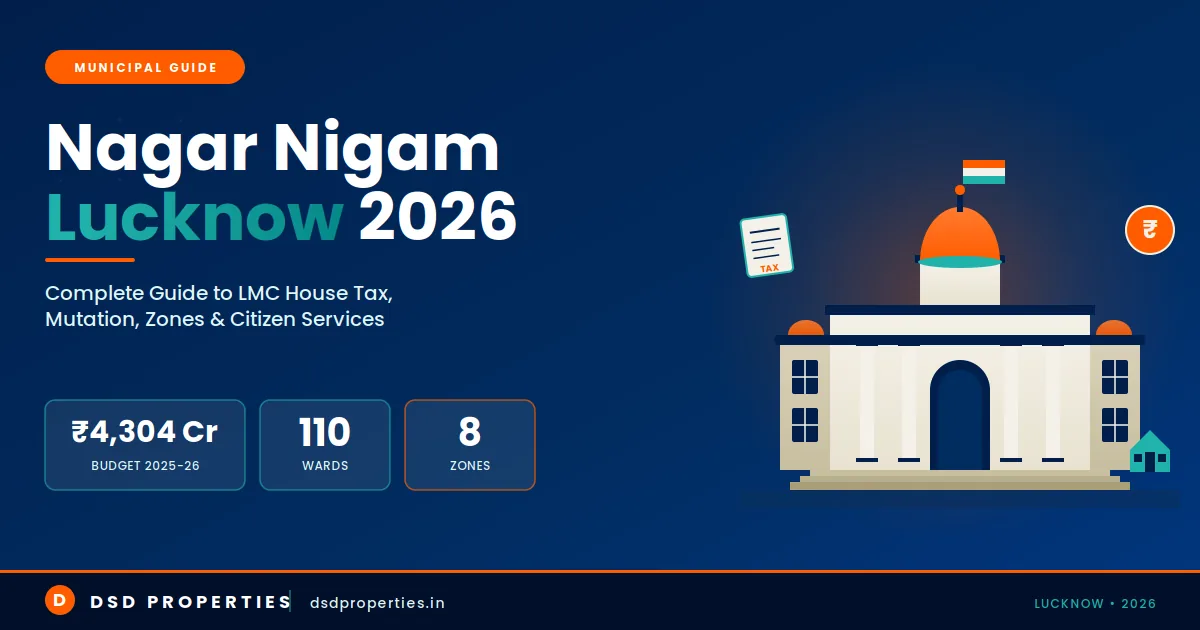
Nagar Nigam Lucknow 2026: House Tax, Mutation, Zones & Services — Complete Guide
If you own a house, plot, or shop anywhere inside Lucknow city limits, one government body decides how much property tax you pay, whether your ownership record shows your name, whether your garbage gets picked up, and whether your building plan is approved — the Nagar Nigam Lucknow. Also called the Lucknow Municipal Corporation (LMC), it is the single largest civic authority in Uttar Pradesh's capital, running everything from house tax to birth certificates to street lights.
Yet most property buyers in Lucknow interact with Nagar Nigam only after something has gone wrong — a tax bill still coming in the previous owner's name, a mutation request stuck for months, or a garbage collection dispute at the front gate. This guide unpacks the entire Nagar Nigam Lucknow system for 2026 — what it does, how its 8 zones and 110 wards are structured, how house tax is actually calculated on lmc.up.nic.in, the full step-by-step online payment and mutation (namantaran) process, and the red flags every Lucknow property buyer should watch for.
What is Nagar Nigam Lucknow (Lucknow Municipal Corporation)?
Nagar Nigam Lucknow — officially the Lucknow Municipal Corporation, or LMC — is the elected civic body responsible for local governance in Lucknow, the capital of Uttar Pradesh. It was constituted in 1960 under the Uttar Pradesh Municipal Corporations Act, 1959, but its lineage goes back to the mid-19th century, when a Conservancy Committee was set up in 1858 to handle sanitation in post-Uprising Lucknow. Over the decades it has grown from a small colonial-era municipal committee into a corporation administering roughly 631 square kilometres and serving a population that has crossed 2.8 million.
The corporation has two parallel arms — an elected wing made up of the Mayor and 110 corporators (parshads), and an administrative wing led by an IAS-cadre Municipal Commissioner (Nagar Ayukta) supported by Additional, Deputy, and Assistant Commissioners plus zonal officers. In simple terms, the elected wing sets policy and approves budgets, while the administrative wing implements them on the ground. Both sides sit inside the main headquarters at Trilokinath Marg, Lalbagh, opposite the well-known Lalbagh area landmarks — a location most Lucknow residents can navigate to easily.
Current leadership (2026)
The mayor is the "first citizen" of Lucknow and heads the general house of corporators. Sushma Kharkwal from the Bharatiya Janata Party has been Mayor since 26 May 2023, after winning the 2023 civic election by a record margin against the Samajwadi Party candidate Vandana Mishra. She is the second woman to hold the post after Sanyukta Bhatia. On the executive side, IAS Gaurav Kumar is the current Nagar Ayukta (Municipal Commissioner), responsible for day-to-day administration, revenue collection, sanitation contracts, and inter-departmental coordination.
What LMC actually does for you
LMC's core mandate covers roughly seven functions that touch every property owner directly:
Property (House) Tax Collection
Annual tax on every residential, commercial, industrial, and vacant plot within the LMC area. This is the single biggest touchpoint most owners have with Nagar Nigam.
Solid Waste Management
Door-to-door garbage collection, sweeping, transportation to processing plants, and monthly user charge on every household under Swachh Bharat guidelines.
Roads, Drains & Street Lights
Construction and maintenance of internal roads, storm-water drains, footpaths, subways, LED street lighting and flyovers inside the municipal boundary.
Birth & Death Certificates
Every birth and death registered inside LMC limits is recorded here — the certificate you get from Nagar Nigam is the legal proof used for passport, school, insurance and property inheritance.
Trade Licences & Advertisement Permissions
Any shop, restaurant, clinic, or commercial signboard inside Lucknow needs a trade licence from LMC; hoardings and glow signs need a separate advertisement permission.
Property Mutation (Namantaran)
Once you buy or inherit a property that falls under LMC jurisdiction (not LDA and not agricultural land), the ownership change has to be recorded in the house-tax register — this is the mutation.
The 8 Zones and 110 Wards of Nagar Nigam Lucknow
To handle a city as sprawling as Lucknow, Nagar Nigam is decentralised into 8 administrative zones, and each zone is further divided into wards — with the total ward count now standing at 110 after the 2022 delimitation added 12 new wards. Every zone has its own Zonal Office headed by a Zonal Officer (usually an ACP-rank officer for LMC purposes), and it is at this zonal office that most property tax queries, mutation applications, and complaints have to be filed in person.
The eight zones are organised roughly on geographic lines and correspond to the older Lucknow neighbourhoods and the newer expansion belts:
| Zone | Broad Coverage Area (indicative) |
|---|---|
| Zone 1 | Old Lucknow — Chowk, Nakhas, Aminabad, parts of Yahiaganj |
| Zone 2 | Aishbagh, Rajajipuram, parts of Alambagh |
| Zone 3 | Aliganj, Mahanagar, Nirala Nagar, IT Chauraha belt |
| Zone 4 | Gomti Nagar, Gomti Nagar Extension, Vibhuti Khand, Vinay Khand |
| Zone 5 | Indira Nagar, Faizabad Road belt, Chinhat, Vikas Nagar |
| Zone 6 | Balaganj, parts of Old City and trans-Gomti fringe wards |
| Zone 7 | Sarojini Nagar, Kanpur Road corridor, Ashiana |
| Zone 8 | Newly-included peripheral wards after LMC boundary expansion |
How zones affect your house tax
Zones matter because the Unit Area Value used to compute your Annual Rental Value differs by zone. A 1,000 sq ft flat in a Zone 4 locality like Gomti Nagar will typically be assessed at a higher unit-area rate than an identical flat in a peripheral Zone 7 or Zone 8 ward. The same logic applies to commercial buildings — a shop in a Hazratganj-adjacent Zone 1 ward is generally in a higher tax bracket than an equivalent shop in an outlying colony.
Nagar Nigam Lucknow House Tax: How It Is Calculated in 2026
House tax — also called property tax or municipal tax — is the annual levy that every property owner inside LMC limits has to pay. It funds nearly everything the corporation does, from sweeping your street to maintaining the flyover you drive on. The tax applies to residential houses, apartments, shops, offices, industrial units, and even vacant plots. Only genuinely exempt properties — government buildings, recognised places of worship run by charitable trusts, and certain registered non-profits — are outside the net.
The core formula
Nagar Nigam Lucknow uses the Annual Rental Value (ARV) method, which is essentially a percentage of the notional annual rent your property could earn if rented in the open market — regardless of whether you actually rent it out or self-occupy it. The master formula is:
Where the total tax rate breaks down as:
• General Tax — 15% of ARV
• Water Tax — 12.5% of ARV
• Sewer Tax — 3% of ARV
Combined effective rate on ARV = up to 30.5% for a property connected to both LMC water and sewer.
The ARV itself is computed as: ARV = Built-up Area (sq ft) × Unit Area Value (per sq ft per month) × 12 months. The Unit Area Value is set zone-wise and property-use-wise by LMC and is the number that most property owners never actually see — but it is what drives the whole calculation.
A worked example
Suppose you own a self-occupied 1,200 sq ft flat in Vinay Khand, Gomti Nagar (Zone 4). If the applicable Unit Area Value for residential use in that zone is roughly ₹4.50 per sq ft per month (indicative), then:
- Monthly notional rent = 1,200 × ₹4.50 = ₹5,400
- ARV = ₹5,400 × 12 = ₹64,800
- General Tax @ 15% = ₹9,720
- Water Tax @ 12.5% = ₹8,100
- Sewer Tax @ 3% = ₹1,944
- Gross annual tax before rebates = ₹19,764
Rebates for occupancy age and category can bring this down significantly, which we cover in the next section. And remember — these are indicative figures for illustration; your actual bill on lmc.up.nic.in against your House ID is the only number that legally matters.
Factors that push your ARV up or down
Location zone
Prime Gomti Nagar, Hazratganj and Aliganj wards are taxed higher than fringe wards under Zones 7 and 8.
Property usage
Commercial and mixed-use properties attract a higher unit-area value than pure residential; industrial is a separate bracket.
Built-up area
Larger built-up area = larger ARV. LMC uses the covered constructed area, not the plot area or the carpet area.
Age & construction type
Newer, RCC-framed buildings are assessed higher; older properties and inferior construction get depreciation adjustments.
How to Pay Nagar Nigam Lucknow House Tax Online
The good news is that Nagar Nigam Lucknow has been running online house tax collection since 2005 — much before most municipal bodies in India digitised. Today, over 90 percent of house-tax transactions in Lucknow happen through the LMC portal or the Lucknow One mobile app, and you can complete the whole process in about 5–7 minutes. Here is the exact sequence:
Offline payment option
If you prefer paying offline, you can walk into your zonal Nagar Nigam office or one of the authorised bank counters (SBI, HDFC, ICICI, PNB). Carry your last-year's receipt, House ID, and a valid photo ID. The cashier will generate an offline receipt against your House ID — keep this stapled with the previous year's receipts. Note that the rebate percentage for offline payment is slightly lower than for online payment in most rebate cycles.
Rebates, Discounts and Occupancy Concessions
Paying your Nagar Nigam house tax early or falling into a special category can meaningfully reduce your annual outgo. LMC publishes the specific rebate window every financial year, but the broad structure has stayed consistent for several years. Here is the current 2026 picture:
Early payment rebate
Property owners who clear their entire annual tax within the first quarter of the financial year — typically before the end of June — get a rebate that has ranged between 5% and 10%. Online payers usually get a slightly better rebate (up to 10%) than offline payers (around 8%). LMC has also run periodic One Time Settlement (OTS) schemes for property owners with old arrears, waiving off interest and penalty in return for full payment of the principal within a set window.
Occupancy-based rebate
The longer you have owned and occupied the property, the more depreciation LMC allows. Broadly:
| Continuous Occupancy | Rebate on House Tax |
|---|---|
| Up to 10 years | 25% |
| 10 to 20 years | 32.5% |
| More than 20 years | 40% |
Category-based concessions
Additional rebates and concessions are periodically extended by the LMC House to specific categories — senior citizens, women property owners (properties registered in a woman's name), differently-abled owners, ex-servicemen, and war widows. Newer notifications since late 2025 have also proposed eco-friendly building rebates for properties with solar panels and rainwater harvesting installations. You must apply for these separately at your zonal office with proof — the rebate is not applied automatically at the portal.
Property Mutation (Namantaran) at Nagar Nigam Lucknow
This is where most Lucknow property buyers get confused. Nagar Nigam Lucknow handles mutation only for a specific category of properties — and applying at the wrong authority is the single most common reason mutation requests get delayed for months. Here's the split every buyer must internalise before applying anywhere:
Agricultural & rural land
Villages under Malihabad, Mohanlalganj, Bakshi Ka Talab, Kakori tehsils — mutation is done by the Tehsildar under UP Revenue Code Section 34, on upbhulekh.gov.in.
LDA-allotted properties
Properties inside LDA schemes — Gomti Nagar, Vrindavan Yojna, Kanpur Road, Anant Nagar, Lake View Apartments — mutation happens at the LDA office in Gomti Nagar, not at Nagar Nigam.
LMC-jurisdiction urban property
Independent houses in non-LDA colonies, older private colonies, resale flats, and shops inside the LMC boundary — mutation is done at the LMC zonal office where your property falls.
Awas Vikas Parishad properties
UPAVP-allotted properties (like Vrindavan Yojna Sectors administered by Awas Vikas) — mutation is done at the Awas Vikas Parishad office, not Nagar Nigam.
Documents required for LMC mutation
- Registered sale deed (bainama) with e-stamp and SRO endorsement
- Previous house tax receipts of the seller (to prove no arrears)
- PAN and Aadhaar of the new owner (buyer)
- Photograph of the new owner
- Mutation application form (available at zonal office and on portal)
- Affidavit on ₹10 stamp paper (in case of inheritance / gift mutation)
- Death certificate + legal heir certificate (in case of inheritance)
Step-by-step mutation process
The end-to-end LMC mutation typically closes in 45 to 90 days if the paperwork is clean. Rural mutation (Tehsildar) and LDA mutation follow different timelines and formats. For a complete walk-through of all three tracks, see our detailed Dakhil Kharij Lucknow guide.
Other Key Services Nagar Nigam Lucknow Provides
Beyond house tax and mutation, LMC is a full-spectrum civic authority. Some services you may not realise fall within its ambit:
Birth and death certificates
Every birth and death that occurs inside LMC city limits — whether in a private hospital, government hospital, or at home — must be registered with Nagar Nigam. Apply through lmc.up.nic.in under "Citizen Services → Birth/Death Certificate". For hospital-based events, most large Lucknow hospitals now forward the registration to LMC automatically. The certificate is downloadable as a PDF once issued, and is the primary legal document required for passport applications, insurance claims, school admissions, and property succession.
Trade licence
Any business establishment — shop, restaurant, clinic, godown, salon, coaching centre — operating inside LMC limits legally requires a trade licence renewable annually. The licence is issued zone-wise and is checked during enforcement drives. Coming into 2026, LMC has been steadily tightening enforcement, and unlicensed establishments face sealing risk.
Advertisement and hoarding permissions
Every glow sign, hoarding, or wall painting on private property that faces a public street needs LMC advertisement tax paid. Illegal hoardings are periodically brought down in drives, and the penalty can exceed the licence fee several times over.
Solid waste management and user charge
LMC, working with the Lucknow Swachhata Abhiyan (LSA), runs door-to-door garbage collection across all 8 zones with GPS-tracked vehicles and RFID readers at access points. Every household pays a monthly user charge (₹50–₹100 for households, higher for shops and restaurants). A dedicated Material Recovery Facility in Gomti Nagar (Zone 4) handles segregated recovery and recycling. If a private contractor demands extra money over and above the online-paid user charge, LMC has a direct Mayor's helpline at 6389200005 for complaints.
Community welfare
LMC also runs schemes for free education (up to age 12 for below-poverty-line children with meals and clothes), heritage preservation for iconic Lucknow structures like the Rumi Darwaza and Chota Imambara precincts, and city development plans in association with central schemes like AMRUT, Smart Cities Mission, and PM Awas Yojana (Urban) — for which LMC maintains the para-wise final beneficiary list on its portal.
Red Flags Every Lucknow Property Buyer Should Know
Now to the part every DSD Properties client asks us about. Nagar Nigam records don't just tell you who owns a property today — they can also expose disputes, arrears, unauthorised construction, and legacy problems that would otherwise catch a buyer only after registry. Here are the specific things to check on lmc.up.nic.in before you pay any advance:
Lucknow One App and Digital Push in 2026
Nagar Nigam's digital layer has grown well beyond the lmc.up.nic.in portal. The Lucknow One App is the corporation's consumer-facing mobile app that consolidates most citizen services into one interface — house tax view and payment, garbage collection user charge, birth and death certificates, e-vehicle registration, grievance registration, and more. Subsidies and incentives have periodically been offered to boost adoption.
How to File a Complaint with Nagar Nigam Lucknow
Whether it's a broken street light, garbage pickup missed for three days, illegal encroachment on a footpath, or a wrong house-tax bill, Nagar Nigam has multiple grievance channels. In practice, the ones that actually work are:
- General helpline: Dial 1533 — free from any Lucknow landline or mobile. This is the fastest first-touch for most civic complaints.
- Toll-free number: 1800-180-0522 — LMC citizen services helpdesk.
- Mayor's office direct helpline: 6389200005 — especially useful if a private sanitation contractor is over-charging or misbehaving.
- Official email: nnlko@nic.in — creates a written trail if you need one for later escalation.
- Online grievance: lmc.up.nic.in → Citizen Grievance module. You get a complaint ID to track status.
- Lucknow One App: One-tap complaint registration with location auto-tagging.
- Walk-in: Your zonal office (or headquarters at Trilokinath Marg, Lalbagh) for issues that need in-person paperwork or hearing.
How DSD Properties Helps You Navigate Nagar Nigam
Related guides you should read next
Frequently Asked Questions about Nagar Nigam Lucknow
What is the difference between Nagar Nigam Lucknow and LDA?
Nagar Nigam Lucknow (LMC) is the civic body that runs the city — house tax, sanitation, birth/death certificates, roads inside its area, and mutation of properties in non-LDA colonies. Lucknow Development Authority (LDA) is a separate parastatal body that plans and develops housing schemes — Gomti Nagar, Vrindavan Yojna, Anant Nagar, Kanpur Road schemes — and handles allotment, building plan approvals, and mutation for its own schemes. LMC and LDA operate side by side but have distinct jurisdictions.
What is the official website of Nagar Nigam Lucknow?
The official Nagar Nigam Lucknow portal is lmc.up.nic.in. It hosts house tax payment, mutation applications, birth and death certificate services, trade licence, grievance registration, and downloadable budget and audit reports. Always ensure you are on the lmc.up.nic.in domain — impostor sites do surface periodically.
Who is the current Mayor of Lucknow?
Sushma Kharkwal of the Bharatiya Janata Party is the current Mayor of Lucknow. She assumed office on 26 May 2023 after winning the 2023 LMC election by a record margin, and is the second woman to serve as Lucknow's Mayor after Sanyukta Bhatia. The Municipal Commissioner (Nagar Ayukta) is IAS Gaurav Kumar.
How do I find my House ID on the LMC portal?
Visit lmc.up.nic.in and use the "Know Your House Tax" or "House Tax Search" option. You can search by owner name, ward number and house number combination, or property address. The system displays your unique House ID (Property Unique Code) along with your assessed ARV and outstanding tax. Save this House ID — every subsequent transaction with LMC uses it.
What happens if I don't pay Nagar Nigam house tax on time?
Late payment attracts interest — commonly around 1% per month on the outstanding amount — and forfeits your eligibility for the early-payment rebate that can be up to 10%. Prolonged default can lead to formal demand notices, property attachment proceedings, and in severe cases sealing under LMC recovery rules. Timely payment is much cheaper.
How much is the mutation fee at Nagar Nigam Lucknow?
The standard mutation fee for a sale-based ownership change at LMC is approximately 1% of the property's registration cost, with a common ceiling of around ₹5,000 for straightforward name-change mutations. Inheritance and gift mutations follow separate fee schedules. Always confirm the exact current fee on lmc.up.nic.in or at your zonal office before paying, as slab revisions do happen.
How many zones and wards does Nagar Nigam Lucknow have?
Nagar Nigam Lucknow is organised into 8 administrative zones, and further into 110 wards after the 2022 delimitation added 12 new wards to the earlier 100. Each ward elects one corporator (parshad) in the quinquennial civic election. Every property's zone determines its Unit Area Value for house tax calculation.
Is the LMC house tax receipt required for property sale?
Yes. During resale, both the buyer's lawyer and any home-loan sanctioning bank will ask for the last 3–5 years of house tax receipts as proof that no arrears exist. The buyer's subsequent mutation application at LMC also requires the seller's clean tax history. Retain digital and printed copies of every year's receipt.
Where can I file a complaint against Nagar Nigam Lucknow?
Use the general helpline 1533, toll-free 1800-180-0522, the Mayor's direct complaint number 6389200005 (specifically for sanitation over-charging), email nnlko@nic.in, the online grievance module on lmc.up.nic.in, or the Lucknow One mobile app. For matters needing formal hearing, walk into your zonal office or the headquarters at Trilokinath Marg, Lalbagh.
Does Nagar Nigam Lucknow give any tax exemption to women property owners?
Yes, LMC periodically extends targeted rebates to women property owners whose self-occupied residential property is registered in their name. The exact percentage is notified in the annual house-tax circular and typically stacks on top of the general early-payment rebate. Senior citizens, differently-abled owners, ex-servicemen, and war widows have their own concession slabs. All category concessions must be applied for separately at the zonal office with proof documents — they are not applied automatically at the online portal.
Where is the Nagar Nigam Lucknow head office located?
Nagar Nigam Lucknow head office is located at Trilokinath Marg, Lalbagh, Lucknow — 226001, Uttar Pradesh. The office is centrally accessible from Hazratganj, Charbagh, and most old-city localities. Working hours are typically 10 AM to 5 PM on all working days, though several citizen-services counters follow a slightly extended window.
Leave a Comment