
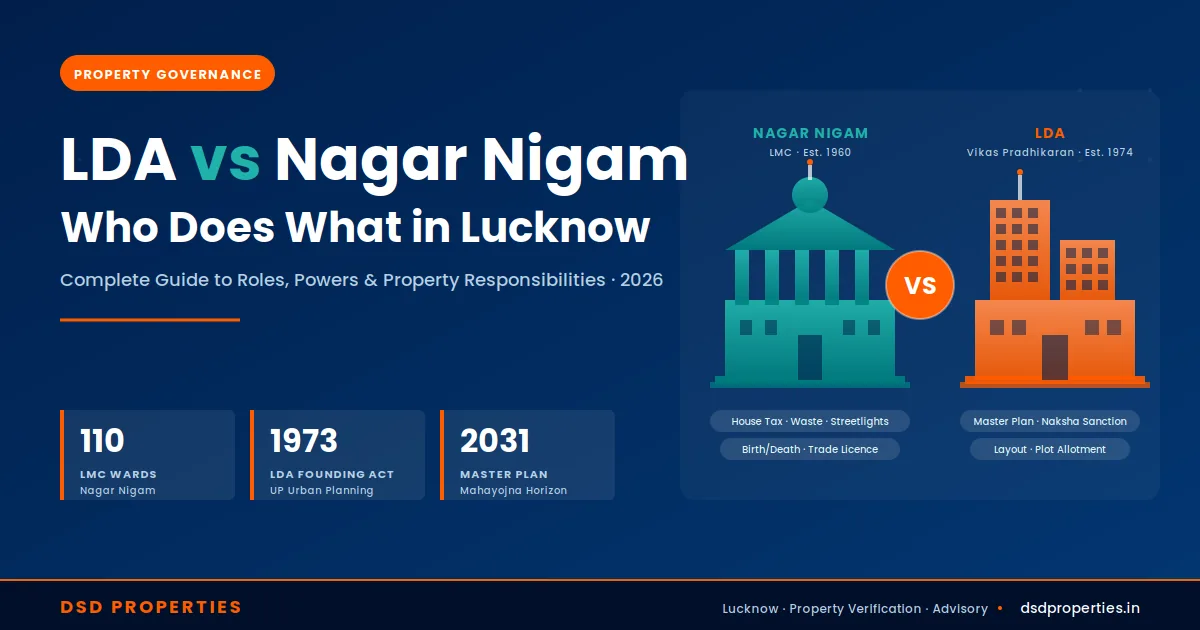
LDA vs Nagar Nigam Lucknow 2026 — Complete Guide to Roles, Powers & Property Responsibilities
Every Lucknow property owner runs into this confusion sooner or later. A house tax notice arrives and you assume it is from LDA. Your colony street light stops working and you write to LDA, only to be told it is a Nagar Nigam matter. You want to get a building map sanctioned and end up standing in queues at the Lalbagh LMC office for three days before someone points you towards Vipin Khand, Gomti Nagar. Both authorities exist. Both matter. But they do very different jobs.
The short version is this: Nagar Nigam runs your daily city life — house tax, garbage, drains, street lights, birth and death certificates. LDA controls how the city grows — the Master Plan, land use, building approvals, plot allotment schemes and freehold conversion. The same property often falls under both, at different times and for different reasons. This 2026 guide explains exactly which authority does what, where the two overlap, and how to walk into the right office the first time so you do not lose weeks doing rounds of the wrong desk.
🧭 The Short Version — Read This First
- Nagar Nigam (LMC) is an elected civic body under the 74th Constitutional Amendment. It handles day-to-day city services and collects your house tax.
- LDA is a state-appointed development authority under the UP Urban Planning and Development Act, 1973. It plans and regulates how Lucknow grows.
- Same property, two authorities: your LDA-built flat in Gomti Nagar pays house tax to Nagar Nigam, but any transfer or freehold conversion goes through LDA.
- Rule of thumb: if the question is "how do I live here?" — it is Nagar Nigam. If the question is "what can I build here?" — it is LDA.
- Get the authority wrong, and you can waste weeks on an application that will simply be rejected by the office that had no jurisdiction to accept it.
What is Nagar Nigam (Lucknow Municipal Corporation)?
The Lucknow Municipal Corporation (LMC), called Lucknow Nagar Nigam in Hindi, is the elected civic body responsible for administering Lucknow city. It was formed in 1960 under the UP Municipal Corporations Act, 1959, and today draws its constitutional authority from the 74th Constitutional Amendment Act of 1992, which made Urban Local Bodies a formal third tier of Indian governance. LMC covers a municipal area of roughly 631 square kilometres, divided into 110 elected wards. Each ward elects a corporator (parshad) for a five-year term. The city as a whole elects a Mayor (Nagar Pramukh), while the day-to-day administration is run by a Municipal Commissioner appointed by the state government — typically an IAS officer.
The current Mayor is Sushma Kharakwal, who took office on 26 May 2023. The Corporation passed a budget of ₹4,304 crore for FY 2025–26, its largest ever. Its head office is at Lalbagh, and its official portal — lmc.up.nic.in — is the single point of entry for property tax, mutation, birth and death certificates, trade licences and grievance complaints. In simple terms, if the service touches your daily life inside city limits, LMC is the authority responsible for delivering it.
Property Tax (House Tax) Collection
LMC is the sole authority for collecting property tax on residential, commercial and vacant properties inside municipal limits — including LDA-built flats. Tax is calculated on Annual Rental Value using self-assessment (Prapatra-Ka).
Solid Waste Management
Door-to-door garbage collection, segregation, transportation and disposal are LMC's responsibility under the Solid Waste Management Rules, 2016. User charges for waste pickup are also collected by LMC.
Municipal Roads, Drains & Street Lights
LMC builds and maintains internal city roads, storm-water drains, footpaths and street lighting. It runs one of the largest street-light networks in the state, with ongoing smart-monitoring upgrades.
Sewerage & Sanitation
LMC handles sewer network maintenance and public sanitation. Bulk water supply and sewerage treatment for the city are actually operated by the Lucknow Jal Sansthan and UP Jal Nigam — related but separate agencies.
Birth & Death Certificates
Registering births and deaths that occur inside LMC limits, and issuing the certificates, is a Nagar Nigam function under the Registration of Births and Deaths Act. This is the certificate most people first interact with LMC for.
Trade Licences & Hoardings
Shops, small factories, restaurants, hotels and outdoor advertising hoardings inside city limits require LMC trade or advertisement licences — a routine but often overlooked requirement.
Slum Development & Public Health
Slum upgradation, community health drives, mosquito control, stray dog management, and basic amenity provision in unauthorised settlements fall under LMC's public health department.
Mutation of Non-LDA Urban Properties
For independent houses and non-LDA colonies inside city limits, mutation (namantaran) of the property tax register happens at the LMC zonal office. LDA-allotted properties, by contrast, mutate through LDA — not LMC.
What is the Lucknow Development Authority (LDA)?
The Lucknow Development Authority — Lucknow Vikas Pradhikaran — is the state-appointed planning and development body that shapes how Lucknow physically grows. It was established under the Uttar Pradesh Urban Planning and Development Act, 1973, one of the most important pieces of urban legislation in the state. LDA is not an elected body. It is governed by a Board chaired by the Commissioner, Lucknow Division (who acts as the ex-officio Chairman), with a Vice-Chairman — a senior IAS officer — running day-to-day operations. Its head office is at Vipin Khand, Sector 38A, Gomti Nagar. The official portal is ldalucknow.in.
LDA's jurisdiction is not the same as LMC's ward map. It extends over a planned development area that covers the municipal limits and a large ring of villages beyond. Around 197 villages currently fall inside LDA's planning area — everything outside that is either Zila Panchayat territory or non-LDA state land. The single document that anchors everything LDA does is the Master Plan Lucknow 2031 (Mahayojna 2031), sanctioned by the Town and Country Planning Department (TCPD) in 2016 under Section 11 of the 1973 Act. If Nagar Nigam is about running the city, LDA is about designing it.
Master Plan Preparation & Enforcement
LDA prepares and enforces the Lucknow Master Plan, currently Mahayojna 2031. It divides the city into residential, commercial, mixed-use, industrial, transport, green and agricultural zones — the map that decides what can be built where.
Land Use Zoning & Change of Land Use
Every plot inside LDA's area sits under a designated land use. Converting a plot from one use to another (e.g., agricultural to residential, or residential to mixed-use) requires a formal LDA approval — Nagar Nigam has no role in this.
Building Plan Approvals (Map Sanction)
Any new building, extension or rebuild inside LDA jurisdiction requires a sanctioned map from LDA's Building Plan Approval System. This is what people call "naksha pass karana." Constructing without LDA sanction inside its area is illegal.
Layout Approvals for New Colonies
Private developers who plan new colonies inside LDA's area must obtain a sanctioned layout showing roads, drains, parks and plot sizes. Without an LDA-approved layout, a colony is unauthorised — the exact issue behind the LDA Illegal Colony List.
Housing Schemes & Plot Allotment
LDA launches its own residential schemes — Anant Nagar (Sultanpur Road), Vrindavan Yojna, Kanpur Road Yojna, Gomti Nagar Extension — through public lotteries and E-auction. Land acquisition, layout planning, and allotment all sit with LDA, not LMC.
Mutation of LDA-Allotted Properties
When you buy or inherit an LDA flat or plot, the transfer of records happens at the LDA office, not the Tehsildar or LMC. LDA maintains its own allotment register, separate from LMC's property tax register.
Freehold Conversion & Nazul Land Management
Converting leasehold LDA property to freehold, and managing Nazul (state-vested) land parcels inside the LDA area, are both LDA functions. These are important for older LDA colonies where the original allotment was on a 99-year lease.
Major Parks, PMAY & Illegal Colony Action
Landmark projects — Janeshwar Mishra Park, Ambedkar Park, riverfront development — sit with LDA. It also implements PMAY (Urban) for planned affordable housing, and takes demolition action against colonies on its illegal list.
LDA vs Nagar Nigam — Function-by-Function Comparison
This is where the confusion usually clears up. Instead of comparing the two bodies as institutions, compare them by the actual task in front of you. Nine times out of ten, the correct authority becomes obvious the moment you name the task:
| Task / Question | Nagar Nigam (LMC) | LDA |
|---|---|---|
| Pay house / property tax | ✅ Sole authority | ❌ No role |
| Get building map (naksha) sanctioned | ❌ No role in LDA area | ✅ Building Plan Approval System |
| Sanction a new colony layout | ❌ No role | ✅ Layout approval + Master Plan check |
| Buy an LDA scheme plot or flat | ❌ No role | ✅ Lottery, allotment, E-auction |
| Change land use (e.g., residential → mixed) | ❌ No role | ✅ Master Plan amendment |
| Get garbage picked up / complain about waste | ✅ Solid Waste Management | ❌ No role |
| Fix a broken street light | ✅ Municipal function | ❌ (except undeveloped LDA layouts) |
| Broken road inside a colony | ✅ Once colony is handed over | ✅ Only until handover |
| Blocked drain / sewer overflow | ✅ LMC + Jal Sansthan | ❌ No role |
| Register a birth or death | ✅ Sole authority | ❌ No role |
| Get a shop / trade licence | ✅ Municipal function | ❌ No role |
| Advertisement hoarding permission | ✅ Municipal function | ❌ No role |
| Mutation of an LDA-allotted flat | ❌ Only property tax record | ✅ LDA transfer file |
| Mutation of an independent house in Aliganj | ✅ LMC zonal office | ❌ No role |
| Freehold conversion of LDA property | ❌ No role | ✅ LDA freehold cell |
| Check if a colony is legal / illegal | ❌ No jurisdiction | ✅ LDA approved & illegal list |
| Demolition of an unauthorised structure | Partial (encroachments) | ✅ Primary — Master Plan violations |
| Manage a slum settlement | ✅ Public health & upgrade | Partial (planning support) |
| Access PMAY (Urban) housing | Some component schemes | ✅ LDA is nodal for its schemes |
| Complain about a public park | ✅ Local city parks | ✅ Marquee parks (Janeshwar Mishra etc.) |
Notice the pattern: LMC's column is heavy on services, LDA's column is heavy on permissions. If you ever forget the split, that one distinction — services vs permissions — will get you to the right desk more often than not.
The Overlap Zones — Where People Actually Get Confused
The theory looks tidy. Real life is messier because a single property often touches both authorities at different points in its life. These are the four overlap zones where Lucknow buyers, owners and NRIs most commonly get stuck:
⚠️ Overlap 1 — LDA-Built Flats in Gomti Nagar, Vrindavan Yojna, Anant Nagar
The flat was built and allotted by LDA. But once you take possession and start living in it, your annual house tax is paid to LMC, garbage is collected by LMC, and street lights are maintained by LMC. Meanwhile, if you sell the flat or want to gift it to your children, the transfer file goes to LDA. Two authorities, one flat — it is not a bug, it is the design.
⚠️ Overlap 2 — New Colony Handover From LDA to LMC
When LDA develops a new sector, it builds the internal roads, drains and parks, and hands them over to LMC for long-term maintenance — usually after a defect liability period. Between "developed" and "handed over" is a grey window where residents write to LMC and LMC says it is still an LDA responsibility, or vice versa. Always check with the local RWA (Resident Welfare Association) which stage your colony is at before filing a complaint.
⚠️ Overlap 3 — Unauthorised Colonies Inside LMC Limits
An illegal colony inside city limits sits in a strange no-man's-land. LDA identifies it as unauthorised (Master Plan violation) and can order demolition. But LMC still collects house tax if the property is registered in its tax database, because tax collection is not the same as approval. Buyers see the LMC tax receipt and mistakenly conclude the colony is legal. It is not.
⚠️ Overlap 4 — Rural Land Just Outside LDA's 197 Villages
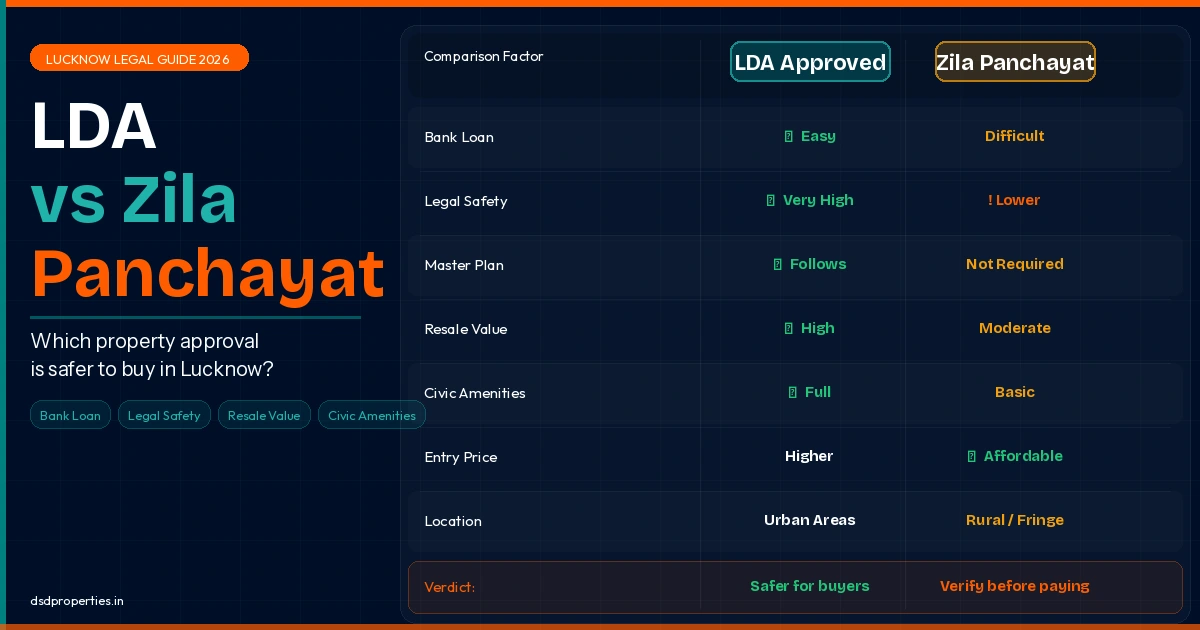
If your plot is in a village outside the ~197 LDA villages, neither LDA nor LMC is your primary authority. Layout approvals there fall to the Zila Panchayat, land records are with the Tehsildar (Revenue Department), and building bye-laws come under state Model Building Bye-Laws applied via the Zila Panchayat. Applying to LDA or LMC for these plots is an instant rejection.
Special Cases — Which Desk Do You Walk Into?
You bought a resale LDA flat in Gomti Nagar
Mutation of the LDA allotment record → LDA office, Vipin Khand. Mutation of the LMC property tax register → LMC zonal office. Both are needed. Skipping either creates trouble at resale or during a home loan a few years later.
You inherited an independent house in Aliganj / Indira Nagar
The house was never an LDA allotment. Mutation happens at LMC (property tax register) based on your legal heir certificate and family tree. No LDA involvement.
You want to build a first floor on your existing house in Kanpur Road Yojna
You need a sanctioned building map from LDA before construction. Ground coverage, FAR and setback rules are set by LDA's building bye-laws. LMC has no role in the sanction — but the completed structure will still be assessed for house tax by LMC.
You want to open a shop in a residential ground floor in Jankipuram
Two separate approvals. First, check whether the land use permits shops under the Master Plan (mixed-use vs pure residential) — that is an LDA question. Second, once permitted, you still need an LMC trade licence to run the shop legally.
You bought a "Zila Panchayat approved" plot on Kursi Road
Neither LDA nor LMC is your primary authority. The plot belongs to the Zila Panchayat + Tehsildar system. LDA's Master Plan may still restrict some uses if the village is inside LDA's 197. LMC has no role until the area is later brought inside its municipal limits — which may or may not happen.
You want to convert your leasehold LDA plot to freehold
Freehold conversion is purely an LDA function. LMC has no role here. Once freehold, the plot's title becomes cleaner and future transfers are simpler.
How DSD Properties Helps
Getting to the right authority the first time
Most of the time wasted in property matters in Lucknow is not because a rule is complex — it is because a buyer walked into the wrong office. Nagar Nigam cannot sanction a building map even if the counter clerk feels bad for you. LDA cannot issue a birth certificate. A wrong application costs you weeks and often the fees paid to the wrong department too.
- Authority-mapping — we tell you exactly which of LDA, LMC, Zila Panchayat or Tehsildar you need for the specific task at hand.
- LDA layout & illegal-colony cross-check — we verify whether your target property sits inside a sanctioned LDA layout, or on the illegal-colony list.
- LMC house-tax history check — we pull up the tax register status so you do not inherit years of pending dues from the previous owner.
- Documented ₹5,000 verification report in 48 hours — jurisdiction, layout, land use, LDA + LMC records, title chain, mutation and pending dues in one PDF.
- Preliminary WhatsApp check — free before you decide to book a full verification.
Leave a Comment