
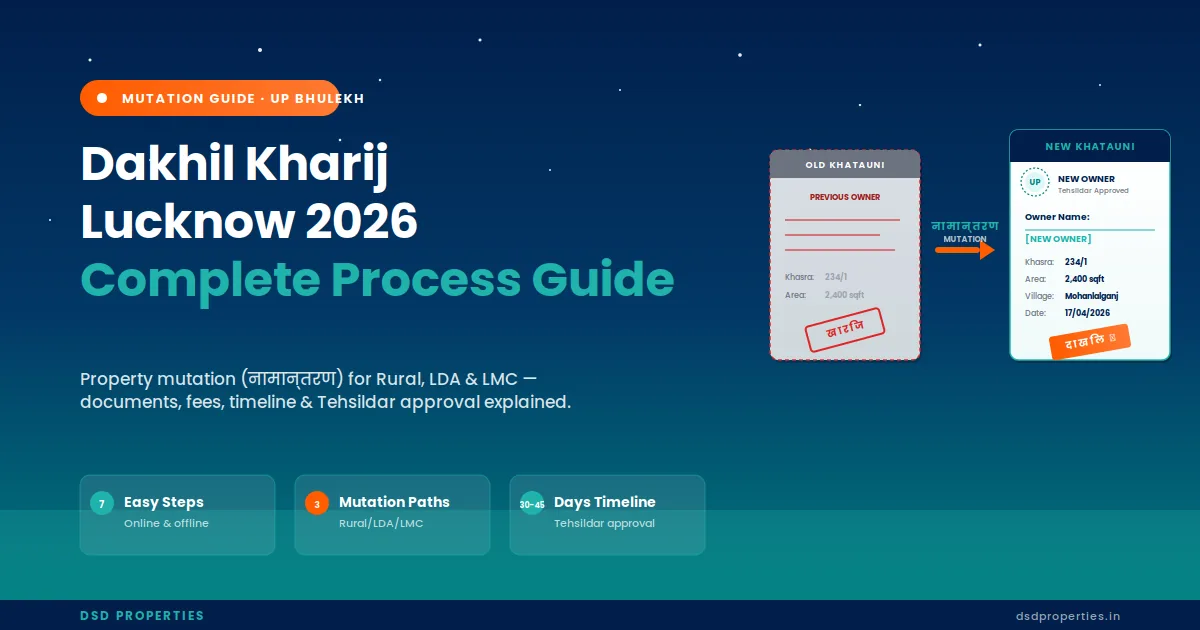
Dakhil Kharij Lucknow 2026 — Complete Property Mutation (Namantaran) Process Guide
Sources: UP Bhulekh (upbhulekh.gov.in), UP Revenue Code 2006 (Section 34/35), vaad.up.nic.in (Revenue Court System), Board of Revenue UP, Lucknow Municipal Corporation, Lucknow Development Authority — April 2026
🧭 Quick Navigation
🔴 Why Registry Alone is Not Enough — The Missing Step
- Registry Proves Transfer, Mutation Makes it Official — A registered sale deed legally proves a property changed hands, but without Dakhil Kharij the previous owner's name continues to appear in the Khatauni and municipal tax records. Government records still treat the seller as the owner.
- Tax Notices Come to the Seller, Loans Blocked for the Buyer — Until mutation is complete, property tax notices, utility bills, and government acquisition notices continue to reach the seller. Banks often refuse home loans against a property where buyer's name is not in the Khatauni.
- Resale Becomes Impossible Without Mutation — When you later try to sell the property, the next buyer will check the Khatauni and see the previous owner's name instead of yours. This is the most common reason resale transactions stall in Lucknow.
What is Dakhil Kharij? (Namantaran / Property Mutation)
Dakhil Kharij — also called Namantaran or mutation — is the legal process of updating government land records to reflect a new owner's name after property ownership changes hands. In Lucknow and across Uttar Pradesh, the process is governed by Section 34 and Section 35 of the UP Revenue Code, 2006. It is administered by the Revenue Department through the local Tehsildar for rural and agricultural land, and by the Lucknow Municipal Corporation (LMC) or Lucknow Development Authority (LDA) for urban properties.
The key distinction every Lucknow buyer must understand is this: registry and mutation are two separate processes. A registered sale deed (executed at the Sub-Registrar Office through IGRSUP) is the legal transfer. Mutation is the administrative follow-up that updates working government records — the Khatauni for rural land, the LDA master records for LDA flats, and the LMC property tax database for municipal properties. Both are required, but mutation is the step most Lucknow buyers either delay or skip entirely, creating serious problems years later.
The term Dakhil Kharij is Urdu-origin — Dakhil means "to enter" (the new owner's name is entered) and Kharij means "to remove" (the old owner's name is removed). It is the single most important step to establish that you, and not the previous owner, are the recognised owner in government working records.
Why Dakhil Kharij Matters — 6 Critical Reasons
Skipping property mutation in UP creates compounding problems. Here are the six real-world consequences Lucknow buyers face when Dakhil Kharij is delayed or never filed:
Consequences of Not Completing Namantaran in Lucknow
- Property tax liability stays on old owner — LMC continues sending tax notices and recovery proceedings to the seller, who may later dispute the sale
- Utility connections become difficult — New electricity meter, water connection, and gas line applications require mutation-updated proof of ownership
- Home loan refinancing blocked — Banks verify Khatauni owner name before sanctioning any loan against the property
- Future resale stalls — The next buyer's lawyer finds the old owner's name in revenue records and refuses to proceed until mutation is corrected
- Government acquisition compensation risk — If NHAI, UPSIDA, or other authority acquires the land, compensation is paid to whoever's name appears in the Khatauni — not necessarily the registered buyer
- Legal heir disputes on inherited property — Without mutation, siblings and distant relatives can later claim the property as unclaimed family asset
3 Mutation Paths in Lucknow — Which One Applies to You?
Lucknow is unique in that a property's mutation authority depends entirely on where it is located and what type of development it falls under. Choosing the wrong mutation path wastes weeks and often fees. Here are the three distinct paths:
Rural / Agricultural Land
Villages in Malihabad, Mohanlalganj, Bakshi Ka Talab, Kakori, rural Sarojini Nagar. Apply online on upbhulekh.gov.in or offline at Tehsildar office. Verified by Lekhpal, approved by Tehsildar under UP Revenue Code Section 34.
LDA Flats & Plots
Properties allotted by Lucknow Development Authority in Gomti Nagar, Sushant Golf City, LDA Kanpur Road schemes, Vrindavan Yojna, etc. Apply at LDA office in Gomti Nagar with transfer fee and LDA-specific application form.
LMC Urban Properties
Independent houses, non-LDA colonies, and resale flats in Lucknow Municipal Corporation area. Apply at LMC zonal office for property tax register mutation. Essential before utility and tax records update.
Step-by-Step Dakhil Kharij Process (Rural — UP Bhulekh Online)
For rural and agricultural land in Lucknow, the mutation process is largely digital. Here is the exact sequence:
Apply Within 45 Days of Registry
The ideal window to file mutation is 30–45 days after sale deed registration at the Sub-Registrar Office. Starting earlier than 30 days can cause delays as the registry record may not yet reflect in the Bhulekh system. Delaying beyond 90 days can complicate the process and occasionally trigger additional inquiry. Keep all original registry papers ready before starting.
📍 Ideal timing: 30–45 days after registry at SRO LucknowVisit UP Bhulekh Portal or Tehsil Office
For online application, visit upbhulekh.gov.in and navigate to the online mutation / Namantaran section. Alternatively, visit the local Tehsildar office — the correct one based on where the land is located (Malihabad, Mohanlalganj, Bakshi Ka Talab, Kakori, or rural Sarojini Nagar). The Revenue Court Management System at vaad.up.nic.in is used by officials to process your case once filed.
📍 Portals: upbhulekh.gov.in (apply) | vaad.up.nic.in (track case)Fill the Namantaran Application Form
The form requires: district (Lucknow), tehsil, village name, old Khatauni/Khasra number, new owner details, reason for mutation (sale, inheritance, gift, will, partition), date of transfer, and registered document number. Upload clear scans of all supporting documents — registered sale deed, previous Khatauni extract, Aadhaar of buyer and seller, PAN, property tax receipts, and photographs. All PDF scans must be under 2 MB each.
📍 Select correct reason: Sale deed, Inheritance, Gift deed, Partition, or WillPay the Mutation Fee
Rural mutation fees in UP typically range from ₹200 to ₹2,500 depending on property value and type of transfer. Some recent schedules list ₹10,000 for sale deed mutations and ₹5,000 for inheritance — confirm the current applicable fee with your Tehsildar office before paying. Payment accepted via UPI, net banking, debit card, or credit card on the Bhulekh portal. Save the payment receipt and application reference number.
📍 Fee varies: always confirm latest amount with Tehsildar before paymentLekhpal Verification & Field Inspection
The local Lekhpal (village revenue officer) is assigned your case and conducts a field verification. This may include a physical site visit, measuring the plot, confirming boundaries with neighbours, and checking that the seller's claim to the property is valid. The Lekhpal submits a report to the Tehsildar. This step typically takes 10–20 days depending on the workload of your tehsil.
📍 Be cooperative with Lekhpal visits — objections at this stage delay the processObjection Period & Public Notice
After Lekhpal verification, a public notice is issued (usually posted at the tehsil office and village chaupal) inviting any objections from neighbours, co-heirs, or claimants. The standard objection window is 15–30 days. If no objection is received, the mutation proceeds. If an objection is filed, the matter becomes a revenue court case handled through vaad.up.nic.in. Most genuine transactions clear this stage without objections.
📍 Objection window: 15–30 days — genuine transactions usually pass without issueTehsildar Final Approval & Khatauni Update
The Tehsildar reviews the Lekhpal report, any objections filed, and the supporting documents. If satisfied, the Tehsildar passes the mutation order under Section 34 of the UP Revenue Code. The updated Khatauni with your name now reflects on upbhulekh.gov.in within 7–10 days of approval. Download and save the mutation order — it is your proof of legal mutation and required for future property transactions.
📍 Verify update on upbhulekh.gov.in — your name should appear as current ownerRequired Documents for Dakhil Kharij in Lucknow
The documents required vary based on the reason for mutation. Here is a complete checklist by scenario:
For Sale Deed Mutation (Most Common)
- Registered sale deed (original + copy)
- Previous Khatauni extract showing seller as current owner
- Buyer's Aadhaar and PAN card
- Seller's Aadhaar and PAN card
- Latest property tax receipt
- Passport-size photograph of buyer
- Stamp duty payment receipt and e-stamp certificate
- Mutation application form (signed)
For Inheritance Mutation (Property After Death of Owner)
- Death certificate of the deceased owner
- Legal heir certificate or succession certificate from competent court
- Family tree / vanshavali certified by Lekhpal or Gram Pradhan
- Aadhaar and PAN of all legal heirs
- No Objection Certificate from all other heirs (if mutation is only in one name)
- Previous Khatauni extract
- Affidavit of relationship with deceased
For Gift Deed or Will-Based Mutation
- Registered gift deed OR probated will copy
- Death certificate (for will-based mutation)
- Aadhaar and PAN of receiver
- Previous Khatauni extract
- Affidavit confirming voluntary transfer
Realistic Dakhil Kharij Timeline in Lucknow
Sale Deed Registered at SRO
Property registered at Sub-Registrar Office through IGRSUP. Stamp duty and registration fees paid. Registered sale deed issued as digital PDF and printed copy.
File Mutation Application
Apply online via upbhulekh.gov.in or offline at Tehsildar office. Submit all documents, pay mutation fee, and receive application reference number for tracking.
Lekhpal Verification
Village Lekhpal verifies documents, conducts field inspection, measures plot, and confirms boundaries. Submits verification report to Tehsildar within 10–20 days.
Public Objection Period
Notice posted inviting objections from neighbours or co-heirs. Standard 15–30 day objection window. If no objection, case proceeds to Tehsildar for final decision.
Tehsildar Approval & Khatauni Update
Tehsildar passes mutation order under Section 34 of UP Revenue Code. Khatauni updated on upbhulekh.gov.in. Download mutation certificate — property is now officially in your name.
Rural vs LDA vs LMC Mutation — A Quick Comparison
| Aspect | Rural (Bhulekh) | LDA Properties | LMC Urban |
|---|---|---|---|
| Authority | Tehsildar (Revenue Dept) | Lucknow Development Authority | Lucknow Municipal Corporation |
| Where to apply | upbhulekh.gov.in or Tehsil office | LDA office Gomti Nagar | LMC zonal office (by area) |
| Typical fee | ₹200–₹2,500 (varies) | LDA transfer fee (scheme-specific) | LMC nominal fee (₹500+) |
| Timeline | 30–45 days (can stretch to 90) | 30–60 days | 15–30 days |
| Key officer | Lekhpal → Tehsildar | LDA Property Officer | LMC Revenue Officer |
| Final record | Updated Khatauni on Bhulekh | LDA transfer certificate | LMC property tax register entry |
5 Common Dakhil Kharij Mistakes Lucknow Buyers Make
🚨 Mistake 1 — Assuming Registry = Mutation
By far the most common mistake. Buyers believe that a registered sale deed means the property is fully theirs in all government records. It is not. Registry and mutation are two separate processes. Until mutation is complete, the Khatauni still shows the old owner's name, and most banks and utility providers treat the previous owner as the legal record holder.
🚨 Mistake 2 — Delaying Mutation Beyond 6 Months
Many Lucknow buyers file mutation only when they need a bank loan or want to sell. This delay can make the process more complex — original sellers may become difficult to trace, Khatauni records may have been updated based on inheritance claims, or disputes may emerge. Ideal filing window is 30–45 days after registry. Never exceed 6 months without completing mutation.
🚨 Mistake 3 — Wrong Mutation Authority Selected
Applying for Bhulekh mutation on an LDA flat, or filing at LMC for rural agricultural land, results in rejection after weeks of waiting. Know your property's administrative authority before filing: rural land goes to Tehsildar, LDA allotted property goes to LDA office, and non-LDA urban property goes to LMC. When in doubt, check with the original seller or your property lawyer.
🚨 Mistake 4 — Incomplete Legal Heir Documentation
For inheritance-based mutation, missing a legal heir certificate or submitting an incomplete family tree is the single largest cause of rejection. When multiple heirs exist, each heir should either sign off on the mutation or provide a registered NOC. Informal family agreements without court-certified succession certificates almost always create problems at the Lekhpal verification stage.
🚨 Mistake 5 — Not Verifying Final Khatauni Update
Buyers sometimes assume that receiving a Tehsildar mutation order means the Khatauni has been updated. Always verify independently on upbhulekh.gov.in after 7–10 days of order issuance. If the portal still shows the old owner, follow up with the Lekhpal or tehsil office. An uncorrected Khatauni despite an approval order creates the same problems as no mutation at all.
Registry vs Mutation — Never Confuse Them Again
This single confusion costs Lucknow buyers lakhs of rupees each year. Here is the simple distinction:
| Criterion | Property Registry (Sale Deed) | Dakhil Kharij (Mutation) |
|---|---|---|
| What it does | Legally records transfer of ownership between parties | Updates government working records to reflect new owner |
| Where it happens | Sub-Registrar Office (SRO) through IGRSUP | Tehsildar / LDA / LMC office |
| Cost | 7% stamp duty + 1% registration = 8% of property value | ₹200 to ₹10,000 depending on type |
| Timeline | Completed in 1 day at SRO | 30–45 days (can extend to 90) |
| Governing law | Registration Act 1908, UP Stamp Duty Act | UP Revenue Code 2006, Sections 34 & 35 |
| Proof document | Registered Sale Deed | Mutation Certificate + Updated Khatauni |
💬 1 Comment
Сайт pwpepwetf.space — це український підбірка, який представляє найкращі новинні портали країни. Тут ти знайдеш надійні інформаційні ресурси, де публікуються офіційні новини, аналітика та важливі події з України та світу. На сайті представлені: - Перевірені новинні сайти з актуальною інформацією. - Експертні думки та аналітичні статті з ключових тем. - Новини від місцевих видань. Якщо тобі необхідно отримувати інформацію з перевірених ресурсів, каталог <a href=https://pwpepwetf.space/>pwpepwetf.space</a> стане чудовим помічником!