
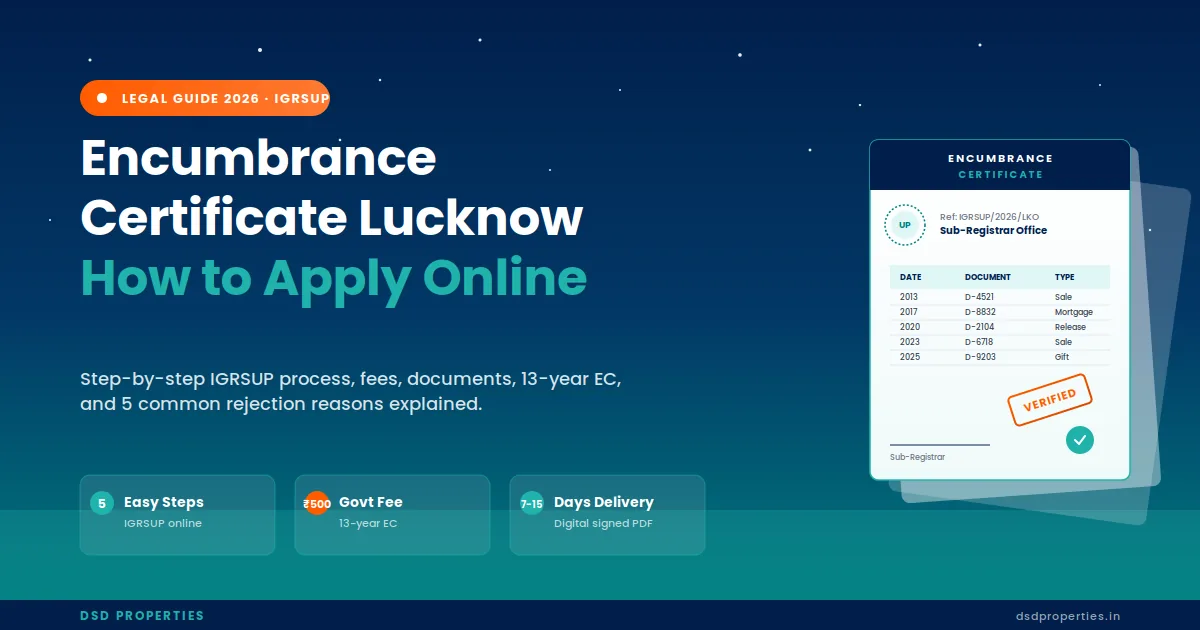
Encumbrance Certificate Lucknow 2026 — How to Apply Online (Step-by-Step Guide)
Sources: IGRSUP (igrsup.gov.in), Stamp and Registration Department UP, Sub-Registrar Office Lucknow, DSD Properties Field Research — April 2026
🔴 Why EC Matters More Than Most Buyers Realise
- Bank Loan Mandatory — No home loan is sanctioned without a valid Encumbrance Certificate. Banks require 13 to 30 years of EC history before approving any housing loan in Lucknow.
- Hidden Mortgages Exposed — The EC reveals whether the property is already pledged to a bank or financial institution. Sellers with existing loans against the property are legally bound to disclose this, but many do not.
- Legal Disputes Flagged — Any registered liens, attachments, or court orders appear on the EC. Properties with unresolved legal disputes are a direct red flag that blocks registry.
What is an Encumbrance Certificate?
An Encumbrance Certificate (EC) is an official document issued by the Sub-Registrar Office that lists every registered transaction on a property during a specific time period. This includes sale deeds, mortgages, gift deeds, partition deeds, lease agreements, and any court attachments or liens. For any property transaction in Lucknow, the EC is the single most important document for confirming that the seller has a clean, unencumbered title.
In Uttar Pradesh, ECs are issued through the Stamp and Registration Department via the IGRSUP (Inspector General of Registration UP) portal. The process has been fully digitised since 2020, and most applications can now be completed online without visiting the SRO in person. However, the collection of the final certificate may still require a physical visit to the concerned Sub-Registrar Office.
In Lucknow, five Sub-Registrar Offices serve different tehsils — Lucknow Sadar, Sarojini Nagar, Malihabad, Mohanlalganj, and Bakshi Ka Talab. The EC must be obtained from the correct SRO based on where the property is located. Getting an EC from the wrong SRO is one of the most common reasons applications fail, and buyers often do not realise this until much later.
7-Year EC
Used for basic property checks, personal records, and quick verifications. Sufficient for small transactions but not accepted by banks for home loans.
13-Year EC
The standard period recommended for all property purchases. Covers most bank loan requirements and catches the majority of transaction history issues.
30-Year EC
Required for high-value transactions, disputed properties, and cases where chain of title must be established from scratch. Most legally safe option.
How to Apply for EC in Lucknow — 5 Step Online Process
Register on IGRSUP Portal
Visit igrsup.gov.in and create a citizen login using your mobile number and email. Verify both with the OTPs sent. Once logged in, navigate to the "Encumbrance Certificate" or "Bharrahit Pramanpatra" section under the online services menu. First-time users should keep their Aadhaar number, PAN, and active mobile number ready as these are required during the application process.
📍 Where to apply: igrsup.gov.in — Citizen Services → Online Services → Encumbrance CertificateEnter Property and Period Details
Fill the EC application form with the property details — district (Lucknow), tehsil (Sadar, Sarojini Nagar, Malihabad, Mohanlalganj, or Bakshi Ka Talab), Sub-Registrar Office, village or mohalla name, khasra number or house number, and property type. Select the period for which you need the EC — most commonly 13 years from the current date. Double-check the tehsil and SRO selection — this is where most applications go wrong.
📍 Tip: Verify your property tehsil on upbhulekh.gov.in before filling the SRO fieldUpload Supporting Documents
Upload scanned copies of the required documents — applicant's Aadhaar card, PAN card, property address proof such as the latest Khatauni or property tax receipt, and if available, the previous sale deed or any existing registered document related to the property. All documents should be in PDF format with file size under 2 MB each. Poor-quality scans are a common reason for application rejection, so use a proper scanner or a good scanning app, not just phone camera photos.
📍 Required: Aadhaar, PAN, Khatauni or property tax receipt, previous sale deed (if any)Pay the EC Fee Online
The fee for EC in Uttar Pradesh depends on the period requested — approximately ₹200 for a basic search and ₹25–50 additional per year for the search period. A 13-year EC typically costs ₹400–500 total. Payment is made through the IGRSUP portal using net banking, UPI, debit card, or credit card. Save the payment receipt and transaction reference number. If payment fails midway, do not submit another application immediately — wait 24 hours and check if the original application has been processed to avoid duplicate charges.
📍 Fee: Approx Rs.400-500 for 13-year EC. Payment via IGRSUP portal onlyTrack Application and Download EC
After submission, you receive an application reference number. Use this on IGRSUP to track the status. Applications typically take 7 to 15 working days in Lucknow, depending on the SRO workload and the period requested. For 30-year ECs, processing may extend to 20 days. Once approved, the EC is available for download as a digitally signed PDF from your IGRSUP account. Some SROs still require physical collection of a stamped copy — check with your SRO if the digital copy is sufficient for your purpose.
📍 Track at: igrsup.gov.in → Application Status with reference numberDocuments Required for EC Application
Mandatory Documents Checklist
- Applicant Aadhaar Card — Clear scan of both sides, readable at normal zoom
- PAN Card — Required for any EC application above ₹200 fee
- Property Address Proof — Latest Khatauni from upbhulekh.gov.in or current property tax receipt from Lucknow Nagar Nigam
- Property Identification Details — Khasra number, gata number, house number, plot number, or any official identifier
- Previous Sale Deed Copy — If available, improves search accuracy significantly
- Mobile Number — Active number for OTP verification throughout the process
5 Common Reasons EC Applications Get Rejected
🚨 Reason 1 — Wrong Sub-Registrar Office Selected
The single most common rejection reason. Each property in Lucknow falls under a specific SRO based on its tehsil. A property in Sushant Golf City falls under SRO Sarojini Nagar, not SRO Sadar. Selecting the wrong SRO means the search returns no results and the application is effectively useless — though you still paid the fee. Always confirm the tehsil on upbhulekh.gov.in before selecting the SRO.
🚨 Reason 2 — Incorrect Khasra or Plot Number
Even one wrong digit in the khasra number results in a "No Record Found" EC — which is technically valid but practically useless. This often happens when buyers copy the khasra from an unofficial document rather than the Khatauni. Always cross-check the khasra number with the current Khatauni on the official Bhulekh portal before submitting the EC application.
🚨 Reason 3 — Poor Quality Document Scans
Blurry Aadhaar scans, cut-off PAN cards, or photos of documents instead of proper scans get applications rejected during verification. This adds 3 to 5 days of delay while you re-upload. Use a scanning app like Adobe Scan or CamScanner set to document mode, and ensure the entire document is visible with all corners and text clearly readable.
🚨 Reason 4 — Mismatched Property Description
If the property description in the EC application does not match what is on record in the SRO — for example, village name written as "Gomtinagar" when the SRO has it as "Gomti Nagar Extension" — the search may return incomplete results. Check the exact spelling used in previous sale deeds of the area before submitting. Minor differences matter.
🚨 Reason 5 — Using EC from Before 2002 Without Manual Search
The IGRSUP digital records reliably cover transactions from 2002 onwards. For transactions before this date, the online EC may not show complete history, and a manual search at the SRO is required. For 30-year ECs covering the pre-2002 period, budget additional time and fees for physical search at the SRO. Do not assume a clean online EC means a clean pre-2002 record.
How to Read Your Encumbrance Certificate
An Encumbrance Certificate comes in one of two forms — a "Nil Encumbrance Certificate" or a detailed transaction-wise certificate. A Nil EC simply states that no registered transactions were found during the search period. This is good if you were expecting the property to be clean, but it can also mean the property has never been registered at all — a red flag for unregistered Gram Sabha or disputed land.
A transaction-wise EC lists each registered deed in chronological order with the document number, date, type of transaction (sale deed, mortgage, gift, etc.), party names, and consideration amount. Read each entry carefully. Look for mortgages that should have been discharged but still appear, court attachments, disputed gifts or partitions, and any entries where the seller's name does not appear as the current owner.
If you see a mortgage entry from a bank, always ask the seller for the mortgage discharge certificate — which proves the loan has been repaid and the mortgage released. Without this, the property technically remains under the bank's charge regardless of what the seller claims. This is the single most common hidden issue discovered during property verification in Lucknow.
Leave a Comment