
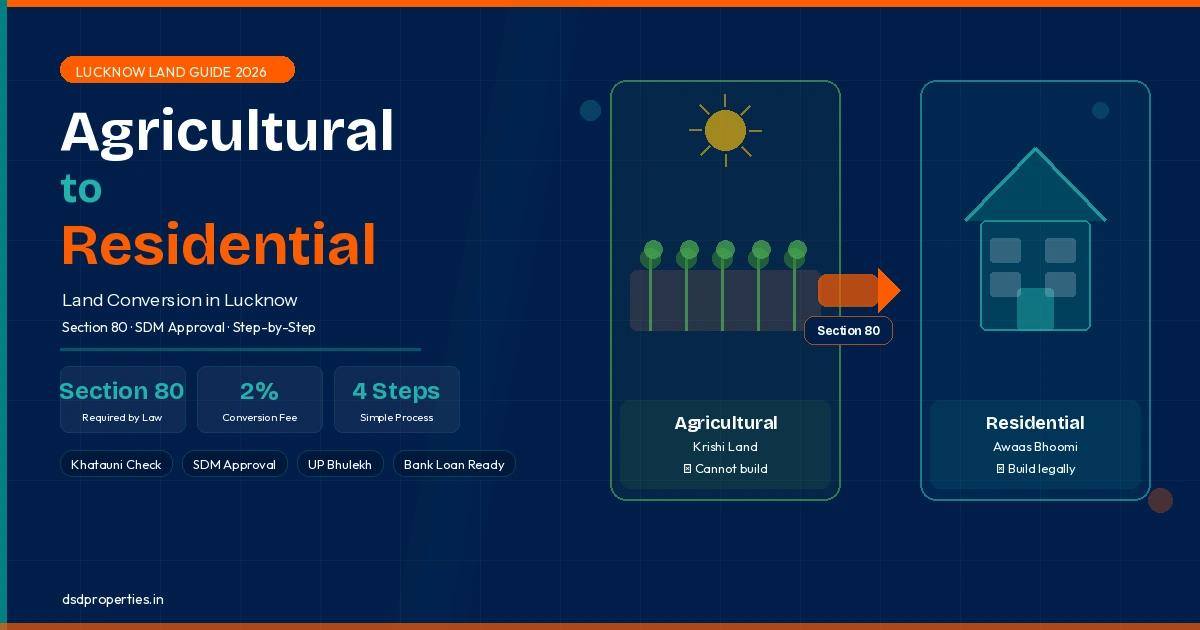
The 2026 Guide to Land Conversion in Lucknow (Section 80)
Sources: UP Revenue Code 2006, LDA Official Records, UP Cabinet Ordinance March 2026, Nivesh Mitra Portal, UP Bhulekh
🚨 Major Update — March 2026: The End of "Dual Approval"
- LDA-approved projects: Section 80 conversion is now automatically deemed approved when LDA layout map is sanctioned — no separate SDM visit needed
- Zila Panchayat / unapproved / village land: Section 80 from the SDM is still 100% mandatory — the new rule does NOT apply here
- "Section 80 in process" is now a red flag: For LDA-approved projects, this excuse is legally obsolete. For unapproved colonies, it means the land is still agricultural — do not pay
- Verify at: UP Bhulekh (upbhulekh.gov.in) — Khatauni must show "Gair-Krishi" not "Krishi" before you pay any amount
Buying a plot of land in Lucknow is a significant financial and emotional milestone. As the city expands rapidly outward along the Kisan Path, Sultanpur Road, and Mohanlalganj corridors, thousands of buyers are investing their life savings into real estate. However, a massive percentage of these buyers are making one critical, often irreversible mistake — they are purchasing Krishi (agricultural) land with the immediate intention of building a residential home, completely unaware of the strict land conversion laws.
In Uttar Pradesh, agricultural land is rigorously protected by law. You cannot simply buy a piece of farmland, build a boundary wall, and start constructing a house. To legally build any residential, commercial, or industrial structure, the land's classification in government records must be formally changed from "Agricultural" to "Non-Agricultural." This process is known as land conversion — and this guide covers everything you need to know about it in 2026. If you want expert help assessing a specific plot before committing, DSD Properties' free Property Advisory is available.
📋 Table of Contents
- Chapter 1 — Section 143 vs Section 80: The Great Confusion
- Chapter 2 — The March 2026 Ordinance: Game Changer for Buyers
- Chapter 3 — Step-by-Step Conversion Process in 2026
- Chapter 4 — Mandatory Document Checklist
- Chapter 5 — The 5 Disasters of Skipping Land Conversion
- Chapter 6 — Special Warning: SC/ST Land Clause (Section 157-A)
- Chapter 7 — Where to Watch Out in Lucknow 2026
- Frequently Asked Questions
Chapter 1 — The Great Confusion: Section 143 vs Section 80
If you speak to any local property broker, farmer, or seasoned investor in Lucknow, you will constantly hear the phrase: "Is plot ka 143 ho gaya hai" (This plot has Section 143 clearance). However, if you look for a "Section 143" certificate today, you won't find one. This is the first major trap for buyers.
The History of Section 143
For decades, land in Uttar Pradesh was governed by the Uttar Pradesh Zamindari Abolition and Land Reforms (UPZA & LR) Act of 1950. Under this old act, Section 143 was the specific legal provision that allowed a landowner to apply to the Sub-Divisional Magistrate (SDM) to declare that a piece of agricultural land was no longer being used for farming and was instead being used for residential, commercial, or industrial purposes.
Once the SDM passed the order under Section 143, the land was freed from the restrictions of the UPZA & LR Act and could be sold or transferred under standard civil laws.
The Shift to Section 80 — UP Revenue Code 2006
The UPZA & LR Act was repealed and completely replaced by the Uttar Pradesh Revenue Code, 2006 (fully implemented across the state from 2016). Under the new Revenue Code, the legal provision for land conversion moved to Section 80.
✗ Section 143 — Obsolete
- From the UPZA & LR Act of 1950
- Legally no longer exists since 2016
- SDMs cannot and do not issue it today
- A "new" 143 document in 2026 = forgery
- Still used as slang in the market
✓ Section 80 — Current Law
- From the UP Revenue Code 2006
- The only valid conversion document today
- Issued by the SDM after full inspection
- Must be reflected in Khatauni as "Gair-Krishi"
- Verify at upbhulekh.gov.in
When a developer or broker promises you "143 approved land" in 2026, the legal document you actually need to see is a Section 80 Declaration in the Khatauni. If a seller hands you a newly dated document claiming to be a "Section 143 order," it is either a forgery or a severe clerical error.
Chapter 2 — The March 2026 Ordinance: A Game Changer
For years, the land conversion process in Uttar Pradesh was plagued by a bureaucratic nightmare known as "Dual Approval." A developer buying agricultural land in an LDA-overseen area had to fight a two-front war simultaneously.
Get LDA layout and building maps approved by LDA town planners
Often took 6–18 months. Developers sold plots during this period with "LDA map in process" as justification.
Go back to the Revenue Department (SDM) for a separate Section 80 order
Even after LDA approved the residential map, the developer still needed a separate revenue conversion — the "dual approval" loophole that was exploited for years.
Developers would sell plots saying "LDA map is passed, Section 80 is in process" — leaving buyers in a legal grey area for years. Buyers paid premium for "LDA approved" land only to find they couldn't get a bank loan because the revenue records still showed the land as a farm.
✅ What the March 2026 Ordinance Changes
- LDA map approved = Section 80 automatically deemed approved — no separate SDM visit for LDA-zone projects
- Applies to projects within notified planning zones of LDA or UP Housing and Development Board (UPAVP)
- "Section 80 in process" is now legally meaningless for any LDA-approved project — red flag if a developer still uses this phrase
- Cuts bureaucratic red tape in half for legitimate developers and buyers
- Does NOT apply to Zila Panchayat areas, Gram Sabha regions, or unapproved private colonies — those still need formal Section 80 from SDM
If you are buying in an LDA-approved gated township in Gomti Nagar Extension, Vrindavan Yojna, IT City corridors, or DLF Garden City — you only need to verify the LDA layout number. The Section 80 conversion is legally implied. For everything else, the SDM process remains mandatory.
Chapter 3 — Step-by-Step Conversion Process in 2026
If your land falls outside the LDA-approved map exemption, you must follow the formal Section 80 conversion process. The good news: in 2026, the UP government has digitized the majority of this workflow, making it more transparent and significantly reducing delays.
Online Application — Nivesh Mitra / Vaad Portal
File the application online through the UP government's Nivesh Mitra portal or Revenue Department's Vaad portal. Upload all property documents, identity proof, and a self-declaration stating your intent to use the land for non-agricultural purposes.
Lekhpal's Field Inspection — The Most Critical Step
The SDM orders the area Lekhpal (revenue officer) to conduct a physical survey. The Lekhpal checks three things: (1) Is the land in a restricted Green Belt or ecologically sensitive zone? (2) Is it marked for future government infrastructure? (3) Is it active productive farmland the government wishes to preserve? A clear report moves the file forward.
Payment of the Conversion Fee — 2% of Circle Rate
If the Lekhpal report is clear, the SDM calculates the conversion fee. As of 2026, the standard fee in UP is 2% of the prevailing government Circle Rate for that village or locality. Pay this fee to the government treasury via challan.
Final SDM Declaration — Section 80 Order
After verifying the fee receipt, the SDM issues the formal Section 80 order. Under new 2026 Service Level Agreements (SLAs), this entire process must be completed within 45 days from the date of application.
Update the Khatauni — Amaldaramad (Don't Skip This)
Getting the order in your hand is not enough. You must ensure the order is executed in the revenue records. The land type in the official Khatauni must be updated from "Krishi" to "Gair-Krishi" (Non-Agricultural). Pull a fresh Khatauni from upbhulekh.gov.in 2–3 weeks after the SDM order to verify the change is reflected.
⚡ The Conversion Fee Calculation
- Formula: 2% × (Government Circle Rate for your locality) × (Plot area in sqm or sqft)
- Example: Plot of 1,000 sqft in a village where circle rate is ₹500/sqft → Conversion fee = 2% × ₹5,00,000 = ₹10,000
- Circle rates vary significantly by village, road type, and proximity to city — verify at the Tehsil office or the UP Circle Rate portal before budgeting
- This fee is paid to the government treasury — not to any broker, agent, or intermediary
Chapter 4 — Mandatory Document Checklist
To ensure your application doesn't get rejected on technical grounds, prepare a complete file before you start. Here is the 2026 checklist for a Section 80 land conversion application in Lucknow.
- Latest Certified Khatauni (Record of Rights) — must be a recent extract from upbhulekh.gov.in showing you as the current rightful owner. An old Khatauni will get your application rejected
- Registered Sale Deed (Registry) — the complete, original registered document proving your purchase. Photocopies are not accepted
- Sajra / Khasra Map — the official village map showing the exact geographical location, boundaries, and dimensions of your specific Khasra number. Obtainable from the Tehsil office
- Mutation Document (Dakhil Kharij) — proof that the land has been successfully mutated into your name in tehsil records after the registry. Without mutation, you are not the legal owner in revenue records
- Identity Proofs — Aadhaar Card and PAN Card of the landowner. Both mandatory; neither alone is sufficient
- Affidavit / Self-Declaration — a notarized document declaring that the land is free from disputes, is not government or Gram Sabha property, and stating your exact intended use (e.g., residential construction)
🚫 Most Common Rejection Reasons
- Khatauni not updated — shows previous owner's name, not current buyer after registry
- Mutation (Dakhil Kharij) not completed before filing — most frequent delay cause
- Land falls in Green Belt zone or NGT-restricted area — automatic rejection, no appeal
- Government acquisition notice on the Khasra — file blocked until resolution
- Missing affidavit or affidavit not notarized — easily avoidable, always check
Chapter 5 — The 5 Disasters of Skipping Land Conversion
Many buyers try to save the 2% conversion fee or avoid the paperwork by building directly on agricultural land. They assume that if they build a strong boundary wall and start living there, the government won't bother them. In 2026, with drone mapping and LDA enforcement actively operating on Kisan Path and surrounding corridors, this is a recipe for financial ruin.
Guaranteed Home Loan Rejection
SBI, HDFC, ICICI, PNB, and every other major bank has stringent legal verification. When their lawyers check UP Bhulekh and see the land marked "Krishi," your loan application is instantly rejected. You are then forced to borrow from private unorganised lenders at exorbitant interest rates — or lose the opportunity entirely.
The LDA Bulldozer — "Peela Panja"
The Lucknow Development Authority actively monitors illegal plotting, now using drone surveys across Kisan Path, Chinhat, and expansion corridors. If a developer cuts plots on agricultural land without Section 80 and LDA layout approval, the authority has full legal right to demolish the structures. In February 2026, 14 demolition notices were issued in the Chinhat–Kisan Path belt alone. Buying an unconverted plot means living with permanent demolition anxiety.
Complex Inheritance Problems — A Hidden Danger
This is the danger most buyers never consider. In Uttar Pradesh, the succession of agricultural land is governed by the UP Revenue Code — which has historically had different rules regarding heirs compared to standard civil law. Converting to residential brings the land under the Hindu Succession Act or Indian Succession Act, ensuring a smoother, more equitable transfer of wealth to all your legal heirs including daughters. Unconverted agricultural land can trigger inheritance disputes decades later.
Denial of Basic Utilities
Municipal corporations and electricity boards (LESA) are becoming increasingly strict. Getting a permanent residential electricity meter or a legal water and sewage connection on land officially recognized as a farm is becoming extremely difficult and, in many cases, now flatly refused. You end up dependent on illegal connections — which carry their own risks and costs.
Plummeting Resale Value — 30 to 40% Discount
In 2026, the Lucknow buyer is educated. The first thing any serious buyer or their broker asks for is the Section 80 paperwork and the Khatauni showing "Gair-Krishi." An unconverted plot consistently sells at a 30 to 40% discount compared to a legally verified, converted plot in the exact same locality. The 2% conversion fee you tried to save will cost you 30 to 40% of the property's value at resale.
Chapter 6 — Special Legal Warning: The SC/ST Land Clause (Section 157-A)
There is one specific legal trap in Uttar Pradesh that ruins more investments than almost anything else: buying land originally owned by a person from the Scheduled Caste (SC) or Scheduled Tribe (ST) communities.
⚖️ Section 157-A — What You Must Know Before Buying Any Land
- Land belonging to an SC/ST individual cannot be sold to a non-SC/ST person without the explicit prior permission of the District Magistrate (DM)
- Obtaining a Section 80 conversion does NOT bypass this rule — both approvals are required independently
- Unethical developers buy SC land without DM permission, manage to get a Section 80 conversion through loopholes, and sell to unsuspecting buyers
- Years later, the original owner's family can file a case — courts will declare your registry null and void because the fundamental DM permission was missing
- Protect yourself: Always trace the Khatauni back at least 15–20 years. If any previous owner belongs to an SC/ST community, verify the DM permission exists in the chain of title documents before paying anything
This is not a rare edge case. In rapidly developing corridors like Kisan Path, Mohanlalganj, and the villages around Raebareli Road, a significant percentage of original landowners belong to SC/ST communities. If you need a professional title chain verification going back 15–20 years, DSD Properties' Property Verification service includes this check as a standard part of every engagement.
Chapter 7 — Where to Watch Out in Lucknow 2026
The need for Section 80 vigilance is higher in certain expanding pockets of Lucknow than others. If you are looking at investments in these areas, double-check your paperwork before paying a single rupee.
| Location | Risk Level | What to Watch | Verify At |
|---|---|---|---|
| Kisan Path Corridor | Very High | 90%+ of unapproved colonies lack Section 80. Drone survey active. Demolitions underway | upbhulekh.gov.in + LDA map check |
| Mohanlalganj / Purvanchal Expwy | High | Agricultural land changing hands daily. Verify Master Plan 2031 zoning before purchase | LDA Master Plan portal + SDM office |
| Raebareli Road outskirts | Medium-High | Spillover from Vrindavan Yojna into Kalli Pashchim villages — treat as agricultural until Section 80 confirmed | upbhulekh.gov.in Khatauni check |
| Sultanpur Road corridor | Medium | IT City acquisition in 11 villages has freezing orders — private sales restricted in some Khasra numbers | LDA IT City acquisition list |
| LDA approved townships | Low (post-2026) | Section 80 now deemed approved with LDA map. Verify LDA layout number at ldalucknow.in | ldalucknow.in layout verification |
For detailed pocket-by-pocket analysis of legal and illegal zones on Kisan Path: Kisan Path Investment Map 2026: 5 Gold Pockets & 3 Red Zones →
For Raebareli Road zone-by-zone analysis: Plots on Raebareli Road Lucknow 2026 — Zone-Wise Price Guide →
❓ Frequently Asked Questions
What is the difference between Section 143 and Section 80 for land conversion in Lucknow?
Section 143 was the land conversion provision under the old UPZA & LR Act of 1950, which has been fully repealed. Section 80 is the equivalent provision under the current UP Revenue Code 2006. Legally, Section 143 no longer exists — SDMs only issue Section 80 orders today. When brokers say "143 ho gaya hai," they mean Section 80. If you're handed a new document dated 2024 or 2025 claiming to be a "Section 143 order," treat it as a serious red flag.
Do I still need Section 80 if I'm buying in an LDA-approved project in 2026?
No — for projects within notified LDA or UPAVP planning zones with a sanctioned layout plan, the March 2026 UP Cabinet ordinance has made Section 80 automatically deemed approved when the LDA map is sanctioned. You only need to verify the LDA layout number at ldalucknow.in. However, for Zila Panchayat areas, Gram Sabha regions, or unapproved private colonies, Section 80 from the SDM remains 100% mandatory.
How long does land conversion take in Lucknow in 2026?
Under the new 2026 Service Level Agreements, the entire Section 80 process — from application to SDM order — must be completed within 45 days. The process is now digitised through the Nivesh Mitra portal, significantly reducing delays compared to the older manual system. However, Lekhpal inspections and document completeness remain the most common causes of delay.
What is the conversion fee for agricultural to residential land in UP?
The standard conversion fee in Uttar Pradesh as of 2026 is 2% of the prevailing government Circle Rate for the specific village or locality. The actual amount depends on the circle rate of your area — this varies significantly between urban and rural pockets. The fee is paid to the government treasury, not to any agent or intermediary.
Can I build a house on agricultural land before Section 80 conversion?
No — construction on unconverted agricultural land is illegal in Uttar Pradesh. The LDA can demolish the structure at any time with no compensation. Banks will refuse a home loan. Permanent electricity and water connections will be denied. Additionally, you will face a 30–40% resale discount compared to legally converted plots in the same locality. The 2% conversion fee is always worth paying before construction begins.
What is the SC/ST land clause and why does it matter for property buyers?
Under Section 157-A of the UP Revenue Code, land originally owned by an SC/ST individual cannot be sold to a non-SC/ST person without explicit prior permission from the District Magistrate (DM). Getting a Section 80 conversion does not bypass this requirement. If the DM permission is missing from the title chain, a court can declare your registry null and void — even years after purchase. Always trace the Khatauni back 15–20 years to check the caste status of all previous owners.
How do I verify if my plot's land use has been changed in records?
Visit upbhulekh.gov.in and pull the latest Khatauni for your Khasra number. The "Bhoomi Prakar" (land type) field must show "Gair-Krishi" (Non-Agricultural) or "Abadi" — not "Krishi" (Agricultural). A Section 80 order in your hand that has not yet been updated in the Khatauni provides no practical protection. Always verify the Khatauni directly, not just the SDM order document.
📚 Related Guides from DSD Properties
Are You Unsure About Your Plot's Legal Status?
Don't risk your life savings on unconverted agricultural land. Let the experts at DSD Properties run a comprehensive 2026 Khatauni and Section 80 verification check on your Khasra number — before you pay a single rupee.
Request a Free Legal Status Check
Leave a Comment