

How to Sell Your House in Lucknow in 2026: 30-Day Seller's Guide to Get 15% More
Selling a house in Lucknow in 2026 is no longer about planting a "For Sale" board and waiting for a buyer to knock. With circle rates revised, buyers checking IGRSUP records before they even visit, and the entire discovery process moving online, the sellers who get the best price are the ones who treat the sale like a project. This guide gives you a realistic 30-to-45-day roadmap, accurate 2026 price benchmarks for major localities, the exact documents a Lucknow buyer's lawyer will ask for, and the tax rules that decide how much of your sale proceeds you actually keep. Whether you own a 3BHK in Gomti Nagar, an independent house in Aliganj, or a plot in Sushant Golf City, the framework is the same.
What this guide covers
A six-step selling roadmap built for the Lucknow market; how to price using circle rate versus market value so you do not leave money on the table; the seller's document checklist; marketing that reaches real buyers; the capital-gains and TDS rules every seller must understand in 2026; and the mistakes that quietly cost sellers lakhs. Every figure is tied to an authoritative source listed above. Numbers should be verified for your specific locality and sale date before you commit.
1. The Lucknow seller's market in 2026: read it before you list
Demand in Lucknow today is driven by infrastructure, not hype. The Metro corridor, the Shaheed Path belt, the Outer Ring Road (Kisan Path), and the IT/HCL employment hubs along Sultanpur Road have pulled buyer interest toward planned, well-connected pockets. The practical effect for a seller is simple: a property with clean documents in a well-connected locality moves quickly, while an over-priced property anywhere sits unsold and goes "stale," which itself drives the price down over time.
Before you decide your asking price, you need a sober view of what your locality is actually fetching. The table below shows listing-level average rates and one-year movement from 99acres and MagicBricks (May 2026). Treat these as a starting band, not gospel — the rate for your exact street, floor, age of construction, and facing can vary meaningfully, and the government registry transaction rate is sometimes higher than online listings.
| Locality | Avg rate (per sq ft, May 2026) | 1-yr change | Typical asset |
|---|---|---|---|
| Hazratganj | ₹9,200 | +21.1% | Premium flats / commercial |
| Butler Colony | ₹9,550 | +12.4% | Independent houses |
| Gomti Nagar Extension | ₹8,000 | +6.7% | New flats / townships |
| Amar Shaheed Path | ₹7,650 | +10.1% | Luxury flats / villas |
| Sushant Golf City | ₹7,600 | +17.8% | Gated township flats & plots |
| Gomti Nagar (main) | ₹7,050 | +6.8% | Resale flats & villas |
| Sultanpur Road | ₹6,850 | +8.7% | Plots / new flats |
| IIM Road | ₹6,800 | +17.2% | Plots / emerging projects |
| Faizabad Road | ₹5,800 | +11.5% | Affordable housing |
| Alambagh | ₹4,900 | +11.4% | Resale houses |
| Chinhat | ₹4,850 | +16.9% | Affordable plots / flats |
| Kanpur Road | ₹4,850 | +10.2% | Plots / value housing |
Source: 99acres / MagicBricks locality price trends, May 2026. These are flat/built-up listing averages; land and plot rates differ. For an exact figure, you can use DSD Properties' locality price heatmap and free AI valuation, or cross-check the official circle rate for your area.
2. The 30-45 day selling roadmap, step by step
A clean sale is a sequence, not a scramble. Sellers who close fast simply do these things in the right order instead of reacting to whatever a buyer asks for next.
Two things keep this timeline on track. First, do the document work in parallel with marketing rather than after a buyer appears — the most common reason a 30-day sale slips to 90 is a seller scrambling for an EC or an NOC while the buyer's interest cools. Second, keep one decision-maker. If multiple family co-owners must each approve every counter-offer, negotiations stall and buyers move on. Agree internally on your floor price and possession terms before the first visit, so you can say yes the moment a fair offer lands.
3. Pricing to get up to 15% more, not 15% less
Pricing is where most of the money is won or lost. Two reference points matter, and they are not the same thing.
The circle rate (also called DM rate or collector rate) is the government's minimum notified value for your area. Stamp duty and registration are always calculated on the higher of the circle rate or the actual sale value, so a registry can never be done below the circle rate. The market rate is what buyers are actually paying, which in good Lucknow localities currently sits above the circle rate.
To set a defensible asking price: start from the current market average for your locality (the table above), adjust for your floor, age, facing, amenities, and parking, then add a small negotiation cushion of roughly 5-8% on top. Buyers in Lucknow expect to negotiate, so an asking price with no room forces them to walk away rather than counter. The "15% more" outcome comes from three levers working together — presentation (a clean, repaired, well-photographed home), positioning (priced just above realistic market, not far above), and proof (clean documents that remove a buyer's risk so they pay full value instead of demanding a discount).
Circle rate vs market value: a quick example
Say your locality's circle rate works out to ₹55 lakh for your flat, but comparable flats are selling at ₹72 lakh. You list around ₹75-76 lakh, settle near ₹72 lakh, and the registry stamp duty is calculated on ₹72 lakh (the higher figure). Knowing both numbers lets you price confidently and answer a buyer's "why so high?" with data instead of guesswork.
4. The seller's document checklist for Lucknow
Legal transparency is the single biggest trust factor for a 2026 buyer, many of whom check IGRSUP records before committing. Missing or unclear papers are the most common reason a near-closed deal collapses. Have these ready before you list.
Title deed / sale deed
Your registered ownership document and the chain of prior deeds. It proves you have the right to sell and that ownership has passed cleanly to you.
Encumbrance Certificate (EC)
Obtained via IGRSUP, the EC shows there are no pending home loans, mortgages, or legal charges on the property. A clean EC is what lets a buyer's bank approve their loan.
Up-to-date property tax receipts
House tax / Nagar Nigam receipts paid through the current year. Outstanding dues transfer with the property and will be deducted from your price.
Occupancy / Completion Certificate
For flats and township units, the OC/CC from the builder or authority confirms the building is legally fit for occupation. Buyers and banks increasingly insist on it.
Society / authority NOC
A no-objection certificate from your housing society, the LDA, or the relevant development authority, plus the latest maintenance-dues clearance.
Approved building plan & identity proof
The sanctioned map for an independent house, plus your Aadhaar and PAN. PAN is mandatory at registration and for TDS reporting on higher-value sales.
If your property has a mutation (dakhil-kharij) pending or the land record (khatauni/khasra) does not match the deed, sort it out before listing rather than during a buyer's due diligence. For the step-by-step on records and certificates, see the linked guides below.
5. Marketing that actually reaches Lucknow buyers
In 2026, the buyer journey starts on a phone screen. A yard sign reaches the street; a good digital strategy reaches the thousands searching for a home in your area every week.
Professional photos and a short video
Bright, high-resolution photos and a 30-60 second walkthrough get dramatically more clicks than phone snaps. This is the cheapest, highest-return marketing money you will spend.
Accurate, complete listings
List on the major portals and a trusted local platform with correct area, configuration, age, amenities, and an honest price. Inflated or vague listings attract time-wasters and repel serious buyers.
Targeted social reach
Short reels and locality-targeted posts on Instagram and Facebook put your home in front of buyers actively looking in Lucknow East, IT City, or your specific belt.
A "verified" angle
Highlighting that your documents are in order and the property is RERA-registered or LDA-approved is itself a selling point. It tells cautious buyers they can transact without fear, which shortens negotiation.
6. Taxes and money: what you actually keep after the sale
The sale price is not your take-home. Two tax rules decide the rest, and getting them wrong can cost lakhs.
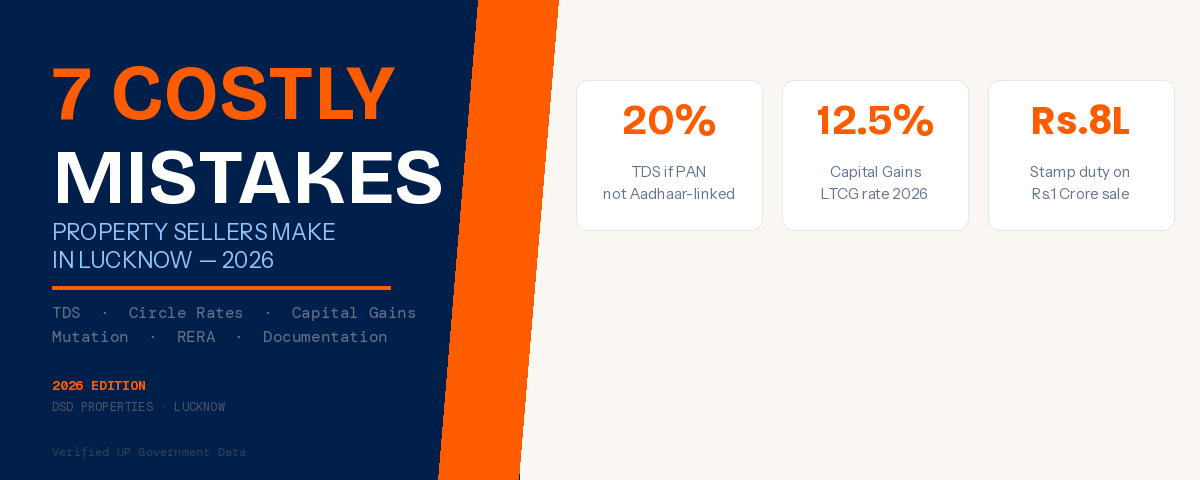
Capital gains tax. If you have held the property for more than 24 months, your profit is a long-term capital gain (LTCG). For property bought on or after 23 July 2024, LTCG is taxed at a flat 12.5% without indexation. For property bought on or before 22 July 2024, you may choose either 20% with indexation or 12.5% without indexation — whichever produces the lower tax. The Cost Inflation Index for FY 2025-26 is 363, which is used in the indexation calculation. If you sell within 24 months, the gain is short-term and taxed at your normal income-tax slab rate.
TDS deducted by the buyer. Under Section 194-IA, when the sale value of a property exceeds ₹50 lakh and the seller is a resident Indian, the buyer must deduct 1% TDS on the total sale consideration (not just the profit) and deposit it with the government. You then claim that credit when filing your return. For NRI sellers the rules are different and TDS is deducted at higher rates under Section 195, so an NRI seller should plan for it in advance.
Legal ways to reduce the tax. You can reduce or defer LTCG by reinvesting in another residential property (Section 54), or by investing the gain in specified NHAI/REC capital-gains bonds within six months (Section 54EC), among other exemptions. These have conditions and deadlines, so confirm eligibility with a qualified chartered accountant before you rely on them. This article explains the framework; it is not personal tax or legal advice.
Stamp duty & registration (paid by the buyer, but you should know it)
In UP for 2026, stamp duty is broadly 7% for a male buyer, 6% for a female buyer, and around 6.5% for joint male-female ownership, with registration charges of 1% — all calculated on the higher of circle rate or sale value. Women buyers get a concession (subject to the current notification limit). Knowing this helps you understand a buyer's total outlay and negotiate realistically.
Mistakes and scams that quietly cost Lucknow sellers
- Over-pricing and letting the listing go stale. The longer it sits, the more buyers assume something is wrong and the deeper they discount.
- Accepting cash to "save tax." It breaks your clean money trail, complicates capital-gains reporting, and is legally risky. Insist on bank transfers throughout.
- Handing over possession before full payment is received. Possession should follow the money into your account, never precede it.
- Skipping buyer verification. Confirm loan pre-approval or proof of funds before you take your home off the market for a "confirmed" buyer.
- Signing a vague agreement to sell. Price, payment milestones, possession date, and penalty for default must all be written into the bainama.
- Trusting a token-advance "investor" who keeps delaying. A genuine buyer moves; a serial delayer often books your property to block it while shopping elsewhere.
The bottom line
You sell faster and for more when three things are true at once: the home is presented well, it is priced just above realistic market value with a small negotiation cushion, and the documents are so clean that a careful buyer has nothing to discount for. Get those right and 30-45 days is a realistic timeline for most Lucknow properties — with a clearly better price than a rushed, document-shy sale would ever fetch.
Frequently asked questions
How long does it take to sell a house in Lucknow in 2026?
A well-prepared, fairly priced property with clean documents typically sells in 30 to 45 days. Properties that are over-priced or have document issues can take several months, and the longer they stay listed the more buyers discount them.
What is the most important factor for a quick sale?
Pricing, closely followed by clean documents. An asking price set just above realistic market value creates buyer competition, while clear paperwork removes the risk that makes buyers demand a discount. Presentation and good photos then convert enquiries into visits.
What is circle rate and how is it different from market rate?
The circle rate is the government's minimum notified value for an area, used to calculate stamp duty and registration. The market rate is what buyers actually pay, which in strong Lucknow localities is usually higher. A registry is always done on the higher of the two, so a property cannot be registered below circle rate.
How much capital gains tax do I pay when selling a house?
If you have held the property more than 24 months, long-term capital gains apply: a flat 12.5% without indexation for property bought on or after 23 July 2024, or your choice of 20% with indexation or 12.5% without for property bought on or before 22 July 2024 (whichever is lower). Held under 24 months, the gain is taxed at your slab rate. Confirm your exact figure with a chartered accountant.
Will the buyer deduct TDS from my sale amount?
Yes. For a resident seller, if the sale value exceeds ₹50 lakh the buyer must deduct 1% TDS on the full sale consideration under Section 194-IA and deposit it with the government; you claim the credit when filing your return. NRI sellers face higher TDS under Section 195.
Can I legally reduce the capital gains tax on my sale?
Yes, through exemptions such as reinvesting in another residential property (Section 54) or investing the gain in specified capital-gains bonds within six months (Section 54EC), among others. Each has conditions and deadlines, so verify eligibility with a tax professional before relying on it.
Which documents must I have ready before listing?
Your registered title/sale deed, a current Encumbrance Certificate, up-to-date property-tax receipts, the OC/CC for flats, any society or development-authority NOC with dues cleared, the approved building plan for houses, and your Aadhaar and PAN.
Should I accept part of the payment in cash?
No. Cash breaks your clean money trail, complicates capital-gains reporting, and carries legal risk. Insist on bank transfers for the entire consideration so the transaction is fully documented.
When should I hand over possession?
Only after the full agreed amount has been received in your bank account and the sale deed is executed. Never give possession against a promise of later payment.
Do I need to register my property on RERA to sell it?
Individual resale of a completed home does not require fresh RERA registration, but if your project is RERA-registered or LDA-approved, highlighting that reassures buyers and can speed up the sale. Always confirm project status on the UP RERA portal.
How do I find the right price for my specific property?
Start with the current market average for your locality, then adjust for floor, age, facing, parking, and amenities, and add a 5-8% negotiation cushion. DSD Properties offers a free AI valuation and a 50+ area price heatmap to benchmark your number before you list.
Leave a Comment