
7 Mistakes Lucknow Property Sellers Make in 2026 (And How to Avoid Them)
Selling a property in Lucknow in 2026 looks simple on the surface — find a buyer, agree a price, register the sale. In practice, the sellers who lose money rarely lose it on the price negotiation. They lose it at the Sub-Registrar's desk when a document is missing, in an income tax notice that arrives months later, or in a deal that collapses because the buyer's bank ran a title check the seller never thought about.
This guide covers the seven mistakes that most often cost Lucknow property sellers time, money, and deals — not generic advice, but the specific legal and financial traps built into how property is sold in Uttar Pradesh. Each mistake comes with what it actually costs and exactly what to do instead. Whether you are selling an LDA plot, a Gomti Nagar flat, or an inherited family property, these are the things to get right before you list.
Before you read on — the one principle behind all seven mistakes
→ In Uttar Pradesh, the buyer's costs and the buyer's bank decide whether your sale closes — not just your asking price. Circle rates, TDS, RERA status, and mutation records are all checked by the buyer's side before money moves.
→ Every mistake below is preventable with preparation done before you list — not after a buyer is sitting across the table.
The 7 Mistakes Lucknow Property Sellers Make — And How to Avoid Them
Overpricing Against Lucknow's Circle Rates
💸 Cost: Deal collapses at the Sub-Registrar deskEmotional attachment to a property is natural, but in Lucknow overpricing has a specific legal dimension most sellers miss: the circle rate floor. The UP government sets minimum property values — circle rates — below which no sale can be registered, and they vary sharply by location.
| Area | Indicative circle rate | What it means for sellers |
|---|---|---|
| Gomti Nagar | ~₹716/sq ft | Cannot register below this even if the buyer agrees |
| Shaheed Path corridor | ~₹370–510/sq ft | Premium location — price against the right sector rate |
| Aliganj / Indira Nagar | ~₹280–420/sq ft | Established residential zone |
| Sushant Golf City | ~₹230–370/sq ft | Varies heavily by sector — verify on igrsup.gov.in |
| Peripheral areas (Sarojini Nagar etc.) | ~₹139–205/sq ft | Lowest urban Lucknow rates |
The real danger is pricing far above market while the buyer can only justify the circle rate. If your asking price is ₹80 lakh but the circle rate values the property lower, the buyer's stamp duty is still calculated on the higher of sale value or circle rate — and any gap between your price and what a buyer can defend becomes a negotiation you usually lose. Verify rates before you decide your number, and cross-check against actual registered transaction prices, which often differ from listing prices by 10–20%.
Treating TDS as “the Buyer's Problem”
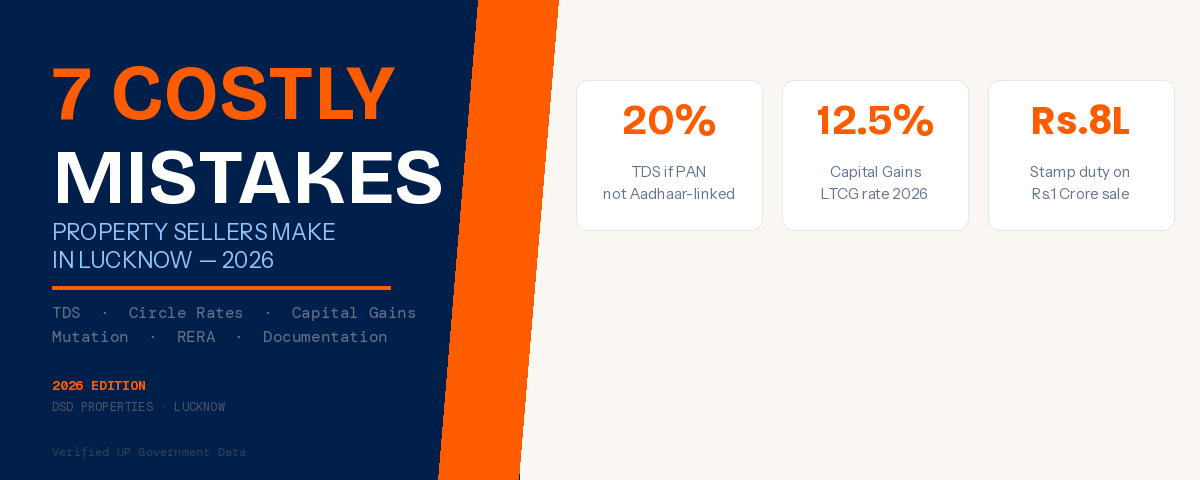
💸 Cost: 20% TDS instead of 1% if PAN is not in orderTechnically, TDS on a property sale is deducted by the buyer, not the seller — so many sellers ignore it entirely. That is a mistake, because the financial impact of getting it wrong lands on you. Under Section 194-IA of the Income Tax Act, when a property sells for above ₹50 lakh, the buyer must deduct 1% TDS before paying you, calculated on the higher of the sale consideration or the stamp duty value.
| Situation | TDS rate | On what amount |
|---|---|---|
| Normal sale, PAN provided & Aadhaar-linked | 1% | Higher of sale value or stamp duty value |
| PAN not provided / not valid | 20% | Full sale consideration |
| Sale value and stamp duty value both below ₹50 lakh | Nil | Not applicable |
| NRI seller (Section 195 applies) | 20%+ | Separate withholding analysis required |
On a ₹1 crore sale, normal TDS is ₹1 lakh. With a PAN issue it becomes ₹20 lakh — and that difference is your money, locked up until you file an ITR and claim a refund, which takes months. The buyer must file Form 26QB within 30 days of registration and hand you a Form 16B certificate; if those are missing, both sides can face notices.
Arriving at Registration Without Complete Documents
💸 Cost: Sale collapses on registration day, buyer walksThe Sub-Registrar's office is strict — if a single document is missing on registration day, you are sent home. A buyer who arranged bank disbursal and took a day off work rarely returns warmly. This is the most avoidable deal-killer in Lucknow property sales, and the fix is simply starting early.
| Document | Where to get it | Lead time |
|---|---|---|
| Original sale deed / registry | Your records / Sub-Registrar | Immediate if in hand |
| Encumbrance certificate (12 yrs) | Sub-Registrar office | 3–7 days |
| Mutation order (Dakhil-Kharij) | Tehsil / upbhulekh.gov.in | Days to weeks if not done |
| Property tax receipts (last 3 yrs) | Lucknow Nagar Nigam | 1–2 days |
| Loan NOC / closure letter | Your bank | 7–15 days — most common stopper |
| Society NOC (if apartment) | RWA / society office | 3–15 days |
| LDA allotment letter (LDA property) | LDA office / your records | Weeks to replace if lost |
| RERA certificate / Khatauni (flat / plot) | uprera.up.nic.in / upbhulekh.gov.in | Immediate download |
Build this checklist the day you decide to sell — not after a buyer appears. A fully prepared seller closes three to four weeks faster than an unprepared one.
Not Planning for Capital Gains Tax Before the Sale
💸 Cost: A surprise tax bill months after the proceeds are spentThis is the mistake that hurts most, because it hits after the celebration. You sell, you spend the money, and then your ITR reveals a large sum owed to the government that was never budgeted for.
| Holding period | Type | Tax rate (2026) |
|---|---|---|
| More than 24 months | LTCG | 12.5% without indexation |
| 24 months or less | STCG | Your income slab — up to 30% |
| Property bought before 23 Jul 2024 | LTCG (choice) | 12.5% no indexation OR 20% with indexation — whichever is lower |
From 23 July 2024, indexation was removed for property and the LTCG rate dropped to 12.5%. For a property purchased before that date you may still choose the old 20%-with-indexation method if it produces a lower bill — which is exactly why a long-held property should be calculated both ways. Three legal routes reduce the liability: reinvesting in another residential property under Section 54, investing up to ₹50 lakh in NHAI/REC bonds under Section 54EC within six months, or parking the gain in a Capital Gains Account Scheme before the ITR deadline.
Selling a Property Where Mutation Is Not in Your Name
💸 Cost: Registration blocked, buyer's home loan deniedMutation (Dakhil-Kharij) updates government revenue records to reflect the current owner — and it is entirely separate from sale deed registration. You can hold a registered sale deed in your name and still not appear as the owner in official Khatauni records, because mutation was never completed after your purchase. This is common in Lucknow for inherited plots, gifted properties, and land bought years ago.
When you try to sell, the buyer's lawyer or bank checks upbhulekh.gov.in. If the Khatauni shows a previous owner, the transaction stalls and the buyer's bank refuses to disburse the loan.
🚨 A common Lucknow scenario
A father buys a 1,200 sq ft plot in Sushant Golf City in 2010 and passes away in 2018. The family transfers the sale deed but never does mutation at the tehsil. In 2026 the son lists the plot; the buyer's bank runs a title check, the Khatauni still shows the deceased father, the home loan is denied and the deal collapses. Fixing mutation then takes 30–45 days — entirely preventable.
Before listing, check upbhulekh.gov.in by district, tehsil and your name. If your name is not shown as current owner, file for mutation at your tehsil immediately — under UP Revenue Code 2006 Section 34, the tehsil must complete it within 45 days.
No RERA Disclosure When Reselling a Flat
💸 Cost: Legal risk, buyer's home loan blockedIf you are reselling a flat in a RERA-registered project — which covers most Lucknow apartments built after 2017 — you carry disclosure obligations most individual resellers do not know about. Under the Real Estate (Regulation and Development) Act 2016, the RERA registration number and project details must appear in your sale agreement if the original project was RERA-registered, and buyers taking home loans verify everything at uprera.up.nic.in before committing.
| What buyers check on UPRERA | Why it affects your sale |
|---|---|
| Project RERA registration status | Expired or cancelled registration is a red flag — serious buyers walk |
| Completion / Occupancy Certificate | No OC means the buyer's bank will not disburse the loan |
| Developer compliance & complaint record | Pending complaints reduce buyer confidence and price |
| Floor plan & carpet area on record | Must match what you are selling or registration is blocked |
Before listing, look up your project, note the RERA number for every agreement and listing, confirm the OC or Completion Certificate is issued, and if there are complaints or an expired registration, price for it and disclose proactively — buyers find out anyway.
Wrong Timing and No Presentation
💸 Cost: A lower sale price and months of extra time on the marketThe last mistake is the most visible and the most fixable. Lucknow sellers routinely list with dark phone photos, vague descriptions, and at the wrong time of year. Both timing and presentation move the final number.
| Season | Buyer activity | Seller's position |
|---|---|---|
| Oct–Nov (Navratri, Diwali) | Highest | Best window — festive sentiment peaks |
| Jan–Mar (pre-financial year end) | High | Strong — buyers close before 31 March |
| Apr–Jun | Moderate | Acceptable — new financial year momentum |
| Jul–Sep (Monsoon) | Lowest | Weakest — site visits drop, price pressure rises |
On presentation, the highest-return move is professional daylight photography at ₹3,000–5,000, which consistently generates more enquiries and faster shortlisting. Fresh paint on main walls and the gate, fixing visible plumbing or electrical issues, and an accurate listing with exact square footage, floor and facing direction all reduce buyer objections and wasted visits.
Fixing the Title and Document Trail Before You List
Three of the seven mistakes — documents, mutation, and RERA — come down to one task done in the right order. Here is the sequence a prepared Lucknow seller follows.
Confirm your name in the live land record. Search the Khatauni for the property by district, tehsil and owner name and verify you appear as the current owner.
📍 Where to check: upbhulekh.gov.inIf mutation is not done, file for Dakhil-Kharij at your tehsil now. It must legally be completed within 45 days, so start before you find a buyer, not after.
📍 Where to file: Tehsil office / upbhulekh.gov.inPull a 12-year encumbrance certificate and confirm the property is free of pending loans, liens or disputes. Close any home loan and obtain the bank NOC early.
📍 Where to get it: Sub-Registrar office / your bankFor a flat, download the project's RERA record and Occupancy Certificate. For a plot, keep the LDA allotment letter and Khasra/Khatauni ready.
📍 Where to check: uprera.up.nic.in / upbhulekh.gov.inVerify your PAN status and clear property tax dues for the last three years. Keep receipts ready — a buyer's lawyer will ask for all of them.
📍 Where to check: incometax.gov.in / Lucknow Nagar NigamRed Flags That Quietly Kill Lucknow Property Sales
🚨 The circle rate gap
If you agree to sell at ₹70 lakh but the circle rate values the property at ₹85 lakh, stamp duty is calculated on ₹85 lakh. The buyer effectively pays tax on money they did not pay you — and this is where deals stall at the registration desk. Always check circle rates on igrsup.gov.in before fixing your price.
🚨 TDS that never reaches your PAN
If the buyer deducts TDS but never deposits it via Form 26QB, the income tax department can flag both of you. After registration, check your Form 26AS / AIS within 30 days to confirm the TDS is actually credited to your PAN.
🚨 A name mismatch in the Khatauni
A registered sale deed in your name means nothing to a buyer's bank if the Khatauni still shows the previous owner. The loan will be refused. Mutation must be in your name before you list.
🚨 An expired or missing RERA / OC record
For a flat resale, no Occupancy Certificate means no home loan disbursal for your buyer. An expired project RERA registration is treated as a red flag by serious buyers and their agents.
Special Cases — Inherited, NRI, and LDA Property Sales
Inherited property: the most common Lucknow trap. Before listing, the sale deed must be transferred and mutation completed in the heirs' names — both steps, not just one. If there are multiple legal heirs, all must consent to the sale or the registration is blocked.
NRI sellers: the ordinary 1% TDS rule does not apply. NRI sales fall under Section 195, with TDS deducted at a higher rate against the capital gain, and a Lower Deduction Certificate (Form 13) may be needed to avoid excess withholding. Plan this with a CA well before the sale.
LDA plots and flats: keep the original allotment letter safe — replacing a lost one takes weeks. The LDA transfer process runs in parallel with the sale deed, and an incomplete LDA transfer leaves the buyer unable to fully establish ownership.
How DSD Properties Helps You Sell Without the Surprises
- Free pre-listing review of your property — circle rate check, document gaps, and an honest price range based on actual registered transactions in your area.
- Title and record verification: we confirm your mutation, encumbrance certificate and Khatauni are clean before you list, for a flat ₹5,000 fee with a 48-hour PDF report.
- RERA and Occupancy Certificate checks for flat resales, so a buyer's bank never blocks your deal.
- Referral to a verified Lucknow CA partner for TDS and capital gains planning before you close.
- End-to-end handling of LDA transfers and Sub-Registrar paperwork so you arrive at registration with nothing missing.
Related Guides
Frequently Asked Questions
- What is the biggest mistake property sellers make in Lucknow?
- Do I have to pay TDS when I sell my property in Lucknow?
- How much capital gains tax will I pay on a property sale in 2026?
- What is the stamp duty on property registration in Lucknow?
- What documents do I need to sell my property in Lucknow?
- Can I sell a property if mutation is not in my name?
- Is RERA disclosure mandatory when reselling a flat in Lucknow?
- What is the best time to sell property in Lucknow in 2026?
- How can I sell an inherited property in Lucknow?
- Do NRI sellers pay different TDS when selling property in India?
- How can DSD Properties help me sell my property in Lucknow?

Leave a Comment