
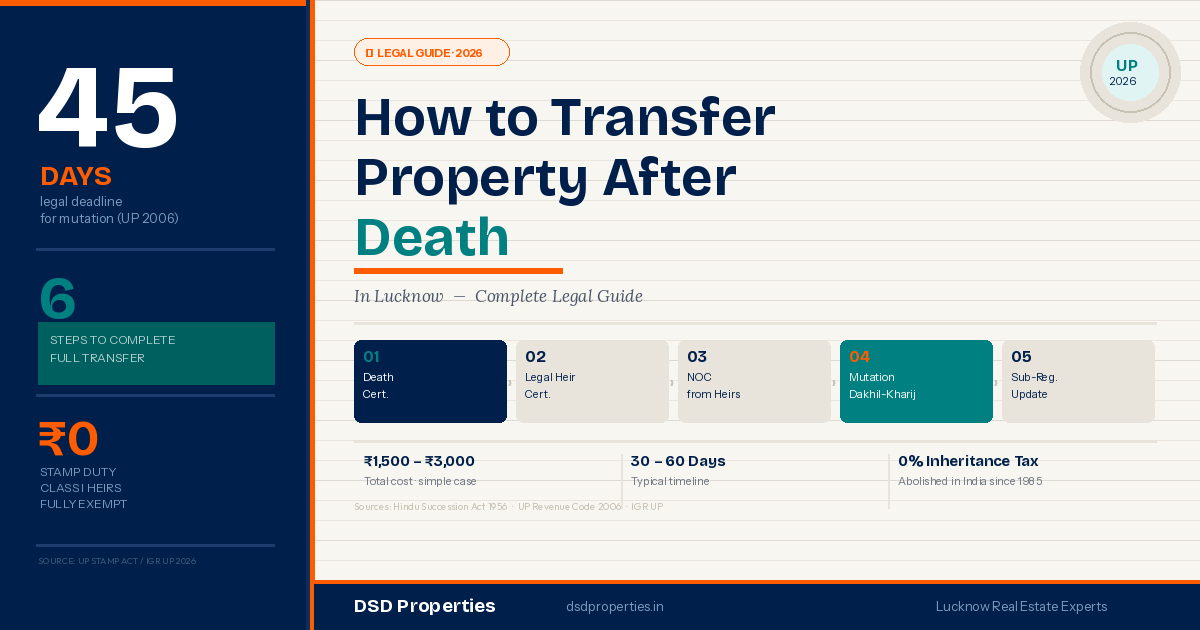
Property Transfer After Death in Lucknow (2026) — Legal Heir, Mutation & Documents
Last updated: March 2026 | Sources: UP Revenue Code 2006, Hindu Succession Act 1956, Indian Succession Act 1925, UP Stamp Act, IGR UP portal
⚖️ Property Transfer After Death — Key Facts for Lucknow 2026
Key takeaway: Transferring inherited property in Lucknow is a defined legal process — not discretionary. With the right documents and no disputes, most cases complete in 30–60 days. Disputes, missing will, or multiple heirs can stretch this to 6–18 months.
Losing a family member is difficult enough without navigating a maze of legal paperwork. Yet in Lucknow — where property values have appreciated 22.61% in a single year — delaying or mishandling the inheritance process can have serious financial and legal consequences. An untransferred property cannot be sold, mortgaged, or developed until it is legally in the heir's name.
This guide walks you through every step of the process under UP-specific law — the UP Revenue Code 2006, Hindu Succession Act 1956, and UP Stamp Act — with exact timelines, document lists, costs, and the most common mistakes that cause delays at Lucknow's tehsil offices.
Table of Contents
- Who Inherits? Understanding UP Succession Law
- 6-Step Process: Death Certificate to Final Mutation
- Complete Document Checklist
- Costs & Timelines — What to Expect
- With a Will vs. Without a Will — Key Differences
- NRI Inheritance — Special Rules
- 5 Mistakes That Delay Transfer in Lucknow
- Frequently Asked Questions
1. How to transfer property after death without a will in Lucknow
Before any paperwork begins, it is essential to understand who has the legal right to inherit. This depends on the deceased's religion, whether a will exists, and the class of heirs.
For Hindus, Sikhs, Jains, and Buddhists — Hindu Succession Act 1956
The Act divides heirs into classes. Class I heirs have the first and equal claim — they inherit simultaneously and no other class gets anything until Class I is exhausted.
| Class | Who Is Included | Priority | Notes |
|---|---|---|---|
| Class I | Spouse, sons, daughters, mother, widowed daughter-in-law, son/daughter of a predeceased son or daughter | First — equal share | All inherit simultaneously in equal parts |
| Class II | Father, siblings, sibling's children, grandchildren (specific categories) | Second — only if no Class I heir | Entry 1 excludes Entry 2, etc. |
| Agnates | Other relatives through male lineage | Third | Only if no Class I or II heir |
| Cognates | Other relatives through female lineage | Fourth | Last resort before Government |
The Hindu Succession (Amendment) Act 2005 gave daughters equal coparcenary rights in ancestral property — the same as sons. This applies even if the father died before 2005, as confirmed by the Supreme Court in Vineeta Sharma vs. Rakesh Sharma (2020). Any property transfer in Lucknow that excludes daughters from ancestral property is legally contestable.
For Muslims
Muslim inheritance is governed by personal law (Sharia) for Sunnis and Shia law for Shia Muslims. In the absence of a will, shares are fixed by Islamic law — a spouse gets 1/4 or 1/8, daughters get half the share of sons. A civil court can issue a Succession Certificate if needed.
For Christians and Others — Indian Succession Act 1925
If no will exists, the spouse gets one-third and the remaining two-thirds is divided equally among children. If no children exist, the spouse gets half and the remaining half goes to other relatives in a defined order.
2. The 6-Step Process: Death Certificate to Final Mutation
These are the exact steps followed at Lucknow's tehsil offices and municipal bodies. Follow them in order — skipping or reordering creates delays.
Obtain the Death Certificate 21-day window
Register the death at the Lucknow Nagar Nigam (for urban areas) or Gram Panchayat (for rural areas) within 21 days under the Registration of Births and Deaths Act 1969. After 21 days, a late registration fee applies and you will need a magistrate's order for delays beyond 30 days. Online registration is available at crsorgi.gov.in. You will receive the death certificate within 3–7 working days. Get at least 6 certified copies — you will need them for every authority.
Obtain Legal Heir Certificate from Tehsildar 7–30 days
Apply at the Tehsil office of the area where the property is located — not where the deceased lived. Submit: death certificate, identity proofs of all heirs, relationship proof, address proof, and a self-declaration affidavit on ₹100 stamp paper. The Tehsildar issues notices to all potential heirs and verifies claims. In Lucknow, this takes 7–30 days in straightforward cases. This certificate identifies all legal heirs and their relationship to the deceased. It is sufficient for most immovable property mutations — a court-issued Succession Certificate is only needed if there is a dispute or if you are accessing movable assets like bank accounts and securities.
Probate (Only if a Will Exists) 30–90 days
If the deceased left a registered will, apply for probate at the Lucknow District Court. Probate legally validates the will and authorises the executor to distribute assets. Technically, probate is only mandatory in UP for wills executed in Presidency towns (Mumbai, Kolkata, Chennai) — but getting it for all wills is strongly recommended as it eliminates future disputes. Court fee is based on the estate value. This step is skipped entirely if there is no will.
Collect NOCs from Other Heirs Variable
If the property is to be transferred to a single heir while other Class I heirs also exist, every other heir must provide a No Objection Certificate (NOC) — a notarised affidavit on ₹100 stamp paper stating they have no claim on the specific property. This is the most common delay point in Lucknow — NOCs require all heirs to be available, cooperative, and reachable. NRI heirs can provide notarised NOCs from the Indian consulate in their country of residence.
Apply for Property Mutation at Tehsil Deadline: 45 days
Mutation (Dakhil Kharij) is the most critical step — it updates the government's revenue records to show the new owner's name. Apply at the Tehsil office where the property is located with: death certificate, Legal Heir Certificate, original property deed (registry), NOCs from other heirs, and a mutation application on the prescribed form. Under UP Revenue Code 2006 Section 34, the Tehsildar must complete mutation within 45 days of application. You can track status online at upbhulekh.gov.in. Note: Mutation updates revenue records — it does not change the title deed. A separate sale deed registration is needed if you plan to sell.
Update Property Records at Sub-Registrar's Office Final step
After mutation is complete, visit the Sub-Registrar's office (where the original property was registered) to update the title records. Bring the mutation order, Legal Heir Certificate, death certificate, and identity proofs. For LDA properties specifically, also update with the LDA office — failure to do so can block future resale or construction approvals. This step is free for inheritance to Class I heirs — no stamp duty is payable on inherited property in UP.
3. Complete Document Checklist
Missing even one document causes the entire application to be returned. Gather all of these before visiting any office:
| Document | Where to Get It | Copies Needed | Required For |
|---|---|---|---|
| Death Certificate | Lucknow Nagar Nigam / crsorgi.gov.in | 6 certified copies | Every step |
| Legal Heir Certificate | Tehsil office | 3 copies | Mutation, bank, Sub-Registrar |
| Original Property Deed (Registry) | From family / Sub-Registrar office | Original + 2 photocopies | Mutation, Sub-Registrar update |
| Aadhaar / PAN of all heirs | UIDAI / Income Tax Dept | Self-attested copies | Legal Heir Certificate, mutation |
| Khatauni / Khasra (land records) | upbhulekh.gov.in or Tehsil | 2 copies | Mutation (for plot/land) |
| NOC from other heirs | Notarised affidavit by each heir | Original from each heir | Mutation (if single heir transfer) |
| Will (if exists) | Original registered will | Original + 2 notarised copies | Probate, mutation |
| Self-declaration affidavit | ₹100 stamp paper, notarised | 1 per heir | Legal Heir Certificate application |
| LDA allotment letter (if LDA property) | LDA office / family records | Original + 2 copies | LDA records update (mandatory for LDA plots) |
| Property tax receipts | Lucknow Nagar Nigam | Last 3 years | Proof of possession, mutation |
If the property was originally allotted by LDA (IT City, Vasant Kunj, Janakipuram schemes etc.), you must separately update the LDA office records after tehsil mutation is complete. This requires the mutation order + Legal Heir Certificate + original allotment letter. Many heirs complete tehsil mutation but skip the LDA update — this creates a mismatch in records that blocks future sale or construction permission approvals for years.
4. Costs & Timelines — What to Expect
| Step | Govt Fee | Timeline | Notes |
|---|---|---|---|
| Death Certificate | ₹10–₹50 | 3–7 days | Free within 21 days in some ULBs |
| Legal Heir Certificate | ₹50–₹200 (affidavit: ₹100 stamp paper) | 7–30 days | Tehsil office. Track at UP e-district portal |
| Succession Certificate (court) | Court fee: ~3% of estate value | 3–12 months | Only if disputed or for movable assets |
| Probate (if will exists) | Court fee: based on estate value | 30–90 days | District Court, Lucknow |
| NOC affidavits | ₹100 stamp paper per heir + notary ₹200–₹500 | 1–7 days per heir | Each heir must sign separately |
| Mutation (Dakhil Kharij) | ₹200–₹500 application fee | 45 days (legal deadline) | Track at upbhulekh.gov.in |
| Sub-Registrar update | Nominal / Free for inheritance | 1–3 days | No stamp duty for Class I heirs |
| LDA records update (if applicable) | ₹500–₹1,000 | 15–30 days | Mandatory for all LDA properties |
| Total (simple case, no dispute) | ~₹1,500–₹3,000 | 30–60 days | Lawyer fees additional: ₹10,000–₹30,000 |
Inheriting property is tax-free. But when you sell the inherited property, capital gains tax applies. The cost of acquisition is the fair market value on the date of the original owner's death (not what they originally paid). If you sell within 24 months of inheritance, Short Term Capital Gains (STCG) applies at your income tax slab rate. After 24 months, Long Term Capital Gains (LTCG) applies at 20% with indexation benefit (12.5% without indexation as of Budget 2024). Consult a CA before selling — timing the sale correctly can save significant tax.
5. With a Will vs. Without a Will — Key Differences
| Aspect | With a Registered Will | Without a Will (Intestate) |
|---|---|---|
| Distribution | As per testator's wishes | Equal among all Class I heirs by law |
| Speed | Faster — 1–3 months typically | Slower — 2–6 months if heirs agree; 1–3 years if disputed |
| Probate required? | Recommended (not always mandatory in UP) | Not applicable |
| Court involvement | Only if will is challenged | Required if heirs dispute shares |
| NOC from heirs | Not needed if all property is clearly bequeathed | Required from all Class I heirs for single-heir transfer |
| Risk of dispute | Low (if will is registered and clear) | High — especially in joint families |
| Recommended action | Get probate + proceed with mutation | Get Legal Heir Certificate + NOCs + proceed |
Many families in Lucknow have handwritten, unregistered wills. While an unregistered will is legally valid in India, it is far easier to challenge in court. If the will is unregistered and any heir contests it, the case goes to a civil court which can take years. The solution going forward: Register all wills at the Sub-Registrar's office — cost is ₹200–₹500 and it takes one day. It eliminates the single biggest cause of inheritance delays.
6. NRI Inheritance — Special Rules
NRIs frequently ask DSD Properties about inheriting property in Lucknow from abroad. Here is what the law actually says:
-
NRIs can inherit any property — no RBI approval needed
Residential, commercial, and agricultural land can all be inherited by NRIs without any Reserve Bank of India permission. The Foreign Exchange Management Act (FEMA) explicitly exempts inheritance from transaction restrictions.
-
NRIs cannot purchase agricultural land — but can inherit it
This is a common confusion. An NRI cannot buy agricultural or plantation land in India. But they can legally inherit it. However, to sell inherited agricultural land, they need RBI approval under FEMA.
-
NOC can be signed from abroad
If an NRI heir needs to provide a No Objection Certificate, they can get the affidavit notarised at the Indian consulate or embassy in their country of residence. The apostilled document is accepted by Lucknow tehsil offices.
-
Power of Attorney for local processing
An NRI who cannot travel to Lucknow can grant a registered Power of Attorney (PoA) to a trusted family member or lawyer to complete all steps on their behalf. The PoA must be notarised abroad and registered at the Sub-Registrar office in Lucknow before use.
-
Selling inherited property and repatriation
NRIs can repatriate up to USD 1 million per financial year from inherited property sale proceeds, subject to payment of applicable taxes and TDS deduction by the buyer (TDS rate: 20% LTCG or 30% STCG on the capital gain portion). File Form 15CA/15CB with a CA before repatriation.
7. Five Mistakes That Delay Transfer in Lucknow
The 21-day window for registering a death is strict. After 21 days, a late fee applies. After 30 days, you need an order from the District Registrar. After 1 year, you need a magistrate's order which can take months. Register the death immediately — it unblocks every other step.
Many Lucknow families simply hold the original property documents and consider themselves the owner. This is legally incorrect. Without mutation, government records still show the deceased as owner. You cannot sell, mortgage, get construction permission, or connect utilities in your name. Mutation is not optional — it is the legal transfer of ownership in government records.
Tehsil mutation and LDA records update are two separate processes. After tehsil mutation, you must separately submit documents to the LDA office for LDA-allotted properties (IT City, various sectors). Skipping this creates a record mismatch that surfaces — often years later — when you try to sell or get a building plan approved.
Starting the mutation process without NOCs from all other heirs results in the tehsil issuing notices to all heirs — and if any heir objects, the case is escalated to a Revenue Court which can take 1–2 years to resolve. Get all NOCs signed and notarised before submitting the mutation application.
Some families try to sell an inherited property directly with the original deed + death certificate + legal heir certificate, bypassing mutation. Buyers' lawyers will reject this — no bank will provide a home loan on an unmutated property, and the transaction creates a defective title chain that affects future buyers. Always complete mutation before selling.
Frequently Asked Questions
-
What is the first step to transfer property after death in Lucknow?
The first step is obtaining the death certificate from Lucknow Nagar Nigam within 21 days of death. Register at crsorgi.gov.in or visit the nearest Nagar Nigam office. Get at least 6 certified copies — every authority you visit will require one. Without the death certificate, no other step can proceed.
-
What is the difference between a Legal Heir Certificate and a Succession Certificate in UP?
A Legal Heir Certificate is issued by the Tehsildar — faster (7–30 days), lower cost, and sufficient for immovable property mutation in UP. A Succession Certificate is issued by a civil court — required for movable assets (bank accounts, shares, FDs) or when there is a dispute. For straightforward Lucknow property transfers, the Legal Heir Certificate is usually enough.
-
How long does property mutation take in Lucknow after death?
Under UP Revenue Code 2006, the Tehsildar must complete mutation within 45 days of application. In practice, straightforward cases with no disputes complete in 30–60 days. Cases with disputes, missing documents, or absentee heirs can take 6–18 months. Track your application status at upbhulekh.gov.in.
-
Is stamp duty payable when property is inherited in Lucknow?
No stamp duty is payable when Class I heirs (spouse, children, parents) inherit property in UP — whether through a will or intestate succession. Stamp duty only applies when the property is subsequently sold: 7% for men, 6% for women, plus 1% registration charge at current IGR UP rates.
-
What happens if there is no will and multiple heirs in Lucknow?
Without a will, property is distributed equally among all Class I heirs under the Hindu Succession Act 1956. If one heir wants the entire property, they need a notarised NOC from every other heir relinquishing their claim. If heirs disagree, a civil court partition suit is the legal remedy — this can take 2–5 years. A registered will is the single most effective way to prevent this situation.
-
Can an NRI inherit and transfer property in Lucknow?
Yes — NRIs can inherit any type of property without RBI approval. They can execute NOCs and Powers of Attorney from abroad through the Indian consulate. When selling, they can repatriate up to USD 1 million per financial year subject to applicable taxes. An NRI cannot purchase agricultural land but can legally inherit it.
The Bottom Line
Property transfer after death in Lucknow is a defined legal process — not a discretionary one. The steps are clear, the timelines are statutory (45 days for mutation), and the costs for a straightforward case are under ₹3,000. The cases that drag on for years are almost always caused by: missing NOCs from heirs, unregistered wills, skipped LDA updates, or delayed death registration.
Act promptly, get all NOCs before applying, register the death within 21 days, and track mutation status online. If there is any dispute among heirs, engage a property lawyer before it escalates to a Revenue Court.
Within 21 days: Register death at Lucknow Nagar Nigam. Get 6 certified copies.
Within 30 days: Apply for Legal Heir Certificate at the Tehsil office. Collect NOCs from all other heirs simultaneously.
Within 60 days: File mutation application at the Tehsil. Upload documents to upbhulekh.gov.in. Track status online.
After mutation: Update Sub-Registrar records. If LDA property — update LDA office separately.
Before selling: Consult a CA on capital gains tax timing — can save significant money.
I'm very much pleased with the experience talking to DSD Properties w.r.t my queries related to real estate - residential and commercial both in Lucknow. For th...
Very transparent and quick verification reports for plots. Totally worth it.
Best team in Lucknow to check if your property documents are genuine or not. Highly recommend.
They have been very helpful and knowledgeable.
A genuinely honest and dedicated platform. Great respect for quality of information available on the site and guidance provided... Wishing you a bright future
These are Trustworthy people and they provide professional legal advisory services. They have friendly approach towards me.
Helpful and Genuine advisor for plots and govt related real estate schemes
Genuine content for Property buyers in lucknow. Provide solutions for all your queries related to properties in lucknow specially LDA approved.
Information is accurate and the guidance given by team is very helpful.
Sometimes you connect with the right people at the right time. I was confused about whether to invest or wait. After talking to them, I got a much clearer pictu...
Before buying property, I contacted them through their website. My experience was very smooth. The information they provide is accurate and easy to understand....
Leave a Comment